


Week 4 of a four-part series on building career resilience.
Week 1: You vs the Robot
Week 3: Stop Waiting to Be Discovered
Week 4: Developing Cross-Domain Fluency
I was recently in Paris for work and was reminded how disorienting it is to move through a place where you do not speak the language. Even small tasks, like ordering a coffee, suddenly require a lot of effort when you can’t easily communicate in a common language.
Inside companies, cross-functional work often works the same way. Each department speaks its own strategic language, so when different teams work on the same project they end up talking past one another. Progress, therefore, depends on the people who can translate between them.
When I joined the Amazon team building Project Leo, I might as well have been in Paris. Sitting with engineers planning component procurement, staring at intricate design documents, and watching CAD files update in real time, it quickly dawned on me that I needed to learn their language or the project would stall. In other words, I had to become the Rosetta Stone who could translate between supply chain and engineering.
The shrinking value of one good skill
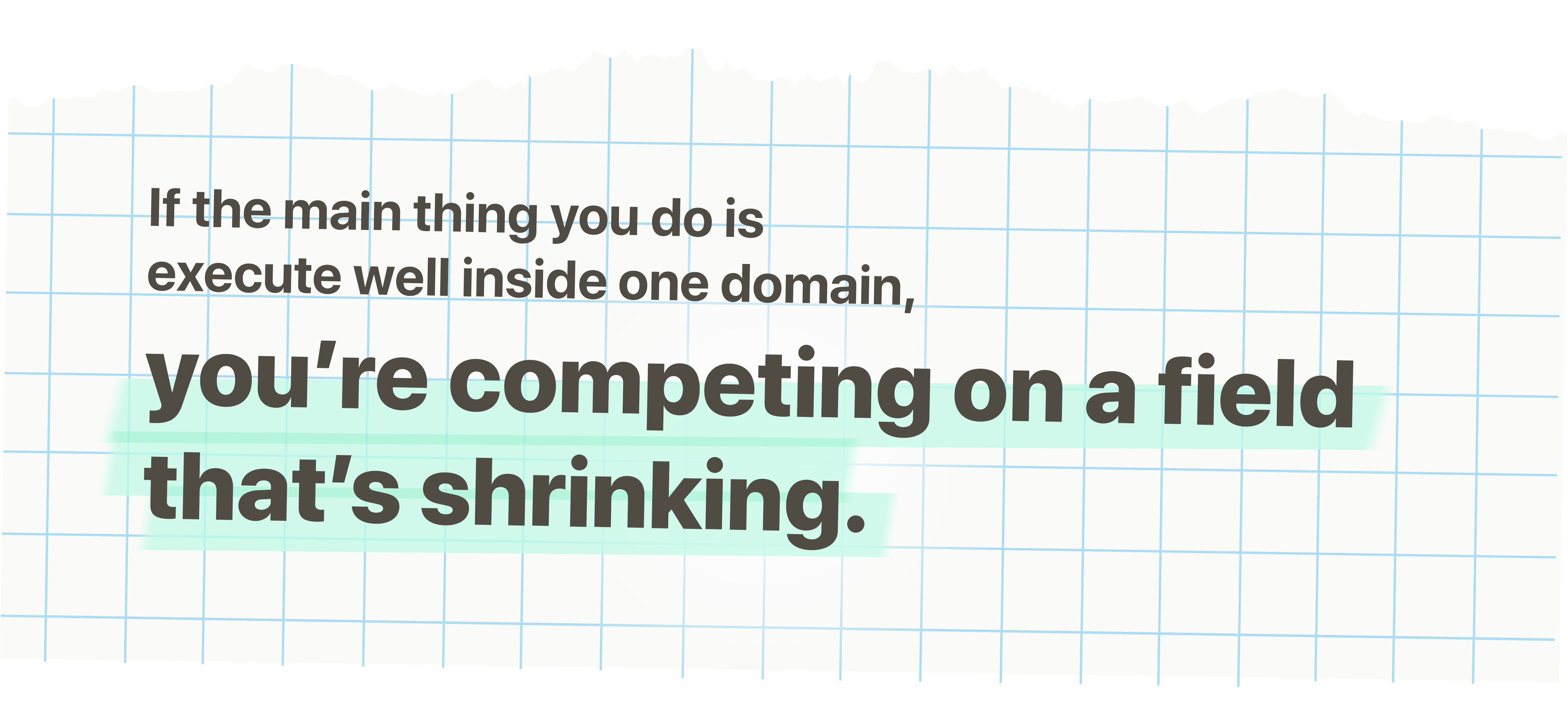
AI is getting excellent at executing tasks. What it still struggles with is asking the right question and making sense of the answer in context.
The analyst who built better Excel models than anyone on the team lost that edge the day everyone got Copilot. The same thing is happening across every domain, faster than most people realize.
This is already happening at the organizational level. Jason Calacanis — one of the besties on the All-In podcast — published a post last month announcing that his firm won’t hire another human employee for at least a year or two. His AI agents handle 20% of the firm’s tasks and improve 10% every week. His conclusion: adding a human to the team has become a “luxury spend.”
He also noted that at his firm, the roles of product manager, UX designer, and developer are merging. One person with the right AI tools now does the work of all three. The specialist who mastered one of those roles has a problem. The person who understands all three has an opportunity.
What AI still cannot do is move between domains. It can’t understand the incentives of a finance team well enough to know which supply chain tradeoffs they’ll accept. It can’t translate what an engineering team is building into what a sales team can actually promise. It can’t sit in a room where operations, product, and customers are all pulling in different directions and find a path forward.
That’s cross-domain fluency. And the research backs it up.
David Epstein spent years studying the world’s top performers across sports, science, and business. His finding, published in Range is that in complex, unpredictable fields (which is every field now), generalists consistently outperform specialists. A study of nearly 400 MBA graduates found that those with broader cross-functional backgrounds received more job offers than their specialist peers and in some cases earned up to $48,000 more.
McKinsey’s research on the emerging agentic organization goes further. The most valuable human workers in an AI-first company, they found, are what they call “M-shaped supervisors” or people with broad fluency across multiple domains who can orchestrate AI agents and human teams simultaneously. The World Economic Forum estimates that nearly 40% of current skillsets will be overhauled or outdated by 2030.
The specialist isn’t disappearing, but the specialist who can only operate inside one domain is quickly losing value.
The two traps
Most people pick one of two losing strategies.
The first is specializing and staying there. Depth feels safe and allows many to get promoted early in their careers, but this is where many stop developing range. AI is now compressing the value of their single-domain skill, the same way it compressed the value of knowing more Excel than anyone else in the room. By the time the ceiling appears, it’s too late to start building fluency elsewhere.
The second is knowing a little about everything and being indispensable to no one. This is the person who can speak every team’s language well enough to seem valuable but isn’t the person anyone calls when something actually has to get done. This person is classic style over substance and may build some credibility early on but is revealed as lacking depth over time.
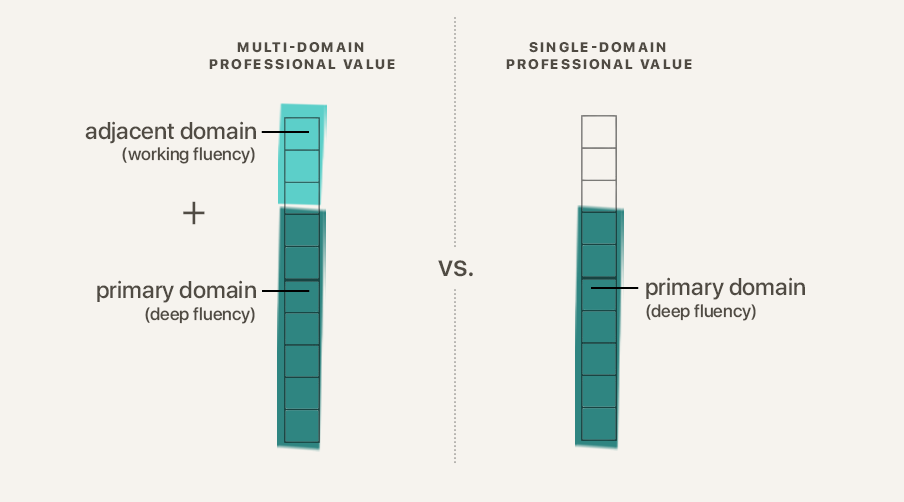
To be successful in an AI-first world, you need a better strategy. You should develop one primary domain with real depth, plus one adjacent domain with working fluency. Enough to understand how decisions get made on the other side of the table, and enough to be taken seriously when you’re sitting at it.
Which adjacency to pick
Your best adjacency is usually the domain that controls whether your work gets funded, approved, or acted on.
Engineering: product or finance — the people who decide what gets built and whether it’s worth building.
Data science: communication and storytelling, because insights that don’t move decisions don’t move organizations.
Marketing: sales or operations, because promises need to be deliverable.
Supply chain or Operations: finance, because every operational decision eventually becomes a business case, and the people who can build that case themselves are the ones who get resources.
HR: technology, because the future of that function is building systems, not administering processes.
Design: sales or market research, because design decisions backed by data analysis become strategic defensible investments.
You don’t need to become an expert. You need to know enough to ask smart questions, understand the answers, and translate between your world and theirs.
What about AI skills?
Regardless of your domain + adjacency pairing, everyone should be building AI fluency in parallel. Here’s a step-by-step guide to start building basic AI fluency in 30 days.
Three things to do this week
Tonight: Name your adjacency. Write down one sentence: “My primary domain is [X]. The adjacent domain I need to develop fluency in is [Y].” If you’re not sure, ask yourself who says yes or no to what you’re trying to do. That’s your adjacency.
This week: Have one real conversation. Find one person in that domain and ask for 30 minutes. The message: “I’m trying to understand how [their function] actually works in practice. Would you be willing to meet for 15 minutes (coffee or call) so that I can ask 3-5 questions?” When you’re there, ask them: “What’s a decision you make regularly that people outside your function almost never understand correctly?” Don’t sell yourself. Just use the time to learn and follow up with a thank you email or text.
This month: Get in a cross-functional room. There is a project happening in your organization right now that spans your domain and your target adjacency. Volunteer for it. You don’t need to be the expert; you just need to be in the room. Fluency doesn’t develop by reading about it. It develops by having to use it under real conditions, when something is actually at stake.
The compounding effect
Over the last four weeks, we’ve discussed how AI fluency amplifies your performance, strong relationships build career optionality, and cross-domain fluency multiplies both.
In the years ahead, every company will have specialists and AI tools. The advantage will belong to the people who become the Rosetta Stone between them.

Inspired to keep reading?
The One-Pedal Trap

I taught my oldest son to ride his bike in a small park in Seattle. He pushed off hard, focused on one pedal, and kept tipping over—exhausted and frustrated.
5 Lessons I’m Giving My Sons About Work and the Future

Last month I spent a few weeks in London for my first visit to the Zero100 office. My family joined me over Thanksgiving and during that week I saw my sons in a new light. I was there for work and they were tourists, but I realized that one day they will be in my shoes.