


Week 3 of a four-part series on building career resilience.
Week 1: You vs the Robot
Week 3: Stop Waiting to Be Discovered
The Job Application Process is Broken
AI didn’t just change how we write resumes, it changed the economics of hiring. For $20 a month, anyone can generate a clean, well-written, ATS-optimized resume and a tailored cover letter for every job they apply to. The marginal cost of sending one more application is effectively zero, so people don’t send five applications anymore. They send fifty or hundreds.
That may feel empowering for candidates, but it’s a supply shock from the hiring side. When everyone can bypass the qualification process and look qualified on paper, resumes stop being a signal and start being noise. Hiring teams respond the only way they can: they stop relying on the application process and start relying on their people to recommend candidates.
Last week, I argued that AI fluency is the skill that gets you in the room. Wall Street Journal shared this week that grads with AI skills are in high demand. That said, it is increasingly true that a human is what will actually get you in front of a hiring team.
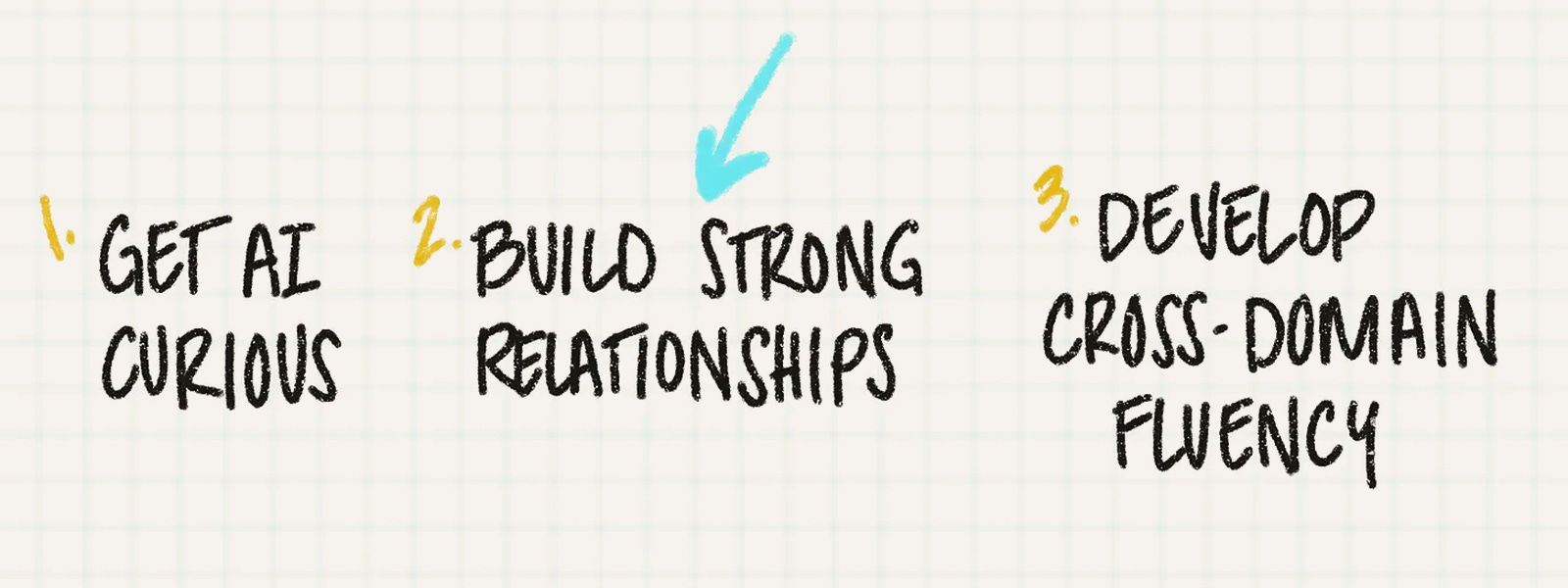
This week, we’ll unpack how to build strong relationships that open doors for you throughout your career.
The Math Nobody Wants to Hear
If you graduate with 200 people who share your major, you don’t have 200 peers. You have 199 near-substitutes. Add in the impact of globalization and the power of AI tools, it’s become clear that most college degrees have become commodities to the point that many are debating whether a college degree is still worth it at all.
Generative AI has created a market where:
The cost of applying to a job is near zero
Everyone’s resume and cover letter looks essentially the same
The volume of applicants per role has exploded
Imagine a hiring manager posts a role on Monday morning. By Tuesday, they have 1,000 applications. Nine hundred of the resumes are clean, well-written, and “tailored.” Two hundred are genuinely good. Fifty are great. Five come with a trusted internal referral or a note from someone they respect. Guess which people are going to get the first interviews.
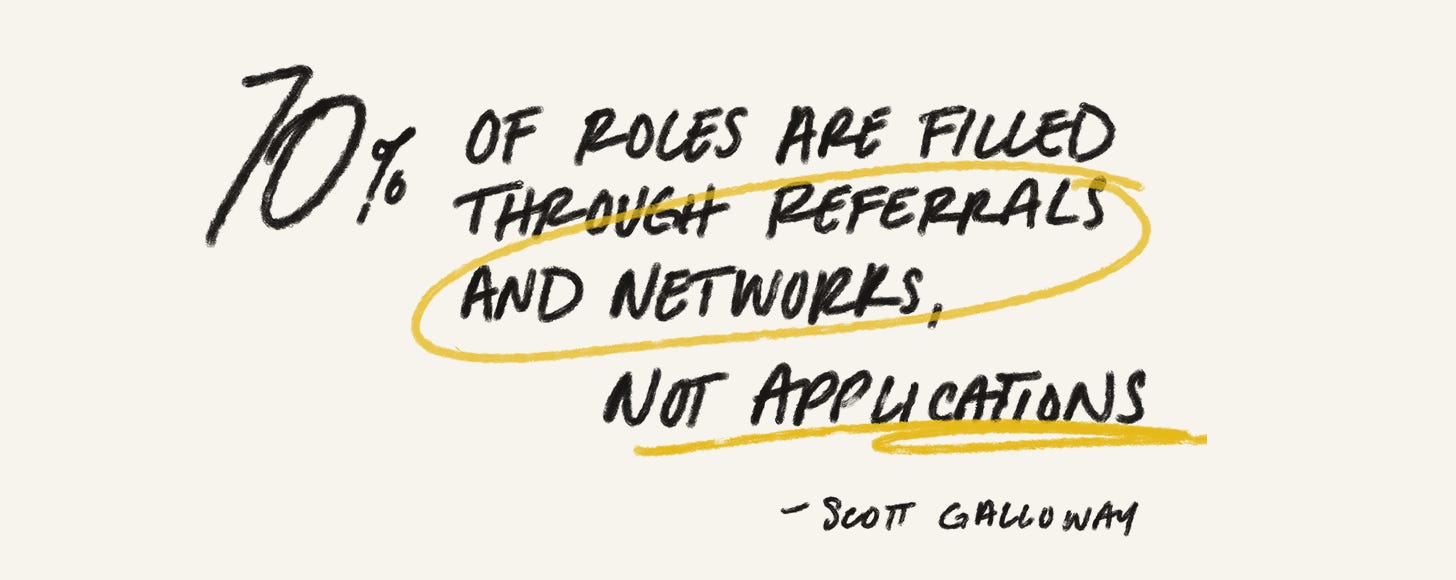
As Scott Galloway illustrates above, most hiring decisions are effectively made before the job posting ever goes live. 70% already have an in with the hiring team and the job posting is often just the compliance layer on top of a decision that’s already forming.
If no one is willing to vouch for you, you’re competing for the leftover 30% of roles in the most crowded, AI-saturated, and commoditized part of the market. That’s not a winning strategy.
The Career Bicycle That Might Save You
I want to introduce you to my Career Bicycle Framework™. Think of your career like a bicycle that runs on two pedals: Performance, the work that earns you a paycheck, and Optionality, the relationships that earn you a future.
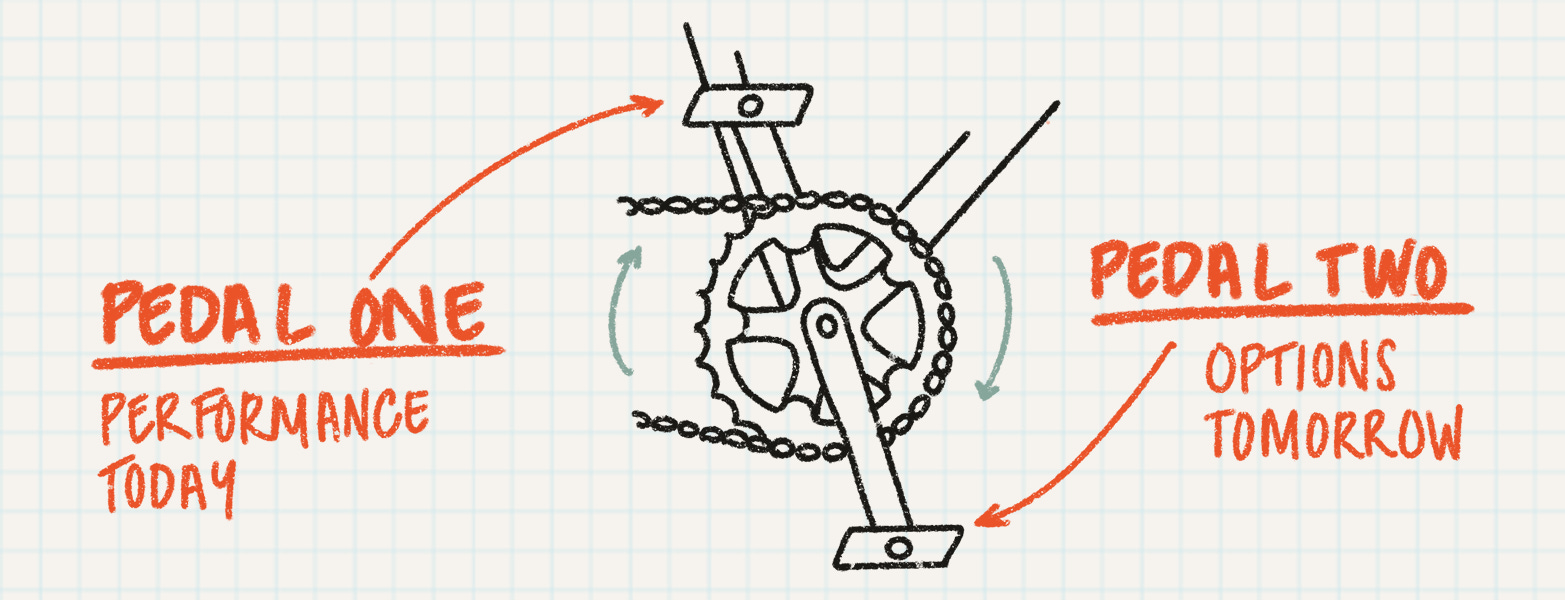
Most early-career professionals obsess over Pedal One. That makes sense because performance is concrete, shows up in reviews, and gets you promoted.
Pedal Two is what gives your career resilience. It’s what creates opportunities when your team gets cut, your company reorganizes, or your manager changes. It’s what turns a cold job search into a warm introduction. It’s also what leads to once-in-a-lifetime opportunities that you may not be fully qualified for yet.
Performance, by itself, is becoming more commoditized over time as people leverage LLMs throughout their workday. Trust, reputation, and human endorsement are becoming more valuable.
Pedal One = Keeps You Employed
Pedal Two = Keeps you Employable
The Two Traps Early-Career Professionals Fall Into
In the first decade of your career, I see the same two mistakes over and over.
Trap #1: Waiting
Let’s call her Mary.
Mary is great at her job. She’s competent, reliable, and consistently delivers strong work. She tells herself things like, “If I just keep performing, I’ll get noticed,” or “I’m not really into networking, I just want to do great work.”
Mary believes the system will eventually reward her and while sometimes it might, often it does not.
When a reorg hits, or a manager leaves, or her team gets cut, Mary discovers something uncomfortable: almost all of her career equity is locked inside her current org chart. Outside her team, very few people know her work and even less would go to bat for her.
She wasn’t wrong to focus on performance (Pedal One), but she was wrong to think it was enough to accelerate a great career.
Trap #2: Spraying
Now meet John.
John is charismatic and ambitious. He believes volume is the game. When he sees a role posted on LinkedIn, he immediately messages the hiring manager or recruiter with a short note and his resume. Sometimes he references the wrong role and it’s clear most of his messages are written by AI, but he thinks this is all part of network building.
In reality, John’s burning social capital before he ever builds any and annoying a lot of people in the process. People don’t remember strangers and they definitely don’t vouch for them.
Both Mary and John may occasionally get lucky, but neither is building a system that compounds over time.
How to Actually Build Strong Relationships
Start Early (and Make It Boring)
Most people only start “networking” when they’re laid off or desperate for a job. That’s exactly when it feels transactional, awkward, and self-serving. People can feel that energy from a mile away.
The best relationships are built when you don’t need anything. You need to treat Pedal Two activities as a normal, continuous part of your career.
Start close:
Book regular 1:1s with coworkers (even if it’s 1x per quarter)
Build relationships across functions
Default to yes for coffee, lunch, and happy hour invites
Then widen the circle:
Engage thoughtfully online with people in your field
Have one real conversation a month with someone outside your company
This positions you to build strong internal and external relationships, which are critical to building your career over the long term.
2. Put Yourself Where Opportunity Can Happen
When I was at Starbucks, I started in manufacturing but wanted to move into corporate roles. That meant finishing a 10-hour shift south of Seattle and then driving north to the corporate office just to have coffee with people doing the jobs I wanted one day.

This was inconvenient and exhausting, but it eventually worked. Those conversations led to a corporate role and multiple mentors, some of whom still shape my career today.
I also moved my entire family from Seattle, WA to Austin, TX for a career opportunity that provided outsized impact and scope, relative to my previous experience. Not every action needs to be as dramatic, but you do have to put yourself in places that provide opportunity.
You can start online, but the strongest ties are built over coffee, meals, projects, and shared context. Put yourself in rooms, cities, and conversations where the kind of work you want is actually happening.
Do Cool Stuff (in Public)
Visibility and action create a surface area for luck and opportunities. Build cool things, share what you’re learning, get curious with AI, and create products or tools that show how you build, not just what you’ve been assigned at work.
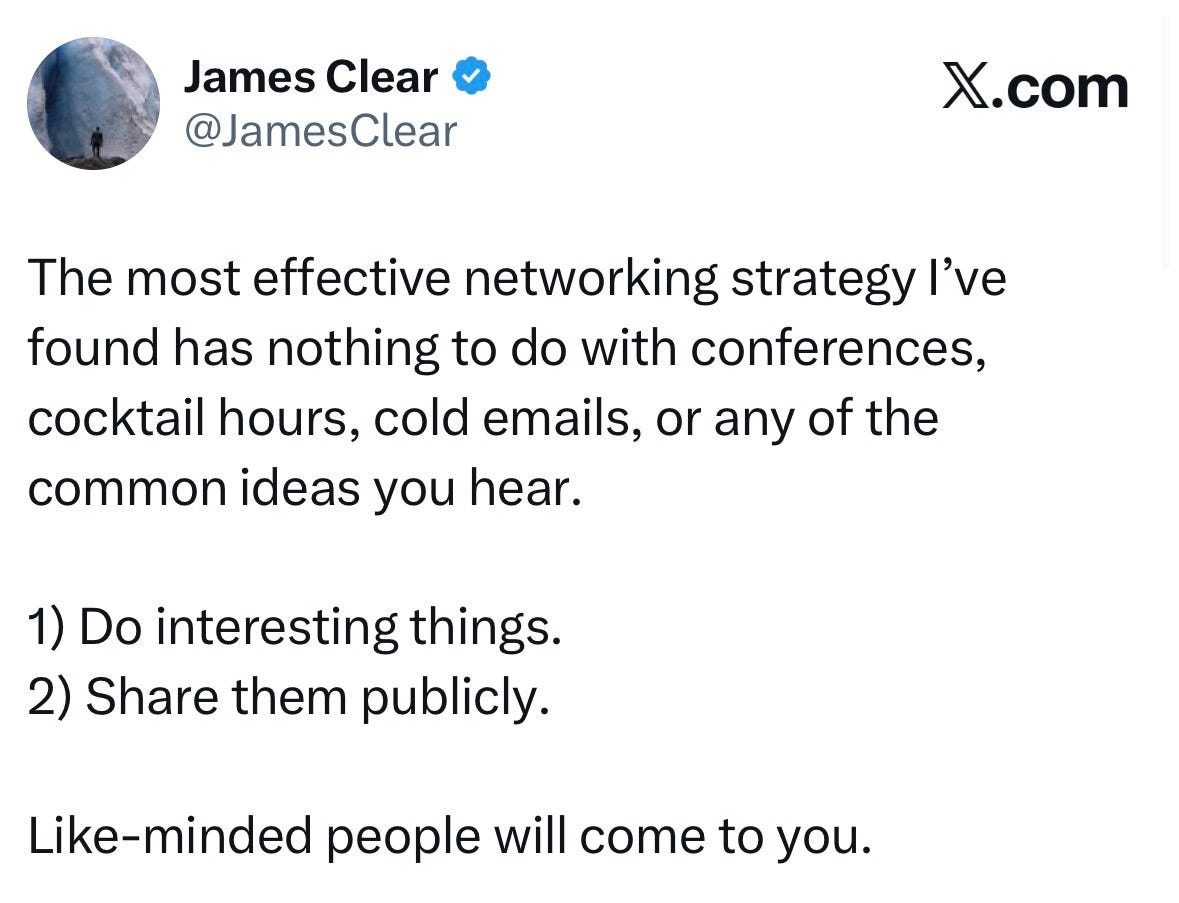
You don’t need to be impressive. It’s far more important to 1) get started on something and 2) build momentum as you iterate and make it a habit. You can start with any of the below:
A simple newsletter
A GitHub project
A YouTube channel
A short LinkedIn post explaining something you just learned
People are drawn to momentum. They remember people who are working on cool stuff, and, over time, this creates something far more powerful than a resume: a reputation and network that you can rely on for decades.
“Arguably, one of the best investments a young person can make is to build an owned media channel every day for 20 years. In the summer of 2007, I started following 100 people a day on Twitter to get 40 follows back. The investment in content, videos, podcasts, and personnel…has had a huge ROI.”
Professor Scott Galloway, The Algebra of Resistance
Time to Take Action
AI didn’t make relationships “nice to have,” it made them the moat for your career.
This week, do three things:
Book one conversation with someone you don’t need (yet).
Share one small piece of work in public.
Help one person with no immediate upside for you.
Next week, I’ll close this series by unpacking the final pillar of career resilience: how to develop cross-domain fluency. This will cover the ability to move between domains, translate between worlds, and stay valuable even as roles, tools, and org charts keep changing. Subscribe below to get the article in your inbox next Thursday!

I write Career Field Guide to give young people the roadmap I never had. No paywall, no gatekeeping — just practical guidance from someone who’s been in the seat.
☕ If it’s been useful, buy me a coffee to keep it going!
Inspired to keep reading?
The One-Pedal Trap

I taught my oldest son to ride his bike in a small park in Seattle. He pushed off hard, focused on one pedal, and kept tipping over—exhausted and frustrated.