


Welcome back to Career Field Guide: the weekly newsletter for people who want to build a career that holds up in the age of AI. If someone forwarded this to you, subscribe here.
This is Part 1 of 8 in the Essential Skills Series: the 10 skills that separate people who advance from people who plateau. Find the whole series here.
Your first few weeks at a new job feel productive. There’s onboarding, training modules, and a buddy. Then one morning your manager sends you a Slack message: “Can you take a look at this and come back with a recommendation?”
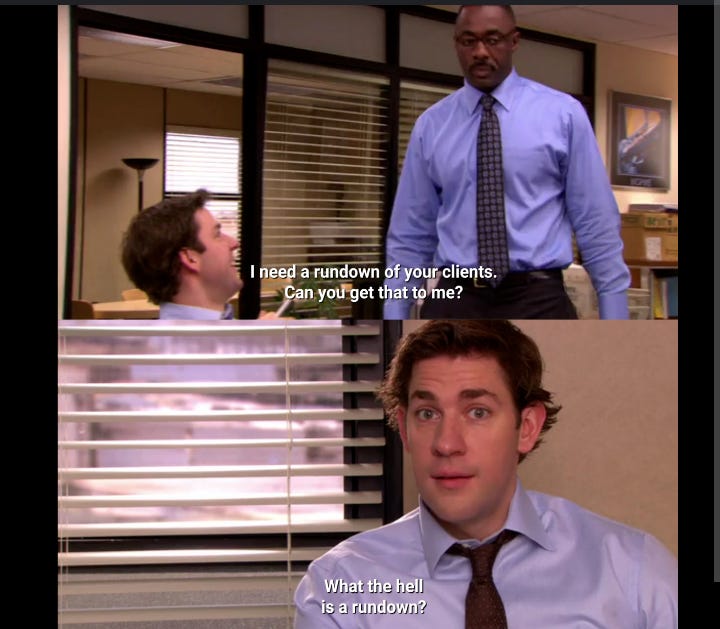
In this interaction, and the hundreds of others like it, you’re either going to show that you know what to do when there’s no rubric or that you’re still too green to be trusted with real responsibility.
I was in New York this week leading a keynote on agentic AI with a room full of supply chain executives. Even with such a technical topic, we spent a significant amount of time discussing the challenge of getting teams to take ambiguous problems and run with them instead of freezing. This isn’t an entry-level problem. It’s a career-long skill, and the earlier you build it, the faster everything else compounds.

The moment it breaks down
“Our customer churn has been creeping up the last two quarters. Can you dig into what’s going on?” -Your Boss
You nod and sit down, but your chest tightens. How deep should you go? Who should you talk to? Is this a priority or a test? Two days later you’re back at your manager’s desk asking for more direction. They give you something half-formed because they’re mentally already in their next meeting. You leave with less clarity and an annoyed boss.
Your manager isn’t frustrated because you have questions, but because every question puts the work back on them. They wanted you to take the ambiguity off their plate, not return it with a Post-it note attached.
Here’s what nobody told you:
The vague assignments from your boss aren’t just tasks, they’re auditions.
Promotions aren’t rewards for past performance. They’re bets on the future and the people in promotion meetings are asking one question: “Do we trust this person to handle what comes next?” Vague assignments are where they start to gather the evidence.
Why this feels so hard
You spent 16 years in school learning that good work means following instructions. Every assignment had a rubric, tests had a prompt, and every project had a due date with a well-defined format.
Then you enter the working world, someone hands you something open-ended, and the instinct that’s worked your whole life stops working. In school, you succeed by asking for more information, dropping in on teacher office hours, and scrutinizing the rubric. But at work, that’s creative stalling and your manager can see it even if they don’t point it out.
The difference between school and work is that your manager doesn’t need you to get it right on the first try. They need momentum and ownership. An 80% answer timely delivered is worth more than a 100% answer they had to pull out of you. Your job is to take crap off your boss’s plate, not add to it.
If you’re a manager reading this, I’m sure you’ve watched this pattern on your own team. You’ll commonly see it in the talented new hire who keeps asking what exactly you want until you start wondering if they can operate without a script. It’s helpful to recognize that it’s rarely a motivation problem. Instead, they’re probably an over-achiever who thinks the goal is perfection. They’re still playing the school game becasue nobody told them the rules changed. Tell them in your next 1:1.
What actually works
Follow this decision flowchart as soon as you feel stuck:
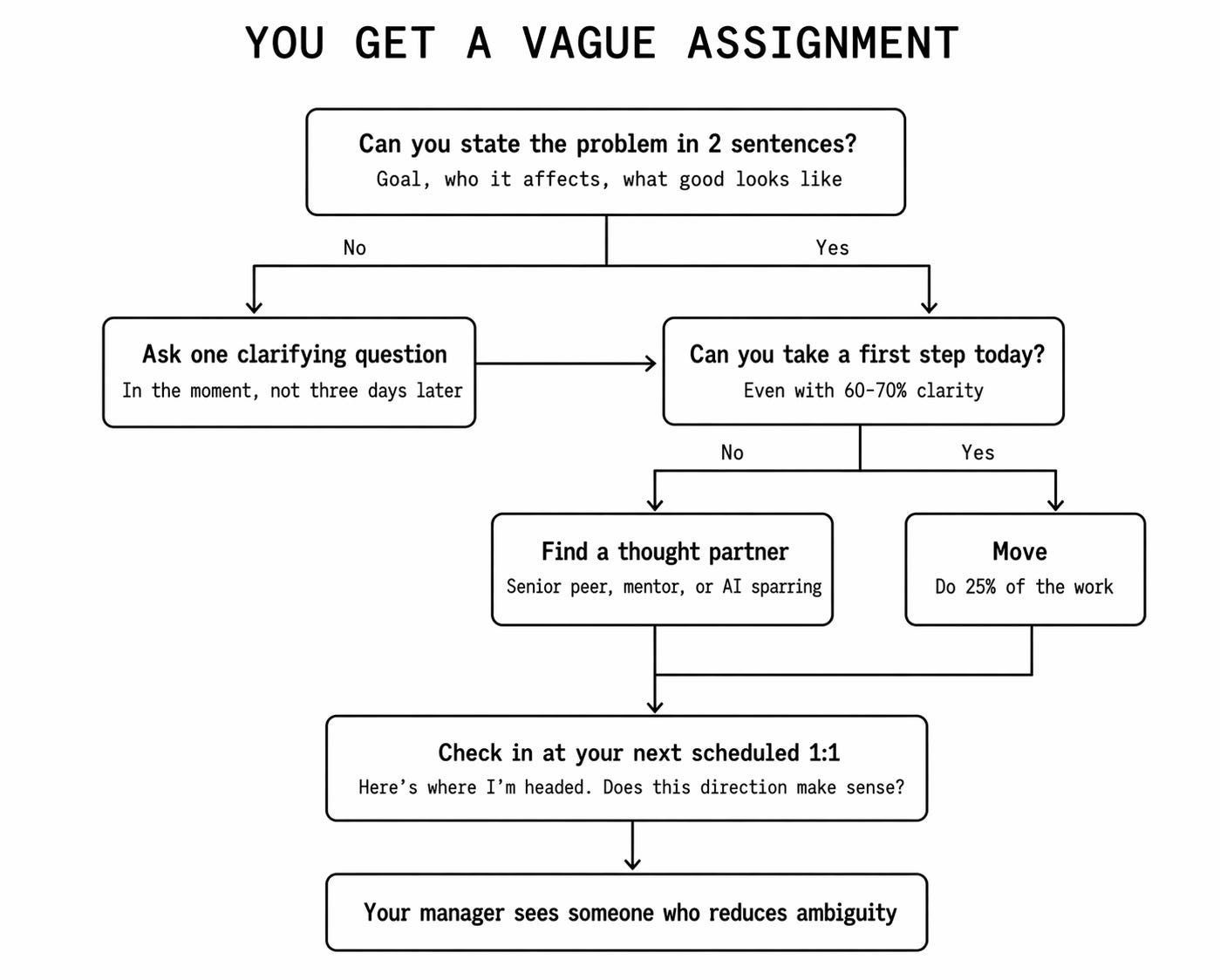
I’ve been on both sides of this. I’ve been the person sitting at my desk not knowing where to start, and I’ve been the manager waiting for someone to come back with a direction instead of another question.
If you don’t understand something, ask immediately. Not later or in a follow-up email. Ask in the conversation. The moment your manager finishes explaining and there’s a piece you don’t fully get, say so. “I want to make sure I understand. When you say, ‘take a look at onboarding,’ are you thinking about the first week or the first 90 days?” The longer you wait to clarify, the more work you do in the wrong direction. Asking in the moment signals confidence and treating your boss like a peer, while waiting three days to ask the same question signals that you’ve been spinning. It gives rookie vibes.
Ask who’s done this before. One of the most underused questions in any workplace. “Has anyone tackled something like this recently? Is there someone I should talk to?” Junior folks perceive this as admitting weakness, but leaders do this instinctively: finding existing knowledge before building from scratch. Most organizations have someone who tried something similar six months ago. Their work, even if it was imperfect, gives you a starting point that saves you days.
Find someone to partner with. The assignment landed on your desk, but that doesn’t mean you have to figure out every piece alone. “Is there someone on the team who would be a good thought partner on this?” This gets you help and it shows your manager you’re thinking about how to get the best result, not just how to survive the assignment. Bonus points if you succeed while working collaboratively and sharing the kudos with a peer.
Vibe check your boss. Before you decide how to approach the work, figure out how your manager likes to work. Some managers want to brainstorm with you, think out loud together, and shape the direction as a team. Other managers want you to go away, come back with something, and only then engage. If you bring brainstorming energy to a manager who wants a finished draft, you’ll look unprepared. If you bring a finished product to a manager who wanted to shape it together, they’ll feel cut out. You can figure this out by watching how they work with other people, by asking directly, or by paying attention to how they respond when you check in. Their body language and energy will tell you everything.
Write your own problem statement. Before your next check-in, write two or three sentences describing the problem as you understand it. What you think the goal is, who it affects, and what a good outcome looks like. You’ll be wrong about some of the framing, and that’s fine. A wrong problem statement that your boss or a senior peer can correct is ten times more useful than no problem statement at all.
Do 25% of the work, then check in. Don’t wait until the project is 80% done to find out you went the wrong direction. Get a rough draft, a first pass, or an initial outline together and bring it to your next regularly scheduled one-on-one. “Here’s where I’m headed. Does this direction make sense, or should I adjust?” You’ve done enough work to show initiative, but not so much that changing course feels like a loss. Important: The key words are “regularly scheduled.” Use your next one-on-one that already exists on the calendar to check in. Don’t create new meetings for status updates on one assignment. Your manager’s time is a scarce resource and how you treat it tells them everything about how you think.
Frame the check-in as partnering, not feeding. There’s a difference between “I’m stuck, can you help?” and “Here’s what I have so far. I’d love your input on the direction before I go deeper.” The first one creates drag while the second creates momentum. Even when you feel completely lost, lead with what you’ve done, not what you haven’t.
If you’re really stuck, talk to a senior coworker. Not your manager, but someone you trust who’s a level or two ahead of you. They’ve been where you are and know which parts of the ambiguity are real problems. Sometimes you don’t need direction from your boss. You need perspective from someone who remembers what it felt like to be in your shoes. Even better if you can build a relationship with a peer of your boss. They can advocate for you directly, and that kind of lateral visibility is how careers accelerate.
Use AI as a sparring partner. Drop in what you know about the problem, your assumptions, and your initial thinking. Use it to stress-test your direction, identify gaps, or generate a rough framework you can react to. Use AI for thinking, not for copy-pasting. If you hand your manager an AI-generated document that you haven’t actually processed and made your own, it will be obvious, and it will undermine exactly the trust you’re trying to build.
What will kill your credibility
I’ve managed enough people to know what this looks like from the other side. These are the things that will erode your manager’s confidence in you, even if they never say it directly.
Don’t outsource the work and call it collaboration. Partnering with a colleague means you’re both contributing. Handing the hard part to someone else because you’re uncomfortable with ambiguity means you just transferred the test your manager gave you. They’ll notice, and the person you handed it to might get the credit for doing the work you couldn’t. Even worse, don’t hand in work without acknowledging who you worked with and how they supported you. Lone rangers are cool in movies, not in offices.
Don’t paste AI output and present it as your thinking. Again, I can’t repeat this too many times: your manager will recognize AI slop, no matter what the AI detector may say. It reads differently and lacks the specificity of someone who actually wrestled with the problem. Once they suspect you’re pasting AI output, they’ll question everything you hand them going forward. Better approach: frame AI usage as part of your process. “I used ChatGPT to benchmark what others have done. You can see how I incorporated some of that thinking here and then refined it based on what I know about our business.” If you acknowledge it, you look innovative and resourceful. If you don’t, it makes you appear untrustworthy.
Don’t go dark for two weeks and then say you’re stuck. This is the most common version of the problem and the most damaging. Silence isn’t neutral. When your manager doesn’t hear from you, they’re not thinking “they must be heads down working.” They’re thinking “I wonder if this is going to land.” Two weeks of silence followed by “I’m stuck” tells them you sat with the discomfort instead of doing something about it. Quick note: If you’re already in this spot, own it directly: “I want to be straight with you. I haven’t made the progress I should have on this. I should have asked for clarification earlier, and I didn’t. Here’s where I am and here’s what I’m planning to do next.” A good boss will respect the honesty. If your boss punishes you for that kind of directness, it might be time to start looking for your next role.
Don’t ask for feedback on every micro-decision. Check in once or twice, but not daily or on every detail. If you’re coming back to your manager every day with a new clarifying question, you’re not reducing ambiguity. You’re creating a new kind of it. They start spending their time managing you instead of managing their own work.
Why this matters at every level
If you’re in college or just starting out, this is the gap between you and the intern who gets the return offer. It’s not grades or technical skills, it’s the ability to take a vague project and say, “here’s how I think we should break this up” or notice that no one taking notes in an important meeting and say, “I’ll take notes and send out next steps for everyone.” They’re driving clarity, which screams leadership material. Again, it’s doing the actions that prove they’re ready for the next role.
If you’re a few years into your career, this is the invisible wall between you and your next promotion. The people who get promoted fastest aren’t the ones with the best answers. They’re the ones who reduce ambiguity for the people around them. Every time you walk into your manager’s office with a defined problem, a proposed direction, and a list of assumptions, you’re doing what most of your peers won’t do for years. This is a key element of executive presence.
If you’re ten years in, you’ve noticed that the ambiguity doesn’t go away—it got bigger. The questions stopped being “what does my manager want?” and started being “what should this team be doing that nobody has asked for yet?” At senior levels, it means having the humility to be a beginner in emerging technologies that no one has brought to the team yet, like AI, and asking questions of junior peers or colleagues who have valuable insight.
Your move this week
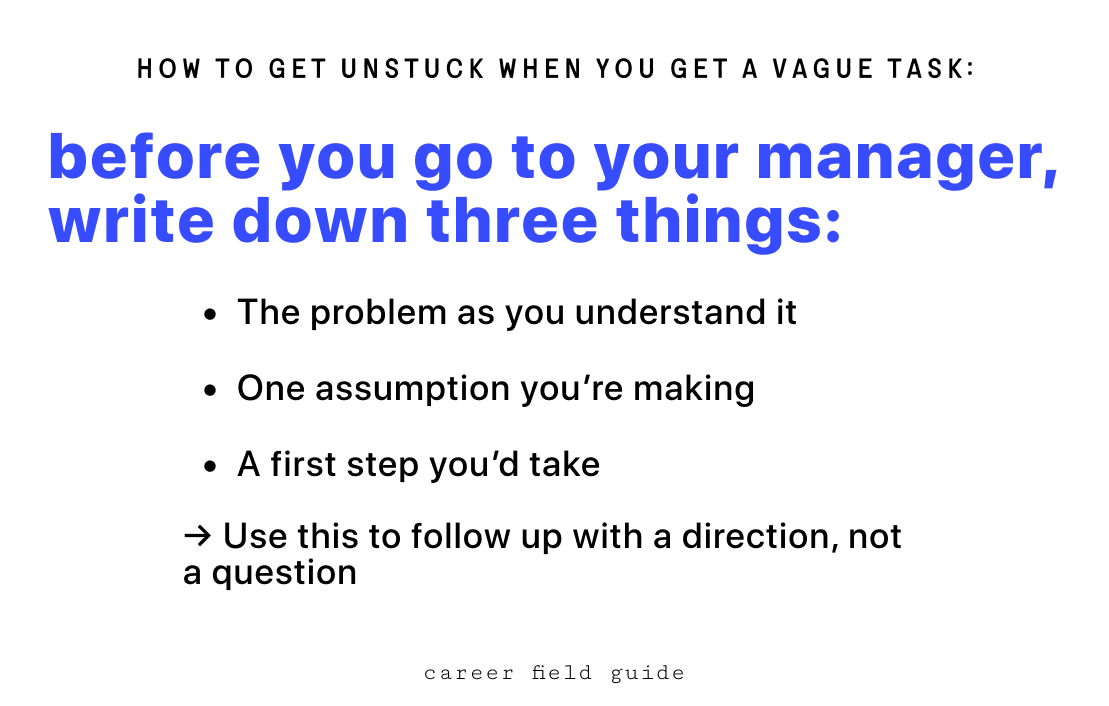
Next time you get a vague assignment, before you ask your first question, write down three things: the problem as you understand it, one assumption you’re making, and a first step you’d take. Bring that to your manager instead of a question. It takes five minutes and it will change how they see you.

If this series is hitting home, forward it to someone in their first few years of work. It’s free, and it might be the thing nobody’s told them yet.
P.S. — I work with a small number of readers one-on-one to help them apply these frameworks to their own career. If you are at a moment where you need more than a newsletter, book one off or ongoing sessions here.
If you enjoyed this, here’s what to read next:
AI Is Taking Your Tasks, Not Your Job

Welcome back to Career Field Guide: the weekly newsletter for people who want to build a career that holds up in the age of AI. If someone forwarded this to you, subscribe here.
The Best Performer Doesn't Get Promoted

The first time I had a seat at the table deciding who gets promoted, I was surprised. I expected the conversation to be about goals and OKRs, but excellent work is table stakes. The real debate was about something else.