


The first time I had a seat at the table deciding who gets promoted, I was surprised. I expected the conversation to be about goals and OKRs, but excellent work is table stakes. The real debate was about something else.
What became clear over the years is that promotions recognize two things:
Excellent work
Who we trust to handle what comes next
People are spending far too much time focusing on #1 as the way to get promoted when it really comes down to #2.
When someone is promoted, leaders are placing a bet that the person they're recommending will not make them look stupid amongst their peers and their boss. That means the person has to have already proven they can operate at the next level, not just perform well at the current one.
This is why so many high performers hit a ceiling they can’t explain. They’re doing everything right and watching someone else get the opportunity.
The people who get promoted aren’t always the best performers. In fact, they’re likely top-half in performance but they’ve built relationships with the people making decisions, made their work visible to the right audiences, and positioned themselves as the obvious choice for the next opportunity. They demonstrated capability for the next level before they were given it.
The question isn’t “am I doing good work?” The question is: “what level am I operating on, and how do I demonstrate the next one?”
I built the Leadership Ladder to help you answer that question.
The (Invisible) Leadership Ladder
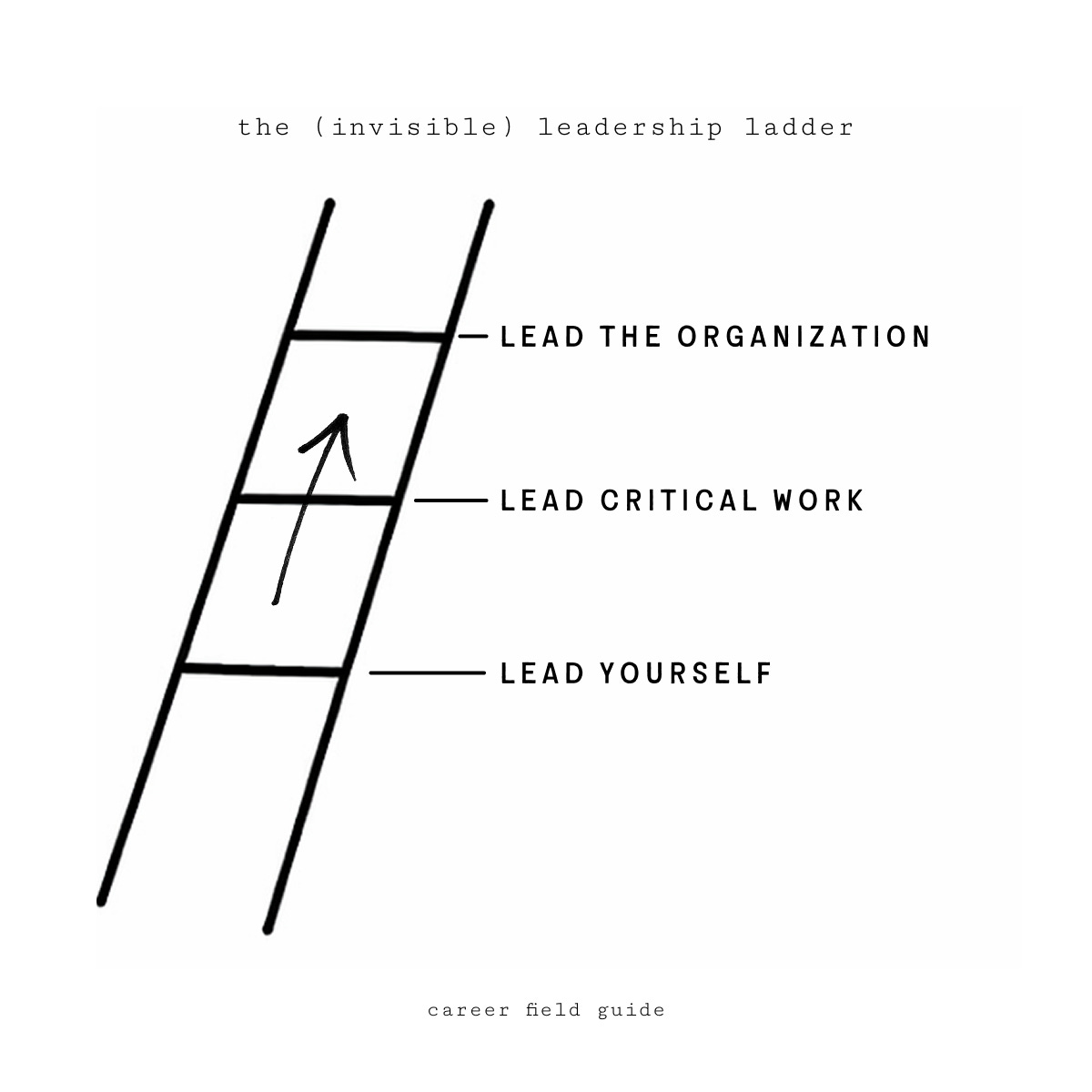
Level 1: Lead Yourself
Do your job well.
Leading yourself means you deliver reliably. You manage your time, your energy, and your commitments without someone standing over your shoulder. People trust you to do what you said you’d do, when you said you would do it, with excellence.
In the AI era, it also means you use AI tools to amplify your own output. Jensen Huang said it on Lex Fridman’s podcast: if he had to choose between two new graduates — one with no AI knowledge and one who’s an expert — he’d hire the AI expert every time.
Technical Fluency at Level 1 means you’re aware of and using AI tools naturally. You know when to trust them and when to question them. You’re not afraid of the technology, and you’re not naive about it either.
Business Judgment means you understand your role, you understand what success looks like for your team, and you make good decisions within your defined scope.
Relational Depth at this level means people want to work with you. You're reliable, you're pleasant, and you raise the energy in the room.
At Level 1, grit matters more than genius. Most people think they’ve mastered this level, but many haven’t. If you can’t use AI to meaningfully improve your output, if people have to follow up with you to make sure things got done, or if your manager is still telling you what to do instead of trusting you to figure it out, you’re still working here.
Level 2: Lead Critical Work
Do work that impacts critical parts of your company.
Leading critical work means you own outcomes that matter beyond your own role. You're not only executing your tasks well but also taking ownership of problems that cross boundaries. You're trusted with your boss's work and leading efforts that are cross-functional.
Technical Fluency at Level 2 is about driving productivity beyond yourself. You're the trusted human in the loop who is accelerating AI across a team or function. When an agentic system makes a bad call, the person who catches it needs to understand both the technology and the business context. That combination barely exists in the workforce right now, and it's highly coveted.
Business Judgment means making good decisions with incomplete information. You’re not waiting for someone to tell you what to prioritize. You’ve built an ability to read a situation, understand the stakes, and act. This can’t be automated because it requires context, accountability, and the willingness to be wrong.
Relational Depth shows up as earned trust, internally and externally. You influence people who don't report to you and raise the credibility of your team beyond its walls. You've built enough trust with the people making decisions that when a room is deciding who gets the next opportunity, your name comes up.
This is what separates the person who gets promoted from the person who gets a great performance review and nothing else.
Level 3: Lead The Organization
Shape the system that everyone else operates inside.
Leading the organization means your decisions set the conditions for hundreds or thousands of other people’s work. You’re accountable not just for outcomes, but for the structure that produces them. There are two sides to Level 3, and both have to be working.
The Internal Side: Building the Machine
Most people think leadership at this level is about strategy decks and executive presentations. It’s really about building the systems (teams, incentives, processes, and culture) that produce results when you’re not in the room.
I learned this at Amazon. The best senior leaders I worked under didn’t make better decisions than everyone else. They built organizations where good decisions happened without them. They hired people who were smarter than them in specific domains, created mechanisms that surfaced the right information at the right time, and spent their energy on the two or three bets that would change the trajectory of the business. Senior leaders are phenomenal people coordinators.
Technical Fluency at Level 3 means you’re shaping how the organization uses technology, not just using it yourself. You’re making investment decisions about AI capabilities. You’re deciding which workflows get automated, which get augmented, and which stay human, and you’re accountable for those calls. The executives I talk to every week are making exactly these decisions right now, and most of them are flying partially blind because they don’t have enough leaders who understand both the technology and the operations.
Business Judgment at this level is about allocating resources across competing priorities with long time horizons. You’re making trade-offs that won’t pay off for two years, and you’re building the case internally for why the organization should follow you there. This requires a combination of analytical rigor and storytelling that very few people develop.
Relational Depth internally means you can move an organization. Not through authority, as anyone with a title can do, but through trust accumulated over time. The people three levels below you know what you stand for. Your direct reports run through walls because they believe you’ve got their back. When you reorganize a team or kill a project, people may not love the decision, but they trust the process.
The External Side: Representing the Enterprise
I once watched one of our executives resolve an urgent operations issue that our team had been navigating for days with a single text to a supplier’s CEO. That's what Level 3 relational depth looks like from the outside. Years of being credible, generous, and consistent in your industry, converted into a two-sentence text that solved in minutes what process couldn't solve in a week.
Level 3 also means you’re a face of the organization to the outside world. Customers, partners, regulators, investors, media, and talent you’re trying to recruit. You are trusted and expected to represent the company’s point of view in rooms where the stakes are real.
Technical Fluency externally means you can translate what your company is doing into language that customers, partners, and the market understand. You’re the person a journalist calls for a quote, or a conference organizer invites to keynote, because you have a point of view informed by real operational data, not just opinions.
Business Judgment externally means you understand how your company fits in the broader ecosystem (competitors, regulators, market shifts) and you position accordingly. You’re shaping how your company shows up in the broader business landscape.
Relational Depth externally means your network creates value for the organization. A phone call from you opens a door that a cold email from anyone else wouldn’t. Customers trust your word and partners want to work with you specifically. Talent joins because of your reputation. Your network is the compounding return on years of showing up the right way in your industry.
The best leaders at this level are building something that outlasts their tenure. They’re developing the Level 2 people below them, creating conditions for the next generation of leaders, and making the kind of long-horizon bets that define what an organization becomes.
Why Performance Alone Won’t Get You There
If you’ve been reading Career Field Guide, you know that a great career requires two things working together: Performance and Optionality. (If you’re new here, the One-Pedal Trap is worth reading.)
Performance is doing your current job excellently. Optionality is building the skills, relationships, visibility, and positioning that create future opportunity. Most career advice focuses only on performance, which is like riding a bicycle with one pedal.
The Leadership Ladder explains why you need both. Performance keeps you at your current level. It earns you good reviews and trust, but it doesn’t earn your promotion because promotion isn’t a reward for the past. It’s a bet on the future and the people making that bet are looking for signals of the next level.
Those signals come from Optionality. The cross-functional project you volunteered to lead. The relationship with the VP who now knows your name. The time you made a judgment call on something ambiguous and it worked. The presentation you gave to a room above your pay grade. None of those things are your job, but all of them are evidence that you can operate at the next level.
Where Are You on the Ladder?
Here’s why this matters now: AI is compressing entry-level work across every industry simultaneously. Anthropic’s labor market data shows that the rate of young workers entering AI-exposed occupations has already dropped 14% since 2022. The executives I talk to every week aren’t waiting to see how this plays out. They’re restructuring teams, hiring differently, and asking “who can operate at the next level?” The gap between what AI can theoretically do and what it’s actually doing is massive right now. When that gap closes, the people who already climbed the Ladder will have a compounding advantage that’s very hard to catch. The window to move is open, but it won’t stay open forever.
Here are three questions to get an honest self-assessment:
1. Can you use AI to produce work that’s measurably better than what you’d produce without it? Not “I’ve tried ChatGPT a few times.” Can you sit down tomorrow, use AI tools as part of your actual workflow, and produce something faster, sharper, or more complete than you could alone? If the answer is no, you haven’t finished Level 1.
2. Have you owned a project or problem that crossed beyond your defined role where you had to coordinate with people who don’t report to you, make a call without being told what to do, and take accountability for the outcome? If the answer is no, you’re performing well at Level 1 but haven’t demonstrated Level 2. That’s the gap your manager sees, even if they can’t name it.
3. If your name came up in a room where you weren’t present, would someone advocate for your promotion? Not your direct manager doing their job. Someone else — ZAa VP, a peer leader, a cross-functional partner — who would say “that person is ready.” If you don’t know the answer, or if the answer is no, your Optionality pedal isn’t turning.
Pick the question where you answered no and spend 30 minutes this week doing something about it. Open an AI tool and build something with it. Volunteer for the project no one wants. Send a message to a cross-functional partner to understand more about their role. Even better, bring these concepts to your boss in your next 1:1 and ask them which level they see you operating at and how to improve.
The career ladder used to be something you climbed by showing up and doing good work for long enough. That ladder is being replaced and the one that’s taking its place rewards people who can operate at higher levels faster, who pair technical fluency with real business judgment, and who build the kind of relationships that make other people want to bet on them.
That’s the Leadership Ladder. And right now, the barrier to climbing it has never been lower — if you’re willing to put in the work.
Start building.

Inspired to keep reading? Bookmark this for your next interview!
Interviews are Won Before You Walk In

In my years as a hiring manager, I saw the same thing happen over and over again.