


Anthropic CEO Dario Amodei published an essay renewing his warning about the economic impacts of AI:
New technologies often bring labor market shocks, and in the past humans have always recovered from them, but I am concerned that this is because these previous shocks affected only a small fraction of the full possible range of human abilities, leaving room for humans to expand to new tasks. AI will have effects that are much broader and occur much faster, and therefore I worry it will be much more challenging to make things work out well.
None of us know the true impact of AI, but it’s critical to recognize that we are in another significant economic shift that may dwarf what occurred throughout the Industrial Revolution.
Amidst the noise, I want to help you think about the skills you should be focused on to be prepared in this age of AI.
Bad Career Advice
Career advice has been remarkably consistent over the last decade: Learn to code, gain technical skills, and engage primarily in STEM disciplines. The advice was not wrong, but it is being exposed in the age of AI. According to OpenAI CEO Sam Altman, “AI can [now] perform the work of entry-level employees.”1 Meanwhile, Anthropic revealed that Claude writes 90% of its own company code.2
If AI can write code, analyze date, and generate reports then what exactly should you be learning to do in 2026?
What Harvard Discovered in 1980
Economist David Deming at Harvard has been tracking something fascinating: how the labor market values different combinations of skills over time. His research3 reveals a pattern that most career advice completely ignores.
Since 1980:
Jobs requiring high math skills AND high social skills grew by 7.2 percentage points (with wages up 26%)
Jobs requiring ONLY high math skills (but low social skills) actually shrank by 3.3 percentage points
Jobs requiring only social skills stayed flat
The jobs that required strong technical skills without strong people skills have been declining for four decades.
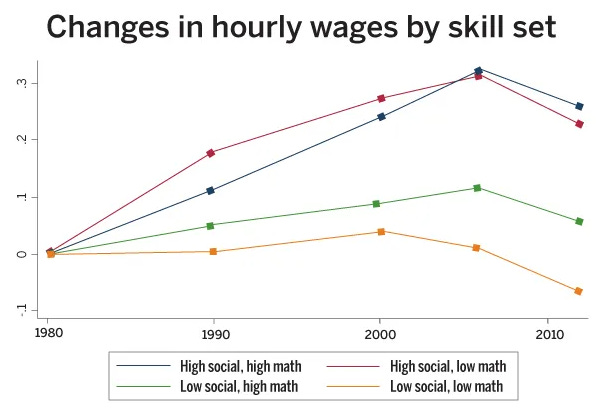
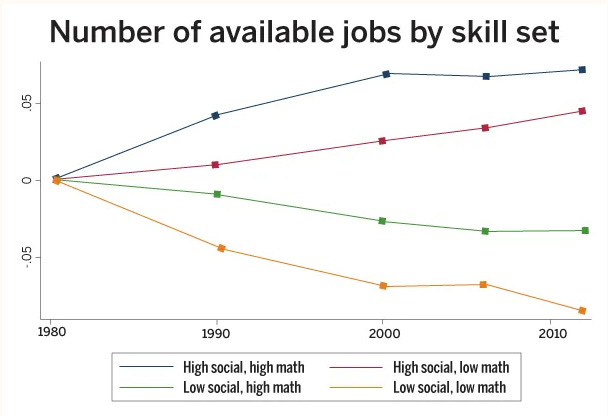
It’s clear that winners in the economy have not been the most technical, but the ones who combined technical capability with human connection.
How AI Makes This Worse and Better
Erik Brynjolfsson at Stanford frames this beautifully. He argues that almost every valuable task breaks down into three phases:
Asking the right question (defining the problem)
Execution (carrying out the steps)
Evaluation (verifying results and refining)
"As execution becomes commoditized, the bottleneck—and the value—shifts to asking the right questions and evaluating results."
Brynjolfsson argues that AI is getting “astonishingly good” at Step 2 (Execution) so the critical skills to develop are asking the right questions and evaluating the results. Workers, he argues, are becoming “Chief Question Officers.”4
Your primary job is not doing the work, but having the judgement to know what to ask, why it matters, and whether the AI actually succeeded.
The Three Skills That Matter Now
Three capabilities consistently emerge as the skills that protect and accelerate careers in the AI economy.
1. AI Fluency (Not AI Expertise)
Jensen Huang, CEO of Nvidia, put it plainly at Davos5: “Learning to work with AI will soon be as fundamental as learning to manage people. Prompting, supervising, and evaluating AI systems will become core skills across industries.”
LinkedIn’s data confirms this. “AI Literacy” is the #1 skill on the rise, defined not as machine learning engineering, but as effectively using tools like ChatGPT and GitHub Copilot. The premium goes to people who can leverage AI as a force multiplier, not people who can explain how transformers work.
2. Domain Judgment
Domain judgment is the pattern recognition that tells you what “good” looks like and it’s one of the hardest for AI to replicate. It’s knowing which customer complaint signals a systemic problem versus a one-off issue or recognizing when a financial model’s assumptions don’t match reality. Broadly, it’s the instinct that something is off before you can articulate why.
The Economist recently highlighted the paradox facing entry-level workers: if AI handles the grunt work that used to teach judgment, how do you develop it? Their answer: the smartest companies are redesigning junior roles around higher-order tasks, such as client interaction, negotiation, and exposure to decision-making.6
The implication for your career: seek roles where you’re evaluated on outcomes, not tasks. Find mentors who can transfer tacit knowledge and build judgment through exposure, not just execution.
3. Human Connection
Scott Galloway shared a stat that should change how you think about job searching: “Google puts out a job opening, they get 200 CVs within eight minutes. They limit it down to the 20 most qualified. Seventy percent of the time, the person they pick is someone who has an internal advocate.”7
In a world where AI can help anyone look qualified on paper, relationships become the differentiator. The highest-value people in organizations are those that can bridge technical and business domains.
This is one of the reasons that you should always go to the happy hour, find opportunities to connect with your coworkers, and start building your network on LinkedIn.
The Career Bicycle Connection
If you’ve been following Career Field Guide, you know I think about careers as a bicycle where one pedal is focused on Performance (excelling at your current role) and the other on Optionality (building capabilities that transfer across jobs, companies, and industries).
The three skills I’ve outlined (AI fluency, domain judgment, and human connection) are critical ‘Pedal Two’ investments. They’re portable, compound over time, and protect you when industries shift or companies restructure.
Building these skills isn’t just about surviving the AI transition, it’s about learning to position yourself for the opportunities that emerge on the other side.
My Challenge to You
This week, audit your skill development. Are you focused on learning tools that AI might master next year? Or are you building judgment that takes years to develop and relationships that can’t be automated?
If you’re early-career: Stop optimizing for tasks. Start optimizing for exposure. Seek roles that put you in rooms where decisions are made, even if you’re just observing. The judgment you absorb is worth more than the spreadsheets you build.
If you’re mid-career: Your domain expertise is more valuable than you think, but only if you can translate it. Learn enough about AI tools to spot where they can augment your judgment (start with generative AI) and become the person who bridges the technical and the strategic.
If you’re leading others: The companies that win will be the ones that redesign entry-level roles for judgment-building, not task-completion. As McKinsey’s Bob Sternfels said at CES: organizations are growing client-facing roles by 25% while cutting back-office roles by the same amount8. The question is which side of that equation your team is on.
The skill everyone’s getting wrong isn’t technical versus soft. It’s thinking you only need one. The future belongs to people who can do both and who build relationships with others who can vouch for that rare combination.

Justin
"I Don't Have Anything Valuable to Say on LinkedIn." Not True.

I met with a mentee last week who shared the below:
Every Career Choice Has a Hidden Cost

Every role you accept optimizes for something and costs you something. I didn’t understand this at the time, but I can trace my own blind spot back to the moment I finally earned a role at Amazon.