


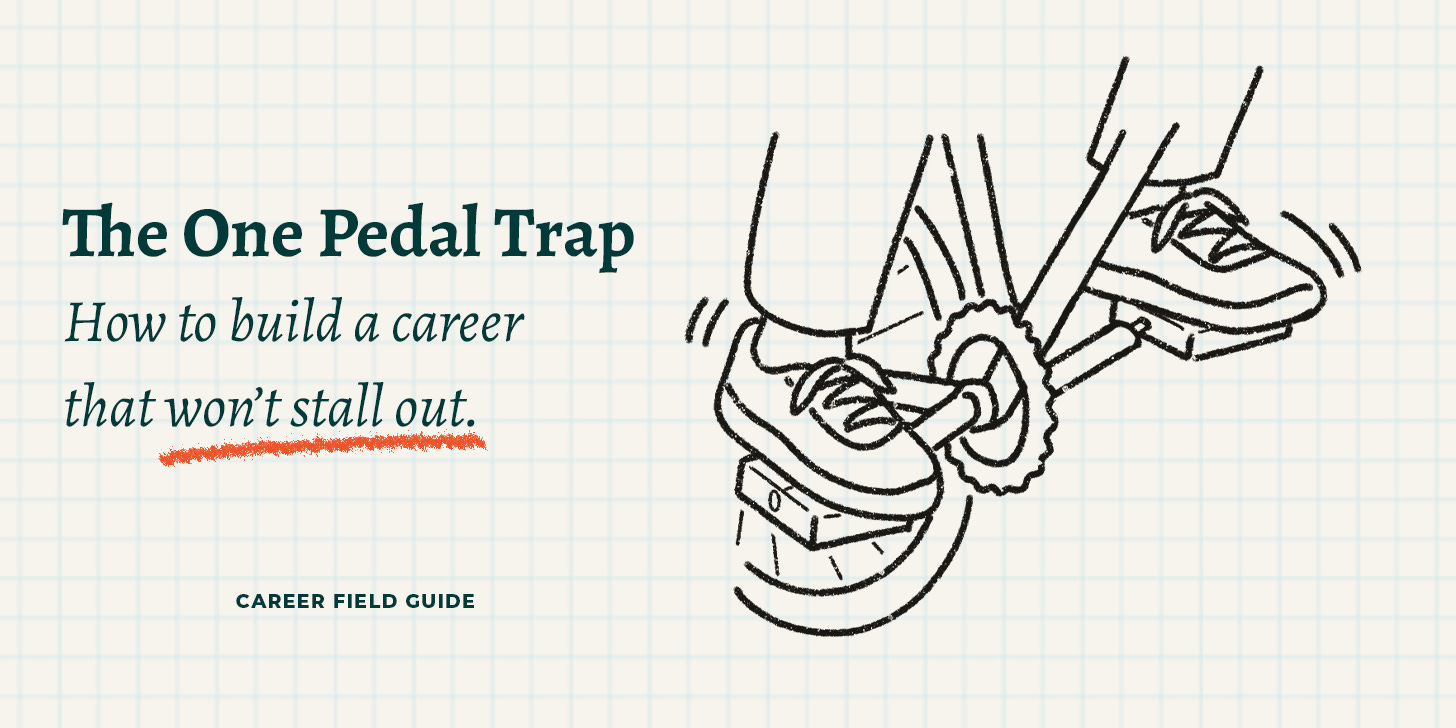
I taught my oldest son to ride his bike in a small park in Seattle. He pushed off hard, focused on one pedal, and kept tipping over—exhausted and frustrated.
From his perspective, he was doing everything right and still not moving.
A lot of careers look exactly like that.
“Every job will be changed.”
Jensen Huang sounded optimistic about AI recently at CSIS, but most Americans are not.1 Whether it’s the more than 1.1 million job cuts in 20252 or the drumbeat of AI-driven displacement, the result is the same: people are scared.

I argued that strong performance at work is no longer protection from layoffs and the response confirmed what many people already feel: fear, confusion, and no clear career strategy in the age of AI.
The most vulnerable workers in the AI transition are not low performers. They’re high performers with no external leverage.
Why High Performers Get Stuck
Over the past few years, tens of thousands of people woke up to an email or text message telling them their job was gone. The surprise wasn’t the scale of the layoffs, but who was laid off.
Those impacted learned two things:
Being great at your job is not the same thing as building a resilient career.
People who rebounded quickly had strong networks outside their company.
The One-Pedal Trap
Most successful careers follow the same pattern: years of becoming exceptional at the job, earning mastery, promotions, and praise inside the company. In reality, high performers are in a more precarious position than they realize:
Their professional network rarely extends beyond current colleagues
They lack relationships with people who could readily hire them elsewhere
Their skills are tied to proprietary systems unique to their employer
When change hits—a reorg, a layoff, or new leadership—the very traits that drove their success become liabilities.
I call this the One-Pedal Trap. You rode so hard on performance that you forgot the other pedal existed.
The Two-Pedal Framework
After watching thousands of people struggle after layoffs, a clear pattern emerged: some people could maintain career momentum, while others could not. The difference wasn’t talent, but how they had been using the two pedals of their career.
A career works like a bicycle. One pedal drives performance today. The other builds strategic growth for tomorrow.
🚴Pedal One: Performance
The work you do every day
This is your current job: execution, reliability, results. It’s how you earn trust and build your reputation. You need to perform well, deliver outcomes, and build credibility with your manager and team. This is what gets you promoted, paid, and praised today.
🚴Pedal Two: Optionality
The work you do on your long-term direction
This is the strategic side of your career: skills, positioning, relationships, visibility, and clarity about what comes next. This is what protects you and creates opportunity tomorrow.
Optionality doesn’t only mean “post on LinkedIn.” It can mean one coffee a month with someone two titles ahead of you at a different company, or deliberately owning a cross-functional project that creates portable signal outside your current org.
Most people focus almost entirely on the first pedal. They work hard, deliver, and stay busy. They assume that strong performance today will automatically create opportunity tomorrow, but it rarely works that way.
The Pedal Ratio
Here’s what most people miss: you don’t need to push both pedals with equal force. You need to be intentional about your Pedal Ratio.
Early in a role, you earn the right to build externally by delivering internally first. No one wants to grab coffee with someone who hasn’t done anything yet. Performance buys credibility, and credibility is the currency that makes Pedal Two work. When you’re new or early in your career, you’re 80/20 (almost all performance), proving you belong.
The danger is never changing that ratio. The person who was 80/20 in year one and is still 80/20 in year eight has built a career entirely dependent on one company’s continued appreciation, which increases career risk.

When you’re established and maturing in your career, you shift to 60/40, then 50/50. The shift to 50/50 isn’t about checking out. It’s about building a career that compounds in two directions at once—one inside your company, one outside of it.
And if you’re sensing instability? That’s when you flip aggressively. When you sense instability—a reorg rumor, a leadership change, an industry shift—you might flip to 30/70, investing heavily in optionality while you still have a paycheck. A 30/70 ratio while you still have a paycheck, a title, and access is infinitely easier than trying to build a network from scratch with a LinkedIn headline that says, “Open to Work.”
The best time to shift your ratio is before it’s forced on you.
How I Learned This the Hard Way
At Starbucks, I only knew Pedal One existed.
I worked my way up from leading a plant team to running complex planning exercises at corporate. I was heads-down, executing, and proving I belonged, but my entire career lived inside the company.
After I joined Microsoft, I sat through a training session on building your network and one of the focuses was getting started on LinkedIn.
That night, I looked at the profiles of a few senior leaders and saw that they weren’t just accomplished internally. They were shaping industry conversations and building relationships with people they’d never worked with directly.
Their careers existed outside the company, not just inside it.
That’s when it clicked: a resilient career requires both pedals moving at once, performance today and optionality for what comes next.
Don’t Crash Your Bike
Both pedals have traps.
⚠️The Performance-Only Cyclist
Profile:
High performer, reliable, exceeding expectations.
Loved by managers.
Network is almost entirely current colleagues.
Few recent interviews and little external signal.
Busy on Teams, quiet on texts.
Result: When layoffs hit, they’re forced to take the first offer and they don’t have options.
⚠️The Optionality-Only Cyclist
The opposite. They’re everywhere.
Profile:
Constant LinkedIn activity
Coffee chats booked weeks out
Heavy focus on personal brand
Mediocre execution
Regularly passed over for promotion
Result: When they try to activate their network, they learn a hard truth: people refer performers, not self-promoters.
Which Pedal Are You Neglecting?
If you’re neglecting Performance:
When did you last ship something your manager bragged about?
Are you known for results, or just for being visible?
If you’re neglecting Optionality:
If you were laid off, how many people outside your company would take your call?
What skills are you building that would transfer to another company?
Most people don’t crash because they stop pedaling, they crash because they ignore imbalance.
The Uncomfortable Truth
Your job doesn’t love you back. Your company will make the decision that’s right for the company. That’s not evil, it’s just how organizations work. The goal is not to care less about your job. It’s to care enough about your future to stop betting it on a single employer.
The answer isn’t to stop performing. The answer is to stop only performing.
You don’t control the environment. You control your exposure to it.
Building a Resilient Career
Wherever you are in your career, this is the question to ask: Which pedal am I neglecting?
If you’re 25 and heads-down proving yourself, great. Keep pedaling on performance, earn trust, and build credibility, but spend at least 20% of your energy developing relationships and skills that exist outside your company’s walls.
If you’re 40 and realizing you have little optionality, it’s not too late. Start now: update your LinkedIn, reconnect with former colleagues, and develop a skill that isn’t tied to your current role.
The best time to build your network was ten years ago, but the second-best time is today.
Rooting for you,
Justin
📌: Share this article with someone who’s grinding hard at work but might be neglecting their second pedal.
Inspired to keep reading:
"I Don't Have Anything Valuable to Say on LinkedIn." Not True.

I met with a mentee last week who shared the below:
Opportunity at Work is Not Random: 3 Ways to Make it Yours

Want to dive in deeper? Get the free article worksheet here