


Welcome back to Career Field Guide: the weekly newsletter for people who want to build a career that holds up in the age of AI. If someone forwarded this to you, subscribe here.
This is Part 5 of 8 in the Essential Skills Series: the 10 skills that separate people who advance from people who plateau. Find the whole series here.
I learned one of the most useful career lessons at Amazon by frustrating my manager.
Before Amazon, I worked in environments where it was normal to run a lot of things through your manager before acting. That was comfortable for me, and I was trying to stay aligned, avoid mistakes, and make sure I was doing the right thing.
Then I got to Amazon, and my manager started getting frustrated that I was not moving fast enough. The issue was that I was asking for approval on decisions in an environment that valued a bias for action, experimentation, and iteration.
That was a turning point because it forced me to learn something school does not teach very well: not every decision deserves the same amount of process.
School Trains You to Wait for Permission
In school, the assignment, deadline, and rubric are given to you with clear instructions. Submitting early or innovating outside of the original ask is usually treated with ambivalence or penalty (”Points will be deducted for papers over 5 pages in length”).
At work, the assignment is often unclear, there are multiple decision-makers evaluating your work, and the constraints are not always visible. The expectation is not always, “Come clarify with me before you do anything.” Often, it is “use good judgment and keep making progress.”
That gap is uncomfortable, especially when you are early in your career or at a new company. Will I look arrogant if I overstep? What if I get it wrong? If I make the call without consulting my manager, will it look like I went rogue? If I do not make the call, will it make me look too junior?
Most people default back to what feels safe. They ask for feedback, ask again, and the work waits. Meanwhile, the manager feels like they have to manage you and your work.
Last week, we looked at how to ask for and receive feedback. Asking first can be the right move, but it is often a sign that you have not yet learned what kind of decision you are making.
One-Way Doors and Two-Way Doors
One of the most useful frameworks I learned at Amazon is the difference between one-way door and two-way door decisions.
A one-way door decision is hard to reverse. Once you walk through, it is expensive, painful, or impossible to go back.
A two-way door decision is reversible. You can try it, learn from it, and walk back through the door if it does not work.
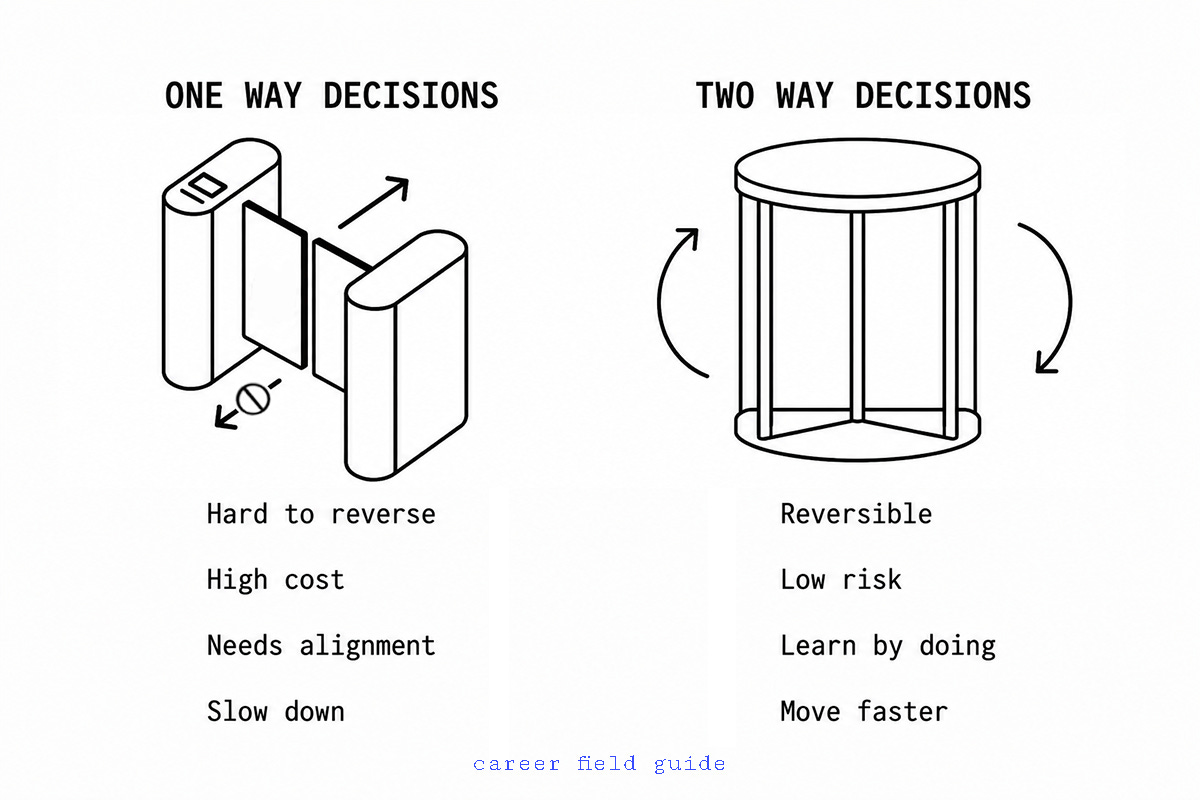
If the decision is hard to reverse (one-way door), then slow down, get context, understand the risks, and build support for your recommendation (including your boss) before taking action.
If the decision is reversible (two-way door), low-risk, and within your role, move forward. Make a reasonable call, communicate clearly, and adjust if it does not produce the outcome you wanted.
The mistake most people make is treating both kinds of decisions the same. Early-career people over-process small decisions and under-prepare big ones. They turn reversible decisions into group projects because they want everyone to agree. Then they launch bigger ideas cold because they assume the quality of the idea should speak for itself.
If you make small decisions too heavy, people stop trusting you to move work forward. If you make big decisions too light, people stop trusting your judgment. Professional judgment is learning the difference.
Move Fast on Reversible Things, Not Risky Ones
To be clear, I am not saying you should stop asking questions or ignore your manager. Nor should you move fast on things that are risky, political, expensive, unethical, customer-facing, legally sensitive, or hard to reverse.
A lot of early-career professionals hear “take initiative” and think it means acting like they own the company. The right move is learning how to carry the right-sized decision. Your manager should not have to approve every tiny step, and they should not find out after the fact that you made a decision with real blast radius.
The goal is calibrated action, which takes insight, wisdom, and a few scars after you step in it.
For When Your Screw Up
Own it immediately, flag it to your boss right away, and recommend how to move forward.
Do not try to fix it quietly or wait until your next 1:1 to surface it. Make problems loud the moment you know about them, including your mess-ups, and own it fully. This is the only way to gain trust and build credibility over time.
If your screw-up reaches your boss from anyone other than you, you lose a lot more credibility than if you own it first, apologize, do what you can to fix it, and move on. Everyone messes up. Leaders own it right away.
The Decision Spectrum
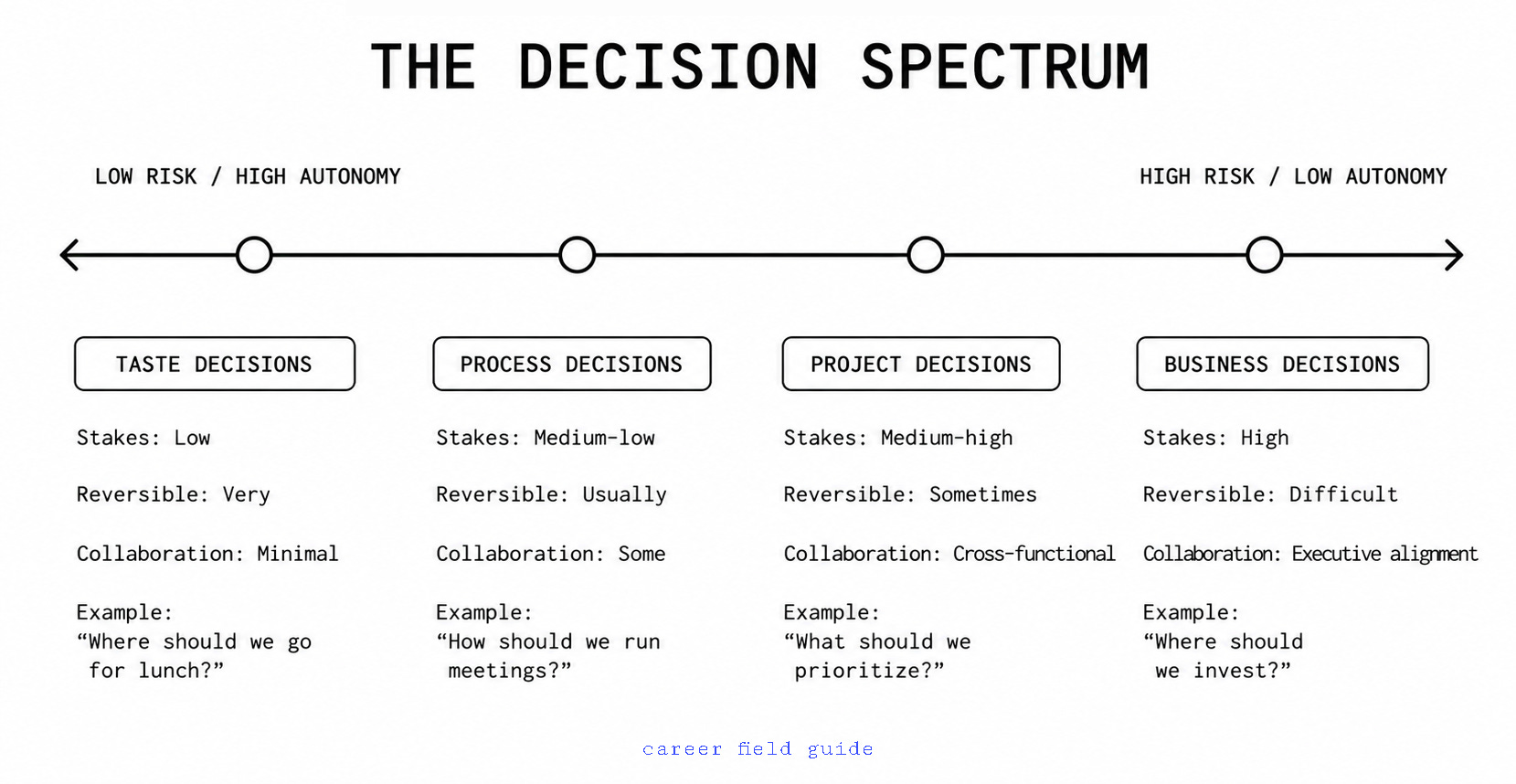
Not every decision has the same weight. The riskier the decision, the more context, trust, and support your idea needs. Here are four points to consider for each decision.
1. Taste Decisions
Taste decisions are small, low-stakes, and easy to reverse.
Where should we go for lunch?
What should the happy hour plan be?
Should the update be a table or a few bullets?
What time should we meet?
These decisions need someone to make a useful recommendation.
A bad version sounds like:
“Where does everyone want to go? I’m good with whatever.”
Now ten people are debating restaurants in Slack for 45 minutes.
A better version sounds like:
“How about tacos at 6? It’s close to the office, has space for the group, and I can make the reservation. Any food allergies?”
That sounds small, but it shows natural leadership and is massive in moving people forward. It is also where people learn whether you make things easier or harder.
2. Process Decisions
Process decisions are about how work gets done.
How should we run the weekly staff meeting?
How should we track action items?
What should the project update include?
How should the team handle handoffs?
What recurring friction could be made easier?
These decisions are usually reversible, but they touch other people’s habits, so tone matters. The goal is to be winsome, not critical.
Do not walk in with:
“This meeting is a waste of time.”
Try:
“I noticed we sometimes run out of time for decisions because the updates take most of the meeting. Would it help if I drafted a simple agenda that starts with decisions needed, then blockers, then updates?”
Same idea, completely different effect. The first makes people defensive, while the second makes you useful. You earn influence by making things better without making people feel stupid for the way it worked before.
3. Project Decisions
Project decisions have real tradeoffs.
What should we prioritize?
What should we delay?
Which path should we take?
What risk should we accept?
Who needs to be involved?
What does “good enough” mean here?
This is where a lot of early-career people get frustrated because they assume the better idea should automatically win. Most project decisions are shaped by timing, capacity, budget, stakeholder trust, technical constraints, leadership priorities, and the people who will have to do the work after the meeting ends.
A good idea that ignores constraints is not a strategy. It is a wish.
For project decisions, do not just bring an opinion. Show that you understand the context. Before advocating for a path, ask:
Who owns the decision?
What constraints matter most?
Who will have to support this?
Who will have to do the work?
What risk is the team trying to avoid?
What would make this easier to say yes to?
That is the difference between having a point of view and helping the group make a decision. A point of view without context is just a preference.
4. Business Decisions
Business decisions are the highest-stakes decisions most people encounter at work. They touch money, customers, strategy, headcount, risk, quality, growth, or future capability.
Where should we invest?
What should we stop doing?
What customer problem matters most?
What capability should we build?
What risk is worth taking?
What tradeoff should the business accept?
The bigger the decision, the less cold your idea should be when it enters the room. Important ideas move through people. People need context, time to react, a chance to improve the idea, and to know whether they are being asked to approve, support, implement, or simply be informed.
If the first time people hear your idea is in the meeting, you are making the meeting do too much work.
Good Ideas Do Not Travel by Themselves
At Microsoft, some of the best support I ever built for ideas did not happen in the formal meeting. It happened in lower-stakes conversations, over coffee, a 1:1, or a happy hour where the topic came up naturally.
The idea still had to be good, but by the time it reached the meeting, it was not landing cold. People had already pressure-tested it, challenged parts of it, and understood why it mattered. I also knew that I had supporters in the room who would back my idea.
That meant the meeting was about alignment, not about debating the value of the idea itself. People early in their career try to win the room from zero. Leaders bring forward something that already has fingerprints from the people who need to support it.
Even the best among us can be territorial or political at work. Asking for feedback, improving your idea with others, and respecting people by running things by them before their boss is in the room is how you show respect and build influence.
Your Move This Week
Pick one decision at work, in an internship, on a class project, in a club, or on a team this week.
Start by asking: what kind of decision is this?
If it is a taste decision, make a useful recommendation. “Let’s do this. I’ll take care of it.”
If it is a process decision, suggest a small test. “I noticed this part is creating friction. Want me to try a simple version next week?”
If it is a project decision, pressure-test before the meeting. “I’m thinking about recommending this path. Before I bring it to the group, what am I missing?”
If it is a business decision, build the support map. Who owns it, what constraints matter, who needs to support it, who will worry, what would make this easier to say yes to.
Then ask yourself one more question:
Am I asking for permission because this decision truly needs approval, or because I am nervous to act and potentially get it wrong?
Sometimes you should slow down, but most days the right move is to make a reasonable call, communicate clearly, and keep iterating. School trains you to wait for permission, but work rewards people who know when permission is no longer the point.
Your job, especially earlier in your career, is to become trusted. Trust comes from learning which doors you can walk through, which ones need support, and which ones deserve a slower hand on the knob.

What else?
Hi! I’m Justin. I share weekly articles to help you improve your career after 15 years of working and managing teams at Amazon, Microsoft, and Starbucks. You can follow along by subscribing below:
I also work with a small number of readers one-on-one to help them apply these frameworks to their own career. If you are at a moment where you need more than a newsletter, book one off or ongoing sessions here.
If you enjoyed this, here’s what to read next:
5 Worst Career Habits Smart Professionals Still Do

Smart professionals love to believe they’re playing the game at a higher level. However, after a decade of leading teams and interviewing hundreds of candidates at Amazon, Microsoft, and beyond, I’ve noticed something uncomfortable:
AI Is Taking Your Tasks, Not Your Job

Welcome back to Career Field Guide: the weekly newsletter for people who want to build a career that holds up in the age of AI. If someone forwarded this to you, subscribe here.