


Welcome back to Career Field Guide: the weekly newsletter for people who want to build a career that holds up in the age of AI. If someone forwarded this to you, subscribe here.
This is Part 4 of 8 in the Essential Skills Series: the 10 skills that separate people who advance from people who plateau. Find the whole series here.

I recently spoke with graduate students at the University of Washington about AI, careers, and what organizations may look like five years from now. One of the questions students always ask me is something like:
“What’s the thing you wish someone had told you in your first job that you had to learn the hard way?”
I gave a fine answer in the moment, but a better answer came to me later in the Uber: Feedback is not a grade.
Are You Worth Investing In?
Feedback is not a grade. At school, feedback tells you how you did; but at work, feedback tells you what to improve next.
That sounds simple until you are sitting in a 1:1 and your manager pulls up a doc you sent them on Monday. They tell you the structure is unclear, the recommendation is buried, and the analysis does not quite hold up under the question they expect leadership to ask.
In the next three seconds, one of three things happens.
You defend. “Right, but the reason I structured it that way is...” You start explaining your thinking before they finish theirs. You’re not being aggressive. You’re trying to demonstrate that you thought about it. They watch you do it.
You deflate. Your face changes. You go quiet. You write things down without responding. The rest of the meeting feels heavy. They notice and start softening the next piece of feedback before it leaves their mouth.
You nod and ignore. “Got it, makes sense, I’ll fix it.” You don’t ask a single clarifying question. You walk out, change two sentences, and send it back. They read it and realize you didn’t actually take in what they said.
All three reactions are understandable, but they’re incomplete and can make feedback more expensive to give next time.
Your manager is not only reacting to the work in that conversation, they are updating a different file in their head: how much honest feedback can I give this person before it costs me more than it’s worth? The answer determines how much of their time, attention, and political capital you get for the rest of the time you work for them.
Feedback Is a Flywheel
Giving honest feedback is uncomfortable. Most managers, peers, and senior colleagues run an unspoken test the first few times they give you anything sharp: Did this land? Was it worth it? Will I do this again?
If the answer is yes, you start getting better feedback, earlier feedback, and more direct feedback. The people around you begin treating you like someone they can be honest with, which is one of the most valuable things a workplace can offer you in your first ten years.
If the answer is no, the feedback gets quieter, more diplomatic, and eventually stops. You may not notice this happening because the absence of feedback can feel like things are going well, even when they are not. The reality is that you’ve just been moved into the category of people who are hard to coach and the people in that category are often the same people who get blindsided by performance reviews or surprised when they do not get promoted.
The fastest way to stop growing at work is to make honesty expensive for the people around you.
The reason feedback feels so charged in the moment is because your brain often hears it as danger before it hears it as information. Your competence, reputation, and belonging all feel tied to your work, so the self-protection instinct is to explain, retreat, or protect yourself before you’ve fully processed what was said.
When that happens, remind yourself: Feedback is not proof that you’re failing. It’s proof that someone still believes your improvement is worth the effort.
That said, it doesn’t mean rolling over either. The mistake almost everyone makes is treating “receive feedback well” and “agree with feedback” as the same thing. The people who handle feedback best are often the ones who eventually push back on it. They just push back at the right time, in the right way, on the right things. That is the difference between being coachable and being endlessly agreeable.
Receive in the Room. Evaluate Out of It. Close the Loop
There are three moves that make feedback useful:
Receive in the room
Evaluate out of it
Close the loop
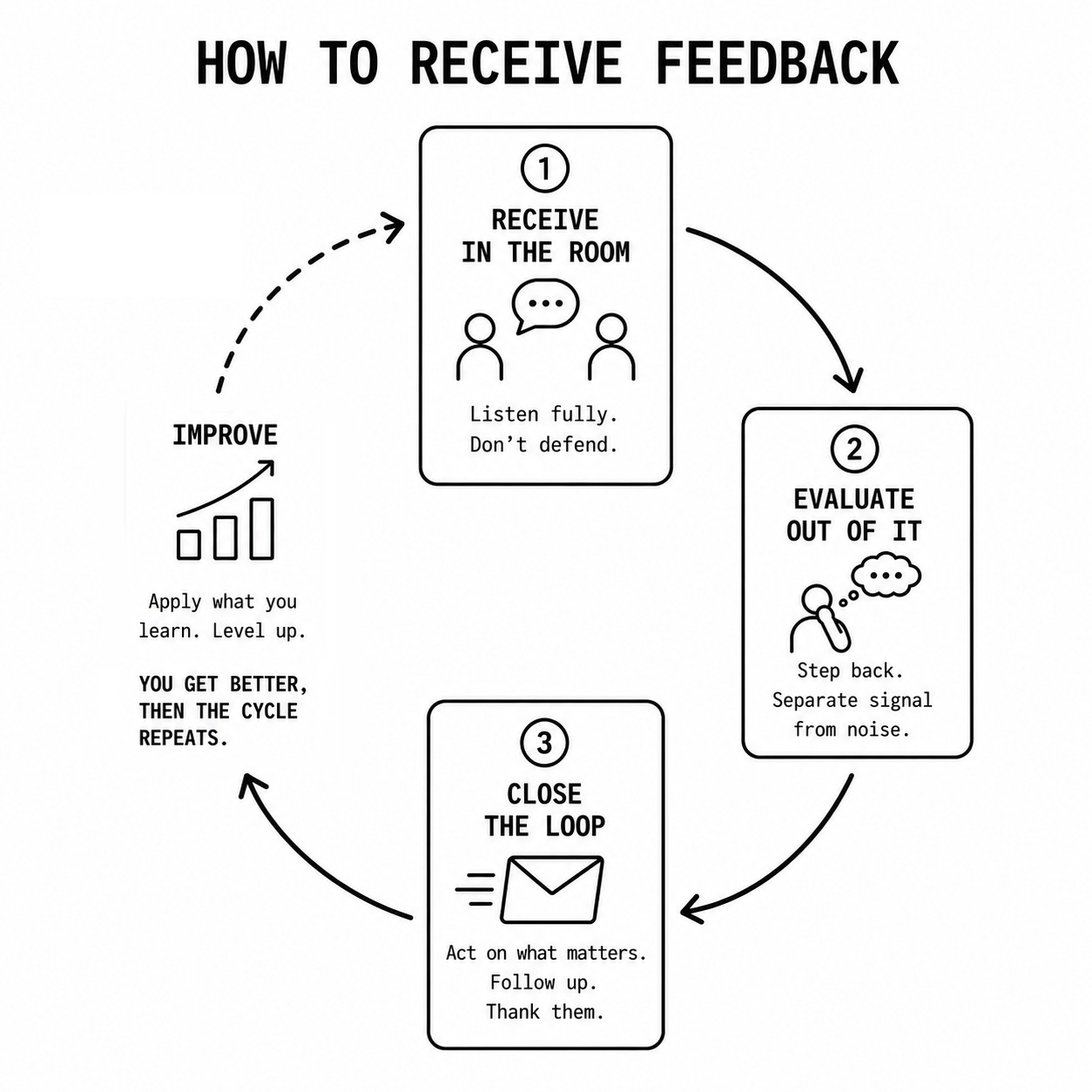
1. Receive in the Room
In the room, your job is not to decide whether the person is right.
Your job is to take the feedback in cleanly enough that you can think about it later when your ego is not sitting at the table. That does not mean you have to agree with everything but at least get clarity on what’s been critiqued.
Concretely, that looks like this:
Listen all the way through before responding. Most people start formulating their response at the first sentence, which means they’re too focused on responding and miss what’s being said.
Ask clarifying questions instead of explaining. “Can you give me an example of where you saw that?” is a hundred times more useful than “Well that’s because...”
Acknowledge specifically. “That makes sense, especially the part about the recommendation being buried” tells the person you actually heard them. “Got it, thanks” tells them almost nothing.
Buy yourself time to evaluate. “I want to think about this and come back to you with how I’m going to adjust” is a complete sentence. You don’t have to commit to action in the room.
Whatever you do, don’t go to “got it, makes sense” too fast. That is often the tell of someone who has already mentally left the conversation. Senior people will clock it immediately.
2. Evaluate Out of It
Out of the room, your job changes. Now you have to figure out whether the feedback is right.
Not all feedback is right. A lot of it is partially right, some of it is wrong, and some of it is wrong in ways that would actively damage your career if you implemented it.
Your job is to figure out which is which, and you can’t do that while you’re still emotionally activated from the conversation.
This is where the open-hand / closed-hand distinction matters.
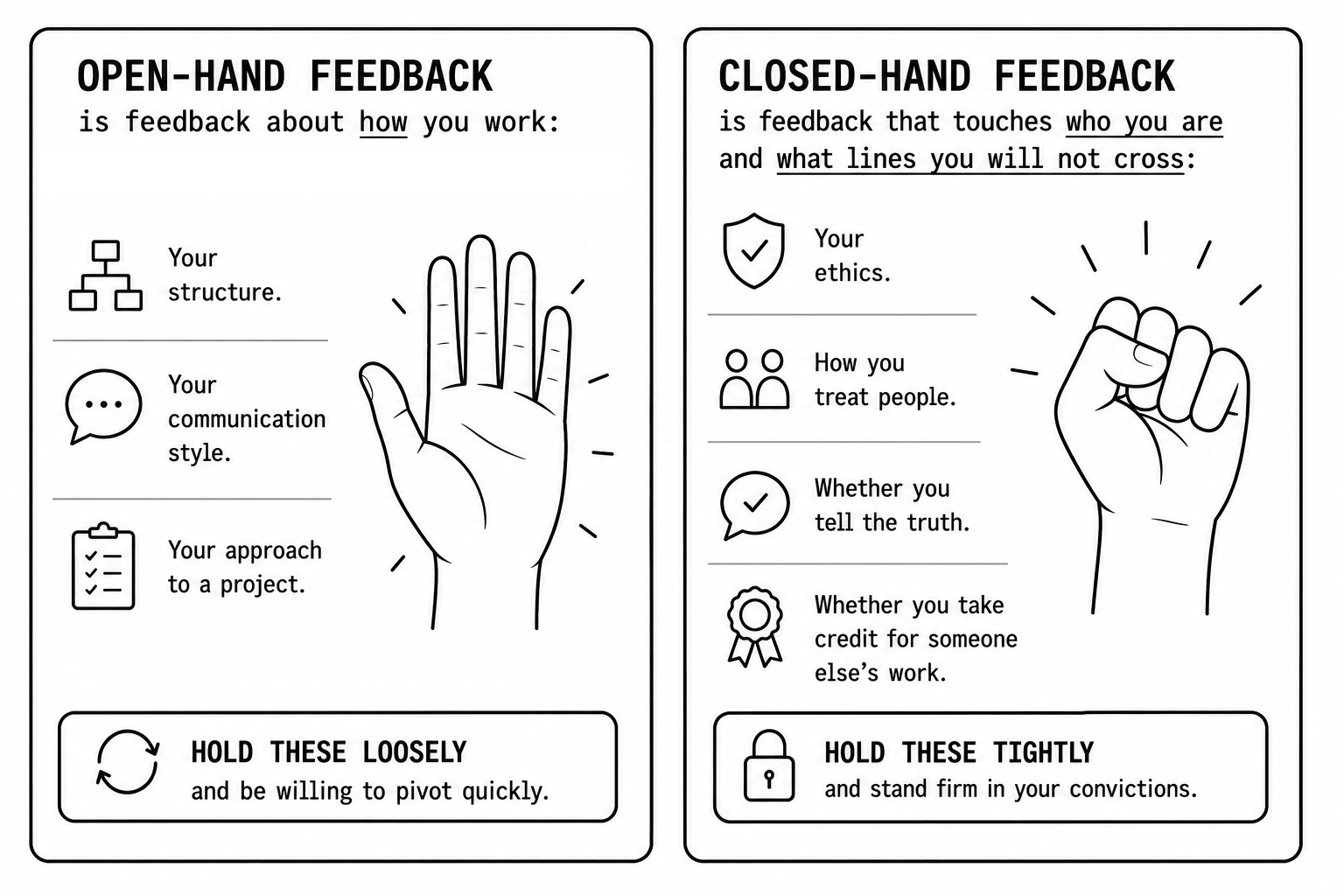
Open-hand feedback is feedback about how you work:
Your structure.
Your communication style.
Your approach to a project.
Hold these loosely and be willing to pivot quickly.
If someone tells you your recommendation is buried, your update is too long, your stakeholder management is unclear, or your project plan is hard to follow, default to curiosity. These are working habits, not sacred truths.
Closed-hand feedback is feedback that touches who you are and what lines you will not cross:
Your ethics.
How you treat people.
Whether you tell the truth.
Whether you take credit for someone else’s work.
Hold these tightly and stand firm in your convictions.
Most early-career people get this backward. They defend habits like values and compromise values like preferences. The first can slow your growth, but the second can change who you become.
As a first-generation college student walking into a Fortune 500 office for the first time, my default was to take everyone’s feedback at face value. I thought everyone must be smarter than me and I assumed the people above me knew more than I did about everything. That was true on some things, but very much not true on others.
That instinct helped me get through the door, but eventually it started working against me. I was well-liked, but I was not always well-respected. I had to quickly pivot after being hired at Amazon. The culture there has strong personalities and strong opinions. The people who succeed are the ones who can hear “you’re wrong” without flinching, defend their point of view when needed, evaluate whether they actually are wrong, and then either change their position or hold it with calm conviction.
Standing my ground in a way that was clear, thoughtful, and not performative was a skill I had to build deliberately. Nothing in my upbringing had taught me that disagreeing with authority was an option, let alone an expectation. The shift was learning that receiving feedback cleanly did not mean surrendering my judgment.
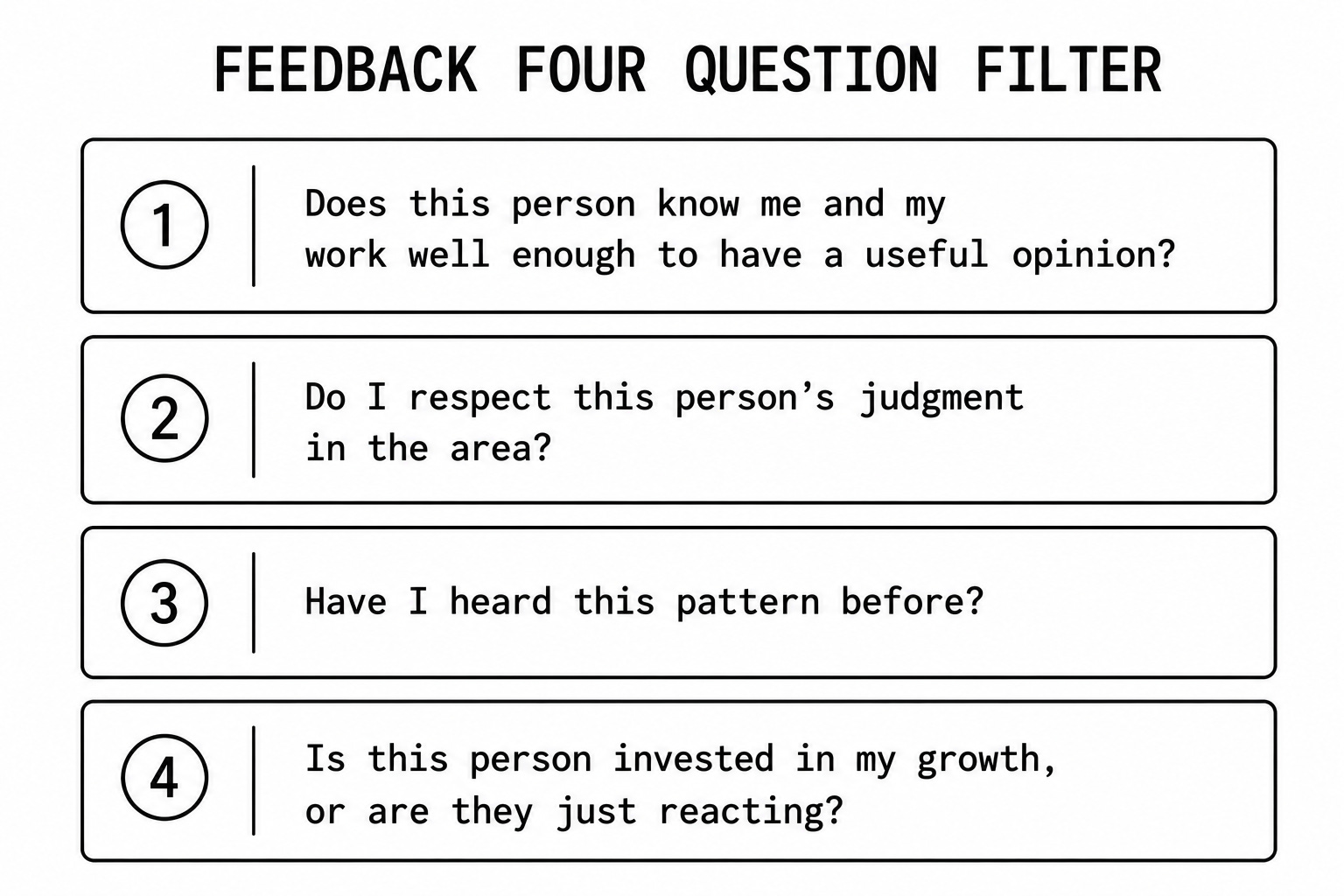
Out of the room, run feedback through a filter:
Does this person understand me and my work well enough to have a useful opinion?
Do I respect this person’s judgment in the area where they are giving feedback?
Have I heard this pattern before, or is this the first time?
Is this person invested in my growth, or are they just reacting?
A critic is not the same as an enemy. Plenty of advocates will criticize you, often more sharply than anyone else. The question is not, “Did this hurt?” The question is, “Is this useful, true, and worth acting on?”
3. Close the Loop
This is the move almost nobody makes, and it compounds more than any other single thing in this article.
A few weeks after you implement something based on someone’s feedback, go back and tell them what changed.
Something like:
“You told me a few weeks ago that I was burying the recommendation. I rebuilt the structure of my last memo around leading with it, and the response was completely different. Thank you for that.”
That small follow-up does a lot. It tells the person their feedback mattered and shows that you can turn input into better work. It makes the next hard conversation easier and teaches them that giving you feedback is high leverage. They invested a few minutes, and you came back with proof that it changed something.
This is how you get busy, sharp people to keep investing in you. I have built some of the strongest advocates in my career not because I was brilliant in every room, but because I was willing to listen, act, and come back better.
The irony is that over time, the same people who once gave you feedback may start asking you for yours. At this happens, it means you are not just someone who can receive judgment, but are becoming someone whose judgment other people trust.
First Drafts Are Cheap, Iteration Is the Job
This matters more now than it did ten years ago because AI has made first drafts cheap. Anyone with a laptop and a decent prompt can produce a memo, an analysis, or a deck. Execution stopped being the differentiator.
The advantage is shifting to people who can improve the work faster. People with judgment, taste, and clarity who can incorporate feedback to make the next version better. Someone early in career may think that the win is completing an ask, whereas a seasoned leader knows the win is making the deliverable impactful. Feedback receptiveness and iteration is how you compound past people who are using the same LLMs as you.
Your Move This Week
Think about a piece of feedback you’ve received in the last 90 days that stung. Could be from your manager, a peer, a stakeholder, anyone.
Run it through the four-question filter:
If the feedback survives the filter, do something about it this week and then close the loop with the person who gave it to you within the next month. If it doesn’t survive the filter, let it go. Stop carrying around feedback that was never useful in the first place.
Then ask yourself the harder question:
What feedback have I been defending that should be open-hand?
And what feedback have I been absorbing that should be closed-hand?
Feedback is not a grade. It is not a verdict or proof that you failed. It is the loop that makes your work better and if you learn how to receive it, evaluate it, and act on it, you become the kind of person people keep investing in.

If this series is hitting home, forward it to someone in their first few years of work. It’s free, and it might be the thing nobody’s told them yet.
P.S. — I work with a small number of readers one-on-one to help them apply these frameworks to their own career. If you are at a moment where you need more than a newsletter, book one off or ongoing sessions here.
If you enjoyed this, here’s what to read next
How to Focus Your Time On the Right Things

Welcome back to Career Field Guide: the weekly newsletter for people who want to build a career that holds up in the age of AI. If someone forwarded this to you, subscribe here.
The Best Performer Doesn't Get Promoted

The first time I had a seat at the table deciding who gets promoted, I was surprised. I expected the conversation to be about goals and OKRs, but excellent work is table stakes. The real debate was about something else.