


Welcome back to Career Field Guide: the weekly newsletter for people who want to build a career that holds up in the age of AI. If someone forwarded this to you, subscribe here.
This is Part 2 of 8 in the Essential Skills Series: the 10 skills that separate people who advance from people who plateau. Find the whole series here.
Busy Isn’t the Same as Productive…And Your Manager Can Spot the Difference
It’s Tuesday afternoon. You have fourteen things on your list, three Slack threads you haven’t answered, and a 1:1 with your manager in the morning.
You’ll spend tonight trying to make progress on all of it. You’ll show up tomorrow with a status update that covers everything. Your manager will nod, ask a few questions, and move on. And then you’ll leave the meeting with a sense that something isn’t landing, even though you worked hard all week.
Here’s what’s actually happening: your boss is getting a sense for whether you have good judgment or not.
Promotion decisions rarely go to the hardest worker in the room. They go to the person whose work is most aligned with what leadership actually cares about, which is why learning to prioritize your work is one of the most important skills you can build early in your career.
School Taught You Perfection. Work Grades You on Impact.
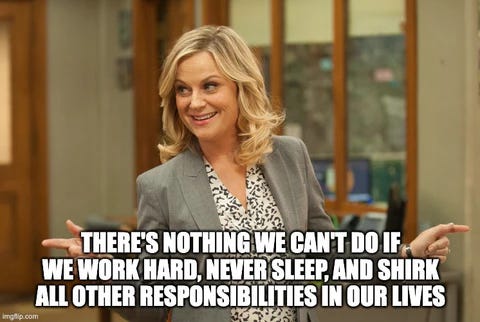
School has one rule: finish everything well. Every assignment matters equally and leaving something incomplete is a failure. That rule gets you through sixteen years of education, but then you enter the workforce and nobody tells you it stops working.
At work, output is judged on impact, not completeness. A task finished on time that moves nothing is invisible. A task left imperfect that moves the right metric gets you in the room for the next exciting project or opportunity. Your manager isn’t grading your completion rate. They’re asking two questions: does this person know what actually matters, and are they doing those things well?
The trap is applying school logic to a work environment where the list never gets shorter and the stakes on each item are wildly unequal. The reality is that most emails don’t need a response and most tasks won’t move your career or your team forward. The challenge is learning which ones will and then doing those items with excellence.
Steve Jobs said focus means saying no to a hundred good ideas and Warren Buffett called everything outside his top priorities his “avoid at all costs” list. They were talking about running companies, but the same logic applies to running your week.
The fix isn’t working harder; It’s knowing what’s actually impactful.
Companies Don't Reward Busy Work. They Reward Aligned Work.
Every company, regardless of size, runs the same way at its core. Leadership sets strategic goals — grow revenue by 20%, reduce cost by 15%, enter a new market, ship a product by Q3. Those goals get broken into team objectives, which filter into individual priorities. The cascade goes all the way down to your weekly task list. This means your work is always being evaluated against something above it, even when nobody tells you what that something is. The best managers make this explicit and reinforce it regularly.
At the highest levels, companies judge performance on three things: metrics that move, profit that compounds, and evolution that keeps them competitive. The number of emails you answered, your Slack response time, or tasks you checked off before lunch will never make leadership’s radar. Ironically, being great at those things is usually the easiest way to spot a junior person versus a more senior one. The junior person optimizes for activity whereas the senior person optimizes for outcome. The gap between them is understanding which game is actually being played.
The early-career trap is operating at the bottom of that cascade without understanding it. You complete tasks because they’re on your list, not because you’ve traced them back to something your organization actually needs.
The reason that this matters is because you can’t possibly do everything at work. There will always be more work than hours in the day, so the way your prioritize tasks indicates your understanding of the business. The professionals who advance fastest are almost always on teams that can draw a straight line from their daily work to their leader’s strategic goals because they understand the cascade and point their energy at it. When budgets get cut, those teams get protected. When opportunities open up, those people get called.
This is why prioritization isn’t a time management skill, it’s a strategic one. Even if you could pack every task into your day (you can’t), you’d still be spending precious time on unnecessary busy work. Before you sort your task list, the most important question isn’t “what’s urgent?” It’s “what does my manager’s leadership team care about most this quarter, and am I pointed at it?”
The practical move is simpler than it sounds. In your next 1:1, ask your manager one question: “What does leadership care most about this quarter, and how does our team’s work connect to it?” A few managers might be vague, which is also useful information, but most managers are excited to hear someone who wants to understand the strategic landscape and help them with strategic goals.
If you can understand your org and team’s strategic goals, prioritization gets significantly easier. If you can’t, no framework will save you.
How High Performers Actually Prioritize
Start with the Eisenhower Matrix
Before your next 1:1, sort everything on your plate into the four quadrants below from the Eisenhower Matrix.
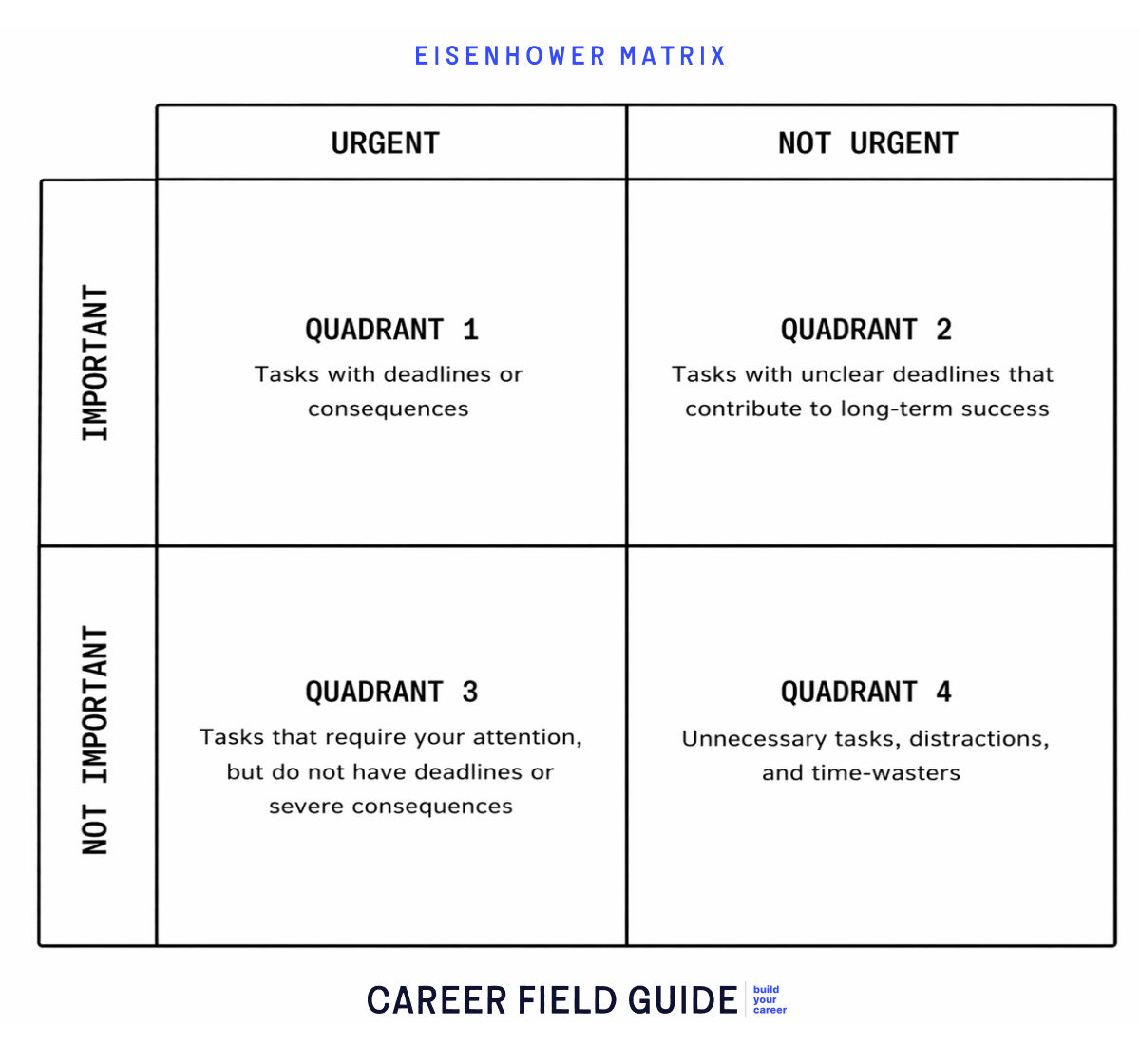
After doing this you'll find that a surprising portion of your week lives in the bottom half. The matrix doesn't give you a perfect answer, but doing it forces you to make a judgment call about how you’ll use your time before someone else makes it for you.
Then pressure-test with four questions
The matrix tells you where tasks land. These questions tell you whether you sorted them correctly:
Does my manager’s manager care about this? If yes, it’s almost certainly high-impact. If you don’t know, find out — that gap is worth closing on its own.
Does this unblock someone else? Work that holds up a colleague or a downstream process compounds in both directions. Doing it fast creates momentum. Sitting on it creates drag that’s visible to more people than you think.
Is the deadline real or social? Some deadlines are attached to business outcomes — a launch, a client commitment, a board review. Others exist because someone asked and it felt awkward not to give a date. Treat these deadlines differently.
Would skipping this be noticed in 30 days? If the honest answer is no, it belongs in the bottom half of the matrix regardless of how urgent it feels today.
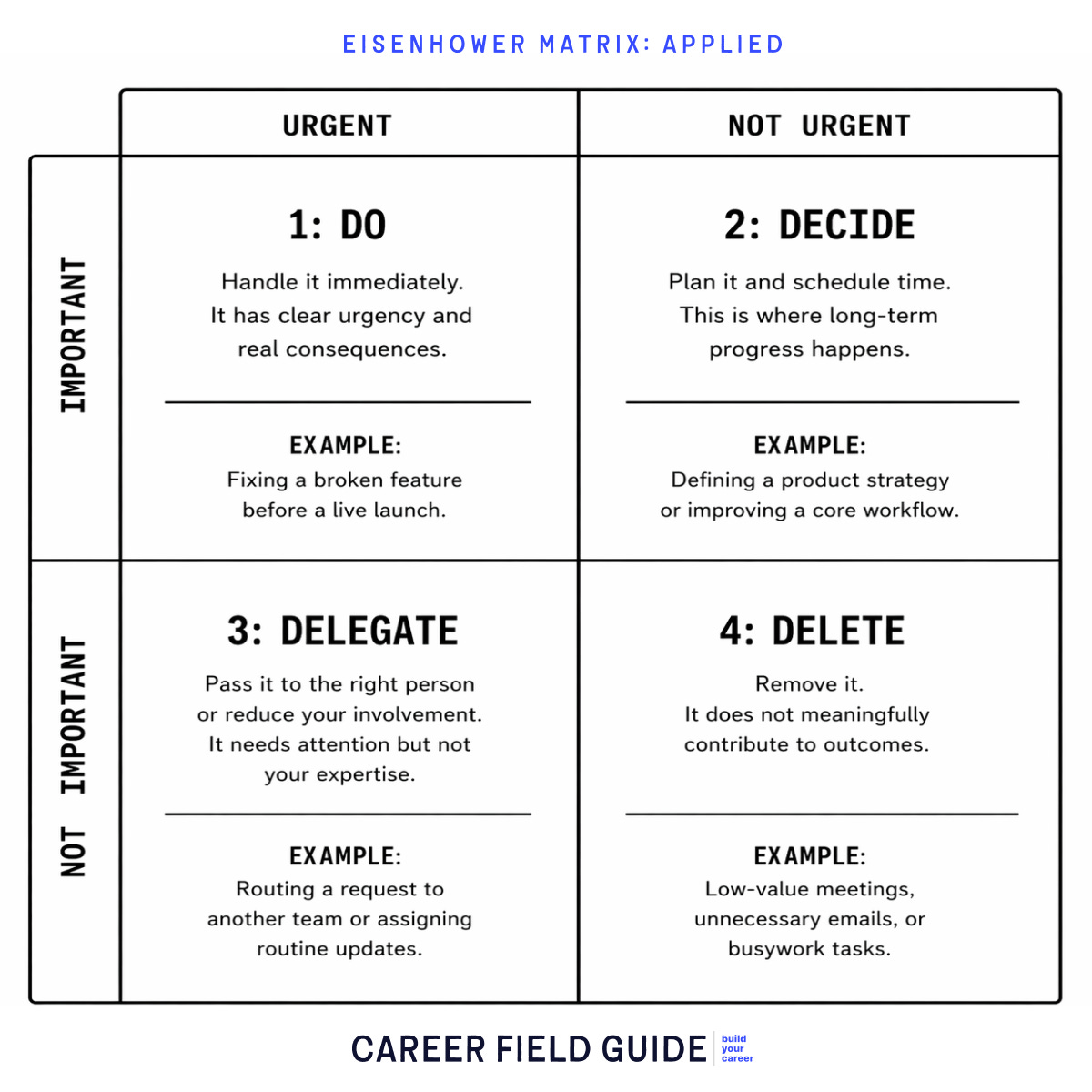
Here’s what this looks like in practice
Early in my time at Microsoft, I was preparing for a weekly 1:1 with my manager and I felt buried by the workload. I had twelve things on my list, all of which felt real and critical. Two were reports I’d been asked to pull, one by my manager, one by a colleague who needed it for a presentation the following week.
Running the four questions changed my read on both. The colleague’s report was urgent and felt important, but my manager’s manager had no visibility into it, it didn’t unblock any cross-functional work, the deadline existed because someone had put a meeting on the calendar, and nobody above my manager would have noticed if it slipped a week so it went in the bottom half. The report my manager had asked for connected directly to a metric their leadership team reviewed monthly. It belonged in the top half and I needed to lead with it.
I showed up to that 1:1 with three things ranked, the rest explicitly deprioritized, and one open question. My manager spent the first ten minutes on the thing that actually mattered and appreciated that I was focused on the critical few items. He was also able to provide quick feedback on rearranging my list so that I can deprioritize a few items that had seemed critical to me, but not to him.
Bring the ranked list, not the full list
My 1:1s with my manager felt like working with a partner when I started showing up with a ranked view and my manager appreciated that I was able to quickly articulate what I think matters most this week, what I’m deprioritizing, and one thing I want his read on.
Your manager can affirm, redirect, or catch something you missed, but you need to do the work of organizing if you want to be seen as a leader. It’s a big difference between asking for direction and asking for calibration. One puts the work on them, the other shows you’ve already done it.
Say out loud what you’re cutting
Don’t quietly drop low-priority work. You need to state it to the others involved: “I’m pushing the vendor report to next week to stay focused on the launch.” The sentence builds trust and ensures that you’re not accidentally missing something critical. It also signals judgment, not avoidance. You want your boss to see you as strategically prioritizing your work, not dropping the ball.
Use AI to Build the Judgment, Not Just the List
Before your next 1:1, run this prompt:
“Here’s my task list: [paste it - don’t include anything confidential]. My manager’s current focus is [one or two sentences]. Our team’s top priority this quarter is [one sentence]. Rank these by likely impact on what my manager cares about most, flag anything that looks low-value given those priorities, and for the top three items explain specifically why they rank highest. I want to understand the reasoning, not just the ranking.”
That last sentence is the important one. You’re asking for the logic behind the sort so you evaluate it; if it’s good, internalize it and apply it yourself next time without needing the help.
Use AI to develop your thinking, don’t blindly follow its outputs.
Your Move This Week
Before your next 1:1: write down everything on your plate, sort it with the Eisenhower Matrix, run the four questions on anything you’re unsure about, and bring the ranked list. Then run the AI prompt above and adjust if anything surprises you.
Your manager doesn’t need you burned out over tasks; they need to know that you understand what matters and that you’re committed to getting it done.

P.S. — I work with a small number of readers one-on-one to help them apply these frameworks to their own career. If you are at a moment where you need more than a newsletter, book one off or ongoing sessions here.
If you enjoyed this, here’s what to read next:
AI Is Taking Your Tasks, Not Your Job

Welcome back to Career Field Guide: the weekly newsletter for people who want to build a career that holds up in the age of AI. If someone forwarded this to you, subscribe here.
Every Career Choice Has a Hidden Cost

Every role you accept optimizes for something and costs you something. I didn’t understand this at the time, but I can trace my own blind spot back to the moment I finally earned a role at Amazon.