


Welcome back to Career Field Guide: the weekly newsletter for people who want to build a career that holds up in the age of AI. If someone forwarded this to you, subscribe here.
AI Is Not Going to Take Your Job (But Here’s What Will)
It’s Sunday night and you’re doomscrolling again when another headline pops up: “Company X to cut 4,000 roles as AI adoption accelerates.” It feels like it’s only a matter of time before you become the headline.
The worst part is not the fear of being fired, it’s the fog of not really knowing what to do about it while you wait for the shoe to drop.
You’ll hear it a lot: “AI won’t replace you, a person using AI will,” but what do you do with that? At the heart of AI-related anxiety is the growing suspicion that the people around you are becoming that person using AI while you are falling behind.
I'm a researcher who helps some of the largest companies in the world navigate these decisions, and this past quarter I've traveled across the US and Europe to understand where AI is actually being implemented. I want to share what I'm seeing, but first, let's talk about you, because there are three mistakes I watch people make over and over again when the ground starts shifting underneath them.
Three Mistakes People Make
Most people respond to technological disruption in the same way, but I see this playing out specifically with AI anxiety in three ways:
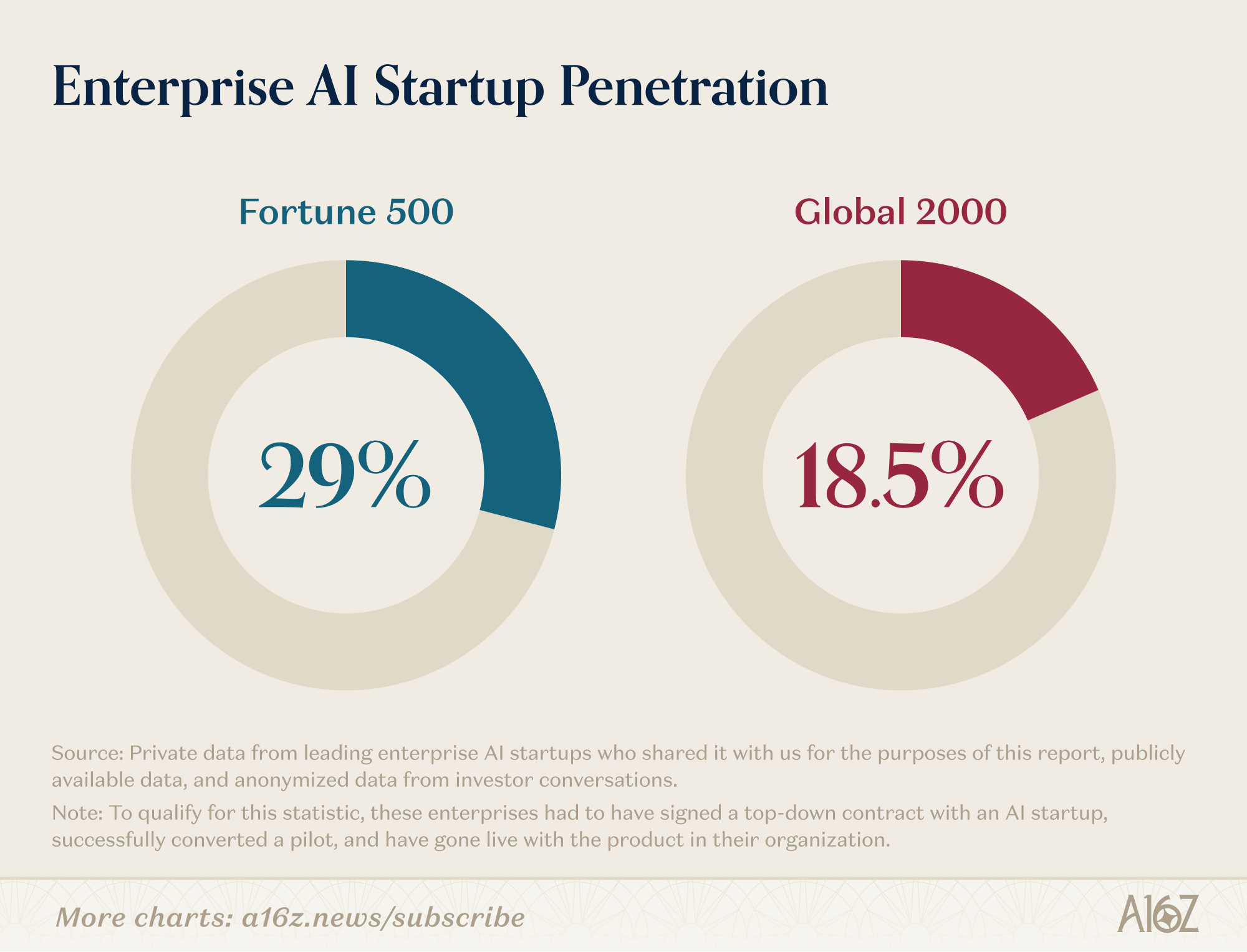
Denial. "My job requires human judgment. AI cannot do what I do." The reality is that nearly 30% of the Fortune 500 are now live, paying customers of a leading AI startup. These are not historically early adopter companies. If the Fortune 500 is moving this fast, the "my industry is different" defense is collapsing. Sticking your head in the ground doesn't just cut you off from the opportunity, it builds a reputation as someone unwilling to grow.
Panic-skilling. On the other end, some people start signing up for every AI course, chasing a prompt engineering certificate, learning to code at midnight, and watching endless hours of AI content. This feels productive but rarely translates into anything your employer actually values. According to the World Economic Forum’s Future of Jobs Report, 81% of employers now prioritize demonstrated work experience over a degree when evaluating candidates, and only 14% view short courses or online certificates as meaningful hiring signals on their own. The skill gap employers care about is not “can you use AI” but “can you apply AI to real business problems in your domain.” Everyone should develop a base understanding of AI, but you need to be intentional before jumping into every shiny opportunity.
Freezing. Doing nothing while recognizing that things are truly changing. This is the most common response and the costliest, because the learning curve advantage compounds. Every month you wait, the gap between you and the person who figured it out widens. Unless you plan to retire in the next five years, AI will become a critical part of your work, so it is best to deal with it head on.
Now let’s look at what’s actually happening so you can make better decisions about what to do next.
How AI Is Transforming Companies
Before AI comes for your job, it's coming for your tasks. AI is not ready to massively displace humans, at least not yet. What's playing out is a more specific and useful story if you know where to look.
The data work is being automated first. Entry-level roles have historically been allocated to the unglamorous work of cleaning, validating, and making sense of data. Questions like “is this data right” and “do we trust these numbers” are increasingly being answered by AI. One of the clearest examples is in customer support, where AI agents are already handling higher ticket volumes, improving resolution rates, and raising customer satisfaction scores, all at lower cost than the status quo. There has also been a “TikTokification” of customer signals where a product goes viral and a company’s supply chain is not ready to capitalize. AI is built to find the needle in that haystack long after your entry-level analyst has left for the day. This is one of the most immediate areas where you will see a labor impact as companies simply need to hire fewer people for this type of work.
The talent question is wide open. Regardless of what you hear online, no one really knows what AI is fully capable of yet. Leaders are desperate for people in their companies to find ways to be meaningfully better at their jobs using these tools, but this is uncharted territory for most people. The best engineers at top companies are reporting productivity gains of 10 to 20x with AI coding tools. That number resets what "good" looks like for everyone. Executives are not eager to remove people because of AI (the technology is not ready, even if they wanted to), but they are having intense conversations about upskilling their people with AI so they can leverage these tools. There will also be an expansion of scope as these tools allow people to do things like write code with natural language, even if they are not on an engineering or data team.
Agentic workflows are moving from science fiction to production. The biggest unlock is not headcount reduction. It's taking a process that has always required five people managing multiple spreadsheets and redesigning it so an AI agent handles the data gathering and pattern matching while a human applies judgment at the decision point. This puts human attention where it actually matters and lets the machine handle the parts that never needed a person in the first place. Model capabilities are improving fast, with some domains showing 20 to 30 percent jumps in benchmark performance in just four months, and every major lab is investing heavily in long-horizon agents and computer use that opens up entirely new classes of work. The most valuable person on your team will be the one who can work with these tools while applying sound business judgment and finding novel applications across the business.
You're Not as Behind as You Think
If you feel like you've missed the moment on AI, you probably haven't. We are still early. But "early" does not mean "plenty of time." This is a great graphic from Ruben Hassid over at How to AI to remind us that there is a ton of opportunity still available.
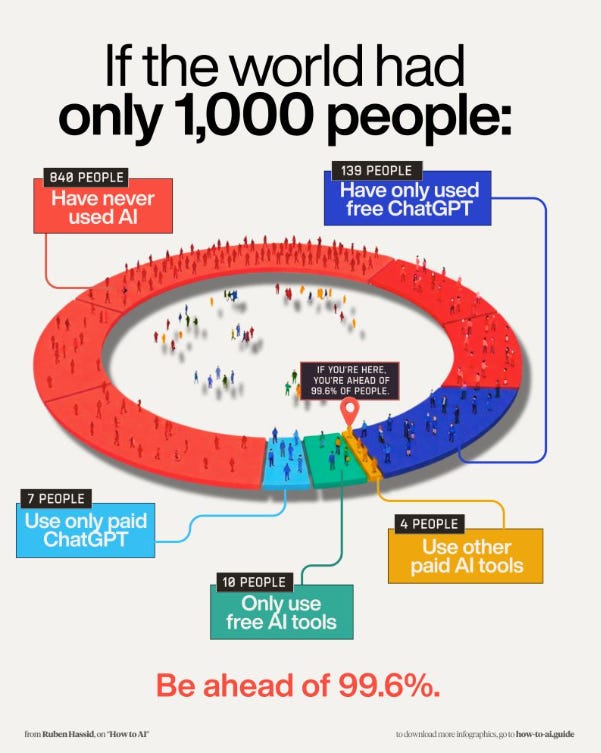
The reality is that we’re early on AI, but it can feel like you’re behind when you’re constantly scrolling on TikTok or X and following people on the bleeding edge of OpenClaw or constantly analyzing Claude’s latest feature drop.
The real shift is that AI raises the baseline expectation for how fast you learn, how fast you adapt, and how quickly you deliver value in a new context. The people who cannot keep up with that new speed or who completely disengage are the ones who become expendable, not because a bot took their job but because someone else figured out how to ramp faster, upskill continuously, and operate at a level that used to take five years of experience to reach.

The photo above is of a room full of human computers. According to NASA, this team of women had been around since the Jet Propulsion Laboratory’s beginnings in 1936 and were responsible for the number crunching of launch windows, trajectories, fuel consumption, and other calculations that helped make the U.S. space program a success.
We have moved from human computers in the 1930s to agentic AI applications in 2026, but the reality is that ambitious people have always had to navigate technological disruption. The challenge is the same as it has always been: minimize mistakes and determine where to invest your limited time, capabilities, and resources.
What to Do Next
The executives I work with are not looking for all of their people to become software engineers. They are looking for people who learn fast, can translate between the technical and the human, and reduce the time between "we have a new tool" and "we are getting value from it."
Here is how to become that person.
Step 0: Build a foundation. Start with NVIDIA CEO Jensen Huang’s “AI is a 5-Layer Cake” to understand the essential infrastructure behind AI. In parallel, bookmark Anthropic Academy and sign up for a free course like this one on AI Fluency. You can also subscribe to their AI Fluency newsletter at the bottom of the academy homepage. These are free and give you a real foundation, not just buzzwords.
Step 1: Name your 90-day problem. Every role has a version of the onboarding question: what takes too long to learn or ramp up on? Maybe it is a new system, a new client’s business, a new market, or a new regulation. Name the thing that, if you could learn it twice as fast, would make you materially more valuable. If you are still in school, pick a topic or research area and run the same process.
Step 2: Use AI to compress your learning curve right now. Instead of investing thousands of dollars in an AI certificate, take the 90-day problem you just named and use AI to cut your ramp time in half this month. Upload a complex document you have been meaning to read and have AI break it down. Build a custom prompt that helps you prep for meetings in a domain you are still learning. Use AI to simulate a conversation with a stakeholder before you have the real one. The point is not to learn AI as a skill, but to get in the practice of using AI as a tool.
Step 3: Make your learning speed visible. It is not enough to get faster. Your manager and the people above them need to see it. This matters more than you think: research from Wharton’s Ethan Mollick found that while over 40% of workers are using AI at work, most are doing it secretly because they are unsure whether revealing it will be rewarded or punished. When you compress a workflow that used to take a quarter into a month, say so. When you use AI to prepare for a meeting and it goes well, mention the prep process. You are demonstrating that you are the kind of person who figures things out fast, and that is exactly the signal that gets discussed in promotion conversations and encourages others to mention your name to their network. Most of your peers are too cautious to step into that space, which is why it is an advantage.
Step 4: Become the person who makes AI work for your team. The biggest bottleneck in AI adoption inside large companies is not the technology. It is the need for someone to sit between the tool and the team and say, “here is how this actually applies to what we do.” That person becomes indispensable, not because they are technical, but because they reduce the learning curve for everyone around them. If you can be that person, it immediately increases your opportunities for promotion, interesting projects, and influence across your organization. This is also great content to share on LinkedIn. If you need help getting started on LinkedIn, I wrote here about how to find your voice and build your network.
A Prompt You Can Use this Week
Here is a prompt you can use today with ChatGPT or Claude to start compressing your learning curve:
You are a world-class executive coach and domain expert. I work as a [YOUR ROLE] at a [TYPE OF COMPANY]. I am currently trying to get up to speed on [THE THING YOU ARE LEARNING OR RAMPING UP ON]. I have about [TIME AVAILABLE] per week to dedicate to this.
Help me build a 30-day learning sprint. I want you to:
Identify the 20% of knowledge in this area that drives 80% of the value in my role
Create a week-by-week plan that prioritizes the most high-leverage concepts first
For each week, suggest one concrete action I can take to apply what I learned in a visible way at work (in a meeting, in a deliverable, in a conversation with my manager)
At the end, give me three questions I should be able to answer confidently after 30 days that would signal to my team that I have ramped up faster than expected
Be specific to my industry and role. Do not give me generic advice.
Use this on whatever you are ramping up on right now, whether it is a new system, domain, stakeholder group, research project, or market.
The Bottom Line
The AI conversation is going to keep getting louder. The headlines are not going to stop, but the people who build careers that hold up are not the ones who panicked the loudest or upskilled the fastest. They are the ones who figured out how to learn faster than the world changed around them.
That skill will never go out of date, regardless of the technology.

P.S. — I work with a small number of readers one-on-one to help them apply these frameworks to their own career. If you are at a moment where you need more than a newsletter, book one off or ongoing sessions here.
If you enjoyed this, here’s what to read next
The Full Stack Worker

This past week I was in Scottsdale with a room full of Fortune 500 COOs and Chief Supply Chain Officers. Executives managing billions in operations, thousands of employees, and supply chains that touch every product you’ve bought in the last week.