


25,000 Agents and Counting…
The CEO of McKinsey shared at CES that they now count 25,000 AI agents in their headcount1. These workers don’t sit in meetings, ask for promotions, or complain about the coffee, but they are doing a lot of the work previously reserved for entry-level employees.
The stakes are clear: Agents are eliminating the work that shaped the first years of a worker's experience—the same work that college career centers tell graduating students will be their foot in the door.
2026: The Year Agentic Goes Mainstream
We have strong conviction that AI agents will change how we all work and live…there will be billions of these agents, across every company and in every imaginable field…many of these agents have yet to be built, but make no mistake, they’re coming, and coming fast.
We will need fewer people doing some of the jobs that are being done today, and more people doing other types of jobs. It’s hard to know exactly where this nets out over time, but in the next few years, we expect that this will reduce our total corporate workforce as we get efficiency gains from using AI extensively across the company.
Andy Jassy, CEO of Amazon2
This is corporate speak for “there will be blood.” Amazon is investing tens of billions of dollars into AI infrastructure because it believes that it will yield an outsized financial return, a significant portion of which will be their ability to reduce their headcount and manage agents vs humans.
The Work That’s Disappearing
The data confirms what hiring managers already know: young workers are being priced out of entry-level roles.
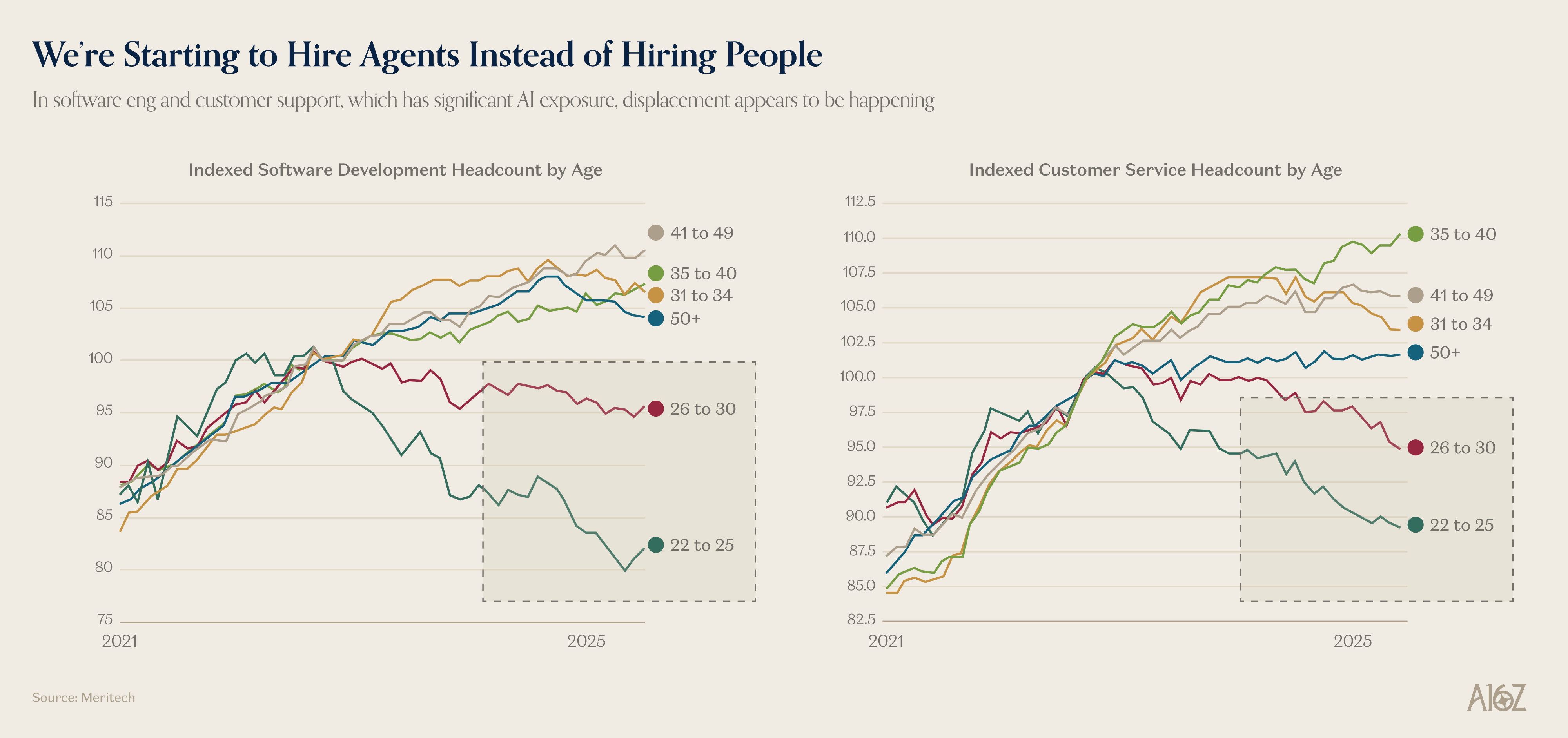
Since 2021, hiring of workers aged 22-25 has dropped 20% in software development and 13% in customer service - the two fields with the highest AI exposure. Meanwhile, hiring of workers 31+ has grown or held steady. This isn’t a recession pattern where everyone suffers equally. Unfortunately for younger workers, this trend is a structural displacement of the bottom rung of the career ladder.
Conversely, the most experienced workers are fine. They have context, relationships, and judgment that agents can’t replicate yet. But the work that creates that experience—the grunt work, the repetitive tasks, the “figure it out” projects that teach you how things work—that’s what agents are consuming first.
If you're under 30 and trying to break into these fields, the game has fundamentally changed. The internships and entry-level roles your professors and parents describe may no longer exist by the time you're ready to apply for them.
When Entry-Level Work Disappears, So Does the Learning
When I joined Microsoft’s Azure supply chain team, a significant portion of my early work was building Excel-based planning tools, compiling KPI dashboards, and creating decks with data analysis and recommendations for leadership. This work wasn’t glamorous, but it was essential to the business and to my development. The work taught me how our supply chain actually functioned, which metrics mattered and why, how different stakeholders interpreted the same data differently, and what “good” analysis looked like versus what just looked impressive.
Today, an AI agent could handle 60-70% of what I did in my first 18 months, including pulling data from multiple systems, generating variance analysis, creating visualizations, even drafting initial recommendations based on historical patterns, faster and more consistently than I ever could.
Here’s the problem: You can’t learn to direct work you’ve never done. The new supply chain analyst gets hired to ‘manage AI tools and provide strategic recommendations,’ but how do you know if the agent’s demand forecast is reasonable if you’ve never built one manually? You can’t develop judgment about what good looks like without first doing the work that creates that judgment.
Companies are hiring people to oversee AI doing entry-level work, which means we're creating a generation of "managers" who've never been managed, "strategists" who've never executed strategy, and "analysts" who've never analyzed anything from scratch—the exact experience that would teach them what good looks like.
What Actually Matters Now (And What to Do About It)
The initial labor reduction is reality and we’ll see continued reductions in entry-level roles in the next few years, particularly in functions where the work is repeatable, digital, and doesn’t require physical presence. New jobs will emerge simultaneously, as companies realize they need people who can bridge the gap between human judgment and AI capability.
If you're graduating into this market, you have every right to be frustrated. You're being asked to compete for disappearing jobs while building judgment through work that no longer exists. That frustration is valid, but it won't protect you. The people who survive this transition will be the ones who build business and technical skills, regardless of their role. Here are three no-regret actions to take:
Engage with AI as a tool, not as a threat or a mystery. This doesn’t mean becoming a machine learning engineer, but you must develop a comfort with experimentation. Learn to debug prompts, recognize when output is garbage, understand the constraints of what these systems can and cannot do. The supply chain analyst who spends weekends testing ChatGPT’s ability to generate demand scenarios learns more about both AI capabilities and demand planning than the one waiting for formal training.
Become bilingual in technical and business language. You need to understand enough about how systems work to spot opportunity and risk, to have credible conversations with the people building these tools, and to translate between what the business needs and what’s technically possible. This doesn’t require a computer science degree, but it does require curiosity about how things actually work and a willingness to sit in meetings where you don’t understand every term, and the patience to ask questions until you do.
Chase project exposure over job titles. The emerging roles: prompt engineer, AI training specialist, agent orchestration manager (or whatever we’re calling them next month). In that these roles didn’t exist two years ago, the people doing them now didn’t wait for a job description to appear on LinkedIn to enter into the field. Instead, they volunteered to help IT test the new planning agent, asked to shadow the team implementing the customer service automation, or made themselves useful to the groups building these solutions. The early adopters are riding the first edge of the wave because they learned the emerging technology even when it wasn’t their “job” because they understood that proximity to AI teaches you more in three months than waiting for assignments teaches you in three years.
Do you wish you’d learned to code back when the internet was simple HTML pages and Flash players? This is that moment—again. Right now, companies are figuring out AI integration in real time. They’re deploying agents without clear success metrics, running into failure modes they didn’t anticipate, and realizing—often too late—that no one actually knows how to manage the transition.
AI technology is moving faster than organizational understanding and that gap is the opportunity window. Relevant expertise is still operationally scarce and every industry needs people who can evaluate where agents work, where they break, and how to design workflows that blend human judgment with AI execution. That window won’t stay open forever, but it’s open now, and it rewards speed over credentials.
Those 25,000 agents at McKinsey still need managing, training, debugging, and strategic direction. The people who learn how to do that well will be the ones who built the career ladders that replace the ones we lost.

P.S. If you're a college career counselor, MBA program director, or corporate L&D leader trying to prepare your people for this transition, I'd welcome a conversation. You can find me on LinkedIn or reach out at justin.gillebo@gmail.com
If you’re inspired to keep reading, here are popular posts:
Opportunity at Work is Not Random: 3 Ways to Make it Yours

Want to dive in deeper? Get the free article worksheet here
Every Career Choice Has a Hidden Cost

Every role you accept optimizes for something and costs you something. I didn’t understand this at the time, but I can trace my own blind spot back to the moment I finally earned a role at Amazon.