


Welcome back to Career Field Guide: weekly career advice for early-career professionals learning how work really works in the age of AI. If someone forwarded this to you, subscribe here.
This is Part 6 of 8 in the Essential Skills Series: the 10 skills that separate people who advance from people who plateau. Find the whole series here.
Writing clearly at work is about helping the reader know what to do next.
A professor reads your whole essay because it’s their job, but at work you’re lucky to get two minutes of someone’s real attention. People scan, so you have to get to the point:
What happened?
Why does it matter?
What do you need from me?
Miss any of these and you’ve handed your work to the reader. Now they have to decode your message before they can do their own job.
Writing Is How Thinking Gets Tested
In the age of AI, anyone can generate a 500-word email in seconds. Because AI has made writing effortless, the market is flooded with long, generic text. Your competitive advantage is no longer just producing words; it’s editing them down to the precise core of what your reader needs to know.
Amazon famously replaced slide decks with written memos in its leadership meetings, a shift Jeff Bezos pushed in 2004 because a narrative forces you to think in complete sentences instead of hiding behind bullets.
I remember the intensity of leading my first doc review at Amazon, sitting in silence while the team read six pages I had written and marked them up in real time. It was punishing to watch my ideas get challenged line by line, but it taught me a critical lesson: writing exposes unclear thinking.
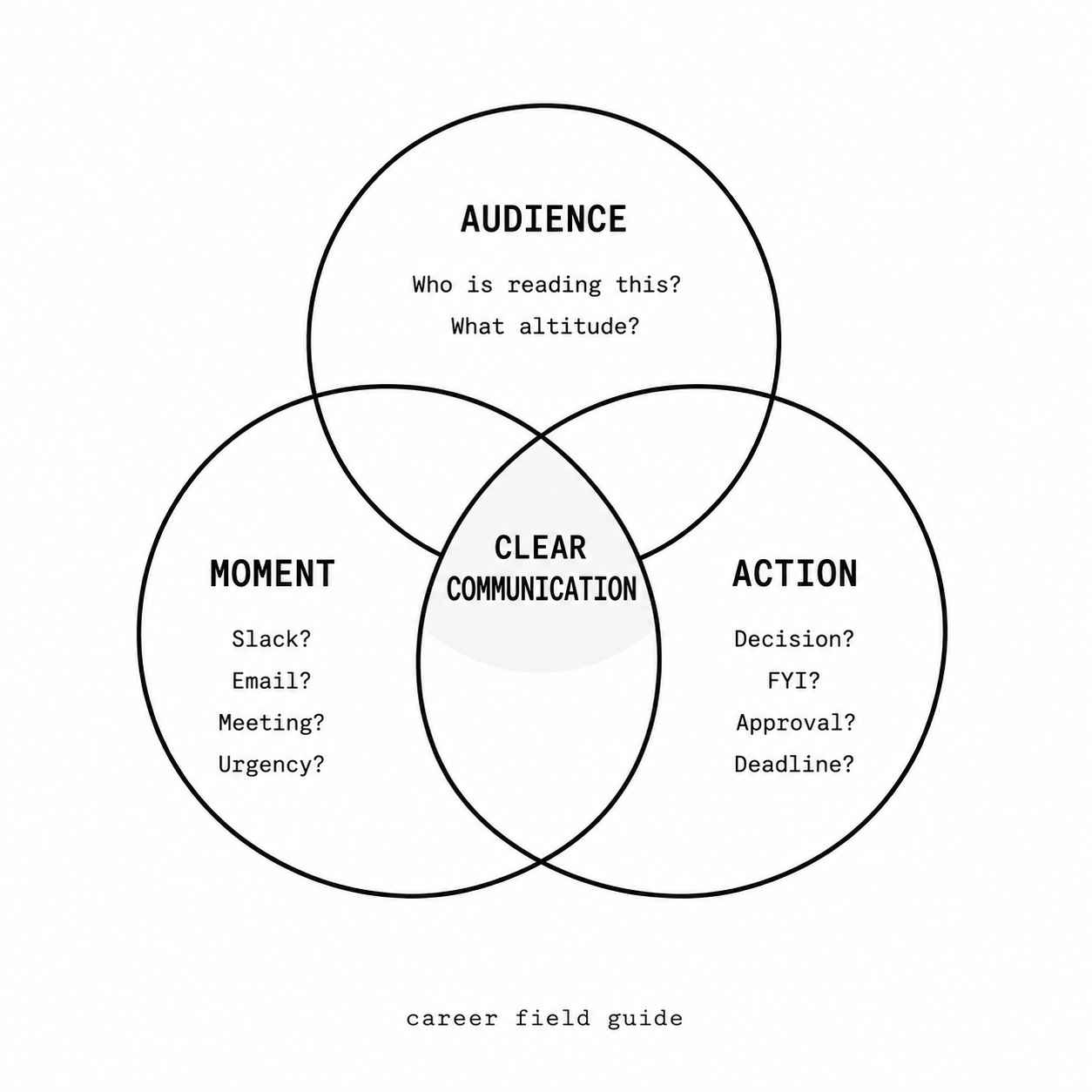
The other lesson from that room was that good workplace writing starts with the reader, not the writer. Before you write anything important, match your message to three things:
Audience
Moment
Action
1. Audience: Who Is Reading This?
You need to understand the altitude of the reader:
An executive needs the point.
Your manager often needs to know where you're stuck.
A new teammate might need you to show them what good looks like.
If I’m writing to an executive, I start with the answer.
Recommendation: delay launch by two weeks to reduce customer risk.
Then I frame the tradeoff:
The issue is not product readiness. It is support coverage. We can launch on time, but the customer experience risk is higher than the schedule risk.
If I’m writing to a peer, I give a little more context.
Can you review slides 4 to 6 by Friday at noon PT? I only need a check on customer accuracy, not design or wording.
If I’m writing to someone junior, I give them the why.
Can you pull three examples of competitor onboarding flows by Friday? The goal is to compare where our sign-up process feels slower. Good output would be screenshots plus 2 to 3 bullets on what each company does well.
Same underlying request, three different altitudes. Writing for the reader is just respecting what that person needs in order to understand and act.
2. Moment: What Does the Situation Require?
Some moments need speed, some need diplomacy, some need a sharper point to cut through the noise.
Picking the right channel is most of the battle:
Slack when the work needs speed.
Email when the work needs alignment or a record.
Docs when ideas need critique or testing.
Meetings when the team is stuck and the email thread keeps growing.
Channel is also culture, and culture is not the same everywhere. At Amazon, it was considered fine, even expected, to stand up and leave a meeting the moment you were no longer giving or getting value. At Microsoft, doing the same thing could land you in hot water. Communicating well includes reading the company you’re in, not just the message you’re sending. No matter the culture, reading the moment means matching your length and format to the urgency of the situation.
A few habits that have saved me grief:
Don’t add another email to your boss’s inbox when a quick Slack or a walk to their desk would do.
Don’t use Slack for something that needs ten rounds of back and forth. Call them or grab fifteen minutes.
Don’t write a novel or hedge your idea when the reader is asking for a clear yes or no.
Don’t ask for “thoughts” when you actually need a decision, or worse, when you’ve already decided and are really just informing them.
And please, for everyone’s sanity, stop burying the point of your message under polite filler. “Hope you had a great weekend!” does not need to precede an Asana update. Your coworkers already know you’re friendly. Get to the point.
The goal is to be clear enough to be useful and thoughtful enough to be heard.
3. Action: What Should Happen Next?
Before you write, ask what result you want from the message. Most people feel stressed, fire something off, and ask for vague support without ever deciding what they need from the reader.
These messages tend to go out late on a Friday and end with something like:
Thoughts?
Wanted to flag.
Just putting this on your radar.
Respect your reader enough to know what you want to happen as a result of your message:
Do you need them to make a decision?
Are you asking for a review, or just making them aware?
Do you need a reply by a certain time?
Using precise words so the ask is unmistakable will 10x the impact of your writing.
Another useful phrase at work: no action needed from you yet. Telling people whether they need to act, and when, is half of clear communication, because it lets a busy reader file your message correctly instead of guessing.
Good Writing in Practice
Asking your manager for a decision
Bad:
Hey Boss, just wanted to send over some thoughts on the client issue. There are a few things going on and I’m not totally sure what the best path is, but I wanted to get your thoughts when you have a chance.
Better:
The client is struggling with the new strategy material we presented Friday, especially slides 4-6 (deck attached). We may need to adjust the plan. Can you take a look and let me know?
Best:
We need to decide by Thursday whether to keep the launch plan we showed the client Friday (deck attached) or adjust it based on their feedback (latest email attached). My recommendation is to adjust and incorporate X and Y, which keeps us responsive to their feedback while protecting our new IP. Can you approve the revised plan by 3 p.m. PT Thursday? If you’d rather talk it through, I’ll find fifteen minutes on your calendar.
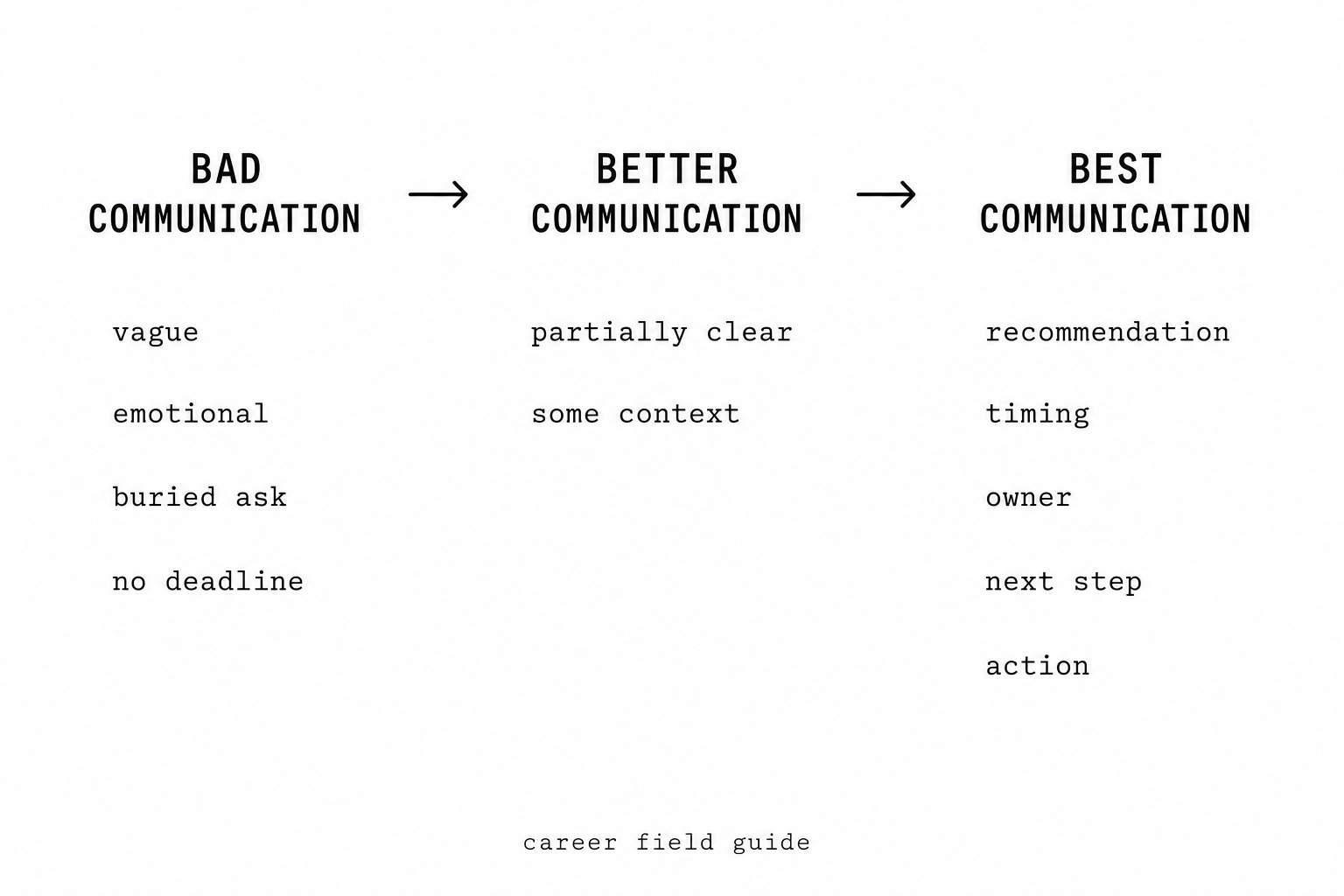
The best version nails all three. Audience: it gives a manager the decision and a recommendation, not a puzzle. Moment: it names the Thursday deadline. Action: it asks for a specific approval by a specific time.
Giving a status update
Bad:
Just FYI, still working on the project and will keep you posted.
Better:
Quick update: the project is moving, but the vendor is delayed.
Best:
Quick update: we’re still on track for Friday, but the vendor is two days behind on their input. I’m following up today and will escalate by noon tomorrow if they don’t respond. No action needed from you yet.
The best version tells the reader what’s happening, what could go wrong, what you’re doing about it, and whether they need to act. That last line, “no action needed from you yet,” is the one that builds trust, because it tells your boss exactly when to stay out of it and when to step in.
Escalating a risk
Bad:
There might be an issue with the timeline.
Better:
The timeline may be at risk because legal has not reviewed the contract.
Best:
Flagging this as a launch risk: legal has not reviewed the contract, and we need approval by Wednesday at 3 p.m. ET to stay on schedule. I just escalated to legal by email with you on CC. If we don’t have approval by tomorrow at 4 p.m. ET, launch slips by one week.
The best version does not panic, but it names the risk, explains why it matters, shows ownership, and defines the consequence. Your boss needs to know about risks early, and you need to make them as loud as the situation deserves.
Urgency is just clarity about what happens if no one acts.
Writing to an executive
Bad:
I wanted to provide some context on the customer onboarding work and share a few updates from the team.
Better:
We have an update on customer onboarding and need your input on launch timing.
Best:
Recommendation: delay the onboarding launch by two weeks to reduce customer risk. The issue is tied to a lack of support coverage. We can launch on time, but the customer experience risk is higher than the schedule risk.
One more thing on messaging execs: if you’re messaging a skip-level leader (your boss’ boss or above), run it by your boss first, or at least give them a heads up. If something you send lands poorly, your boss hears about it directly, so keep them in the loop and save yourself the headache.
Asking a peer for input
Bad:
Can you review this when you get a chance?
Better:
Can you review the attached deck by Friday?
Best:
Can you review slides 4 to 6 by Friday at noon PT? I only need a check on customer accuracy, not design or wording.
The best version saves the other person time. It tells them where to look, when you need it, and what kind of feedback you actually want, which is the Action piece in miniature.
The Hardest Case: When You’re Frustrated
Writing when you’re emotional should send alarm bells and cause you to slow down before clicking send.
People who are just trying to make a point will vent, cut others down, and do whatever it takes to look right. People genuinely trying to make a difference are willing to look like they lost the argument if that’s what helps the work move forward. One of the biggest career limiters is being seen as a hot head who dumps on people under stress.
Here is the same situation, handled three ways.
Bad:
We talked about this last week, and you said you’d have it done by Friday. This is now blocking the rest of the work and you’re putting me in a bad position.
Better:
We’re blocked because the input wasn’t ready Friday. Can you send it today?
Best:
We’re blocked on the customer summary and need it today to keep the timeline on track. Can you send your section by 2 p.m.? If that timing no longer works, tell me what’s realistic so I can adjust the plan.
The best version names the issue without turning it into a character judgment, gives a deadline, and leaves room for reality. It moves the work forward. You can always follow up in a one-on-one later to talk about the process and how to work together better. In the moment, the focus should be getting the work across the finish line.
If you’re hot under the collar, write an angry version of your message in a Word doc, delete it, and get it out of your system. If needed, take a walk or sleep on it and then write the version that moves the work forward and doesn’t end with you sitting in HR’s office.
Before sending anything emotional, ask:
Am I trying to solve the problem or prove I’m right?
Will this make the next step easier or harder?
Would I stand behind this if it were forwarded?
Often, maturity means letting it go and getting the job done.
Your Move This Week
Pick a message you need to send this week that actually matters: a request to your boss, an update to your team, a flag to someone senior. Before you send it, run it through the three questions:
Audience. Am I writing at the right altitude for who’s reading this?
Moment. Is this the right channel, and does the tone fit what the situation needs?
Action. Have I made the one thing I need unmistakable, and said when I need it?
Then delete every sentence that isn’t doing one of those three jobs. Most first drafts are twice as long as they need to be, and the cutting is where the thinking actually happens.
If you want the real version of what made me better at this, send the draft to one person whose judgment you trust and ask them to mark it up. Not “does this sound okay” but “where do you have to stop and figure out what I mean?” A chatbot can tell you if a sentence is clear, but a person who knows the work can tell you if you’re solving the right problem so use both to refine your writing.
Use your communication to move the work forward and build the culture you want to see in your workplace.

If this series is hitting home, send it to someone who needs it.
P.S. I work with a small number of readers one-on-one to help them apply these frameworks to their own career. If you are at a moment where you need more than a newsletter, book a one-off or ongoing session here.
If you enjoyed this, here’s what to read next:

The Playbook of Interview Scripts You’ll Actually Use

Interviews don’t reward the best workers. Interviews reward the best storytellers.