


This past week I was in Scottsdale with a room full of Fortune 500 COOs and Chief Supply Chain Officers. Executives managing billions in operations, thousands of employees, and supply chains that touch every product you’ve bought in the last week.

The conversation wasn’t abstract. Thirty years of globalization are being unwound in real time, AI is moving faster than governance can keep up, and behind closed doors, the people doing the hiring were asking the same question out loud: where are the people who can actually navigate this?
That question has a direct answer and if you’re building your career, it’s the most important thing you can understand right now.
The Market in Splitting in Two
There’s two competing versions of what’s happening for people in the job market right now:
Catastrophe: AI is coming for everything, your degree is worthless, learn a trade or drive for Uber (until they’re all autonomous too).
Optimism: Don’t worry, new jobs always emerge. Technology creates more than it destroys. It will be fine.
Neither is quite right. The more accurate version is that the job market is genuinely difficult1 and a specific kind of person is thriving.
Hiring for college graduates is down 16% compared to last year and 44% below 2022 levels2. Companies are pausing hiring not because they don’t need output, but because AI and digitization is making it cheaper to get output without headcount.
At the same time, according to The Wall Street Journal, base salaries for AI-skilled workers with zero to three years of experience grew 12% from 2024 to 2025, the largest gain of any experience group. At companies like Scale AI and Databricks, 22-year-olds are making $200K base before equity. Databricks CEO Ali Ghodsi told the Journal: “Under 25, you can be making a million.3”
The market isn’t collapsing: It’s bifurcating and the divide isn’t really about age or even technical skill, it’s about something harder to name and harder to fake.
What the people doing the hiring decisions are actually saying
Every executive I spoke with in Scottsdale is wrestling with the same gap.
They can’t find people who are technically fluent and have real business judgment. They also can’t find experienced operators who are genuinely excited about embracing new AI tools. The person who sits comfortably in both places barely exists.
This isn't a small problem. When an agentic system makes a bad call, it can ripple into hundreds of millions of dollars of disruption before anyone catches it. The human in the loop isn't a formality; they're the last line of defense. That person needs to understand the technology well enough to question it, and the business well enough to know when something is wrong.
That person is extraordinarily rare, every executive I know is looking for them, and you can become that person: the full-stack worker.
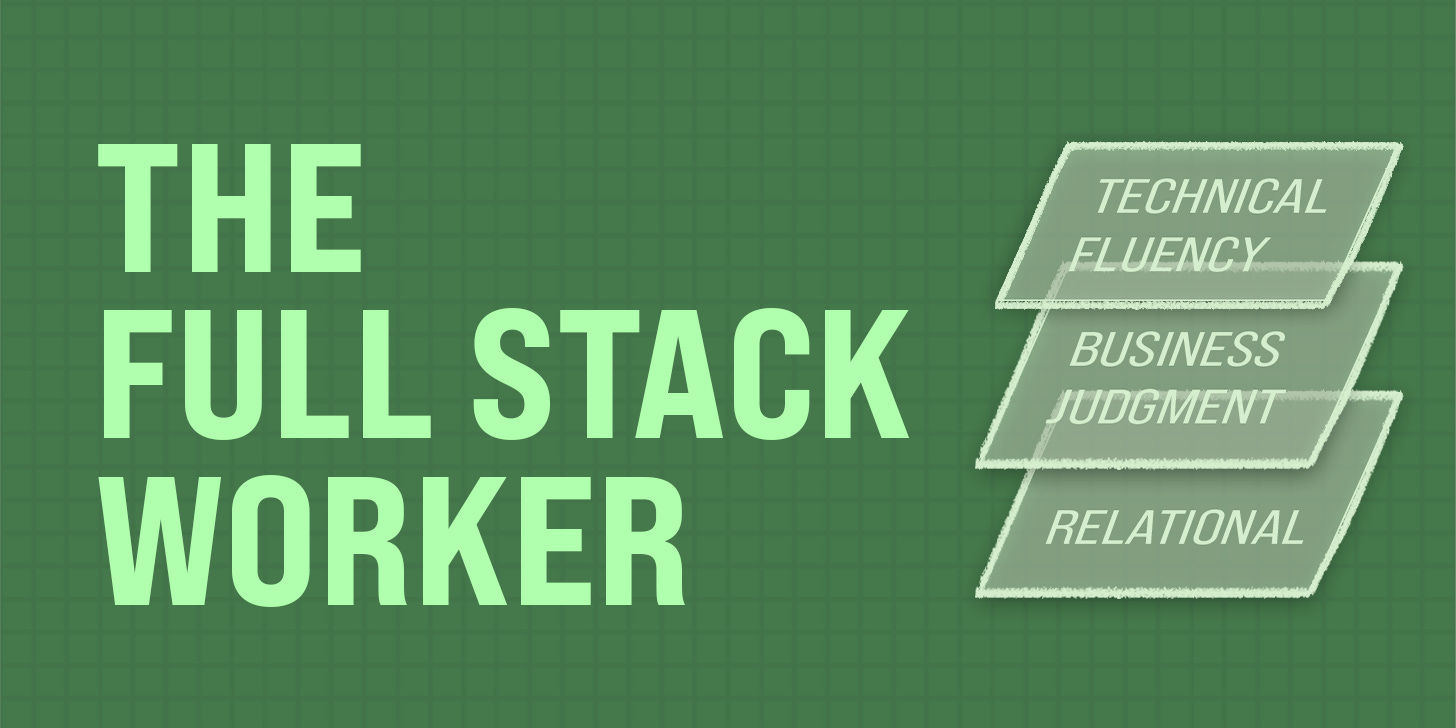
The Full-Stack Worker
A full-stack engineer works across an entire system, not just one layer. The Full-Stack Worker is that idea applied to being human at work.
Three qualities that function as a system with each layer making the others more powerful:
Technical Fluency. Not necessarily a CS degree, but genuine comfort with AI tools, data, and the systems shaping your industry. Enough to use them, question them, and improve them. The bar here is curiosity more than credentials, but those who go technically deep will be rewarded with pay and opportunities.
Business Judgment. The ability to read a situation, understand what’s actually at stake, and make a call when the data is ambiguous, which it always is. This is what executives mean when they say they can’t find good people. Judgment can’t be automated because it requires context, stakes, and accountability.
Relational depth and grit. The ability to make people want to work with you, follow you, and bet on you combined with the stubbornness to do hard things without being asked. Not charm as a substitute for competence, but as a multiplier of it.
An AI agent can execute, generate, and optimize. It cannot walk into a room, make a judgment call under pressure, and make people want to follow them. That’s still a human thing. In 2026, make it your thing.
🤖 Bookmark this article for a step-by-step guide to build AI fluency and create portfolio-ready proof you can bring to your next interview or annual review.
The Window is Open
Nobody has ten years of AI experience yet. The ceiling on how fast you can close the gap on a 45-year-old with decades of institutional knowledge has never been lower. Most Fortune 500 companies are still figuring out how to move past AI pilots, which means the people who can bridge technical fluency, business judgment, and relational depth are needed right now, not in five years.
This window won’t stay open indefinitely. The people who get after it in the next two or three years will have a compounding advantage that’s very hard to close later.
The executives in that room in Scottsdale are looking for someone. That someone could be you. Start building.
Career Field Guide is a newsletter for early-career professionals building AI-resilient careers. If this resonated, forward it to someone who needs it or subscribe below.