


Welcome back to Career Field Guide: weekly career advice for early-career professionals learning how work really works in the age of AI. If someone forwarded this to you, subscribe here.
This is Part 8 of 8 in the Essential Skills Series: the 10 skills that separate people who advance from people who plateau. Find the whole series here.
Bombs are dropping in Iran, the economy has fractured into a brutal K-shape, technocrat billionaires are laying off thousands to hoard GPUs and Elon is, well, doing Elon things.
But sure, Jessica. Let’s definitely grab a 15-minute virtual coffee to “touch base” on our weekend plans.
If the performative theater of modern work makes you want to scream, you aren’t alone. When the world is this bleak, logging on to manufacture small talk feels less like networking and more like corporate brain rot. The instinct is to put your head down, clear the inbox, and log off.
But that’s the trap: ignoring Jessica is a career hazard.
No matter how overwhelming the world may feel, your career success still depends on other people. If you only focus on your direct tasks, you fall into what I call the One-Pedal Trap. Think of your career like a bike requiring two pedals to move forward.
Most people only push the Performance pedal. They execute tasks, hit metrics, and hope someone notices. But to actually get anywhere, you need the second pedal: Optionality.
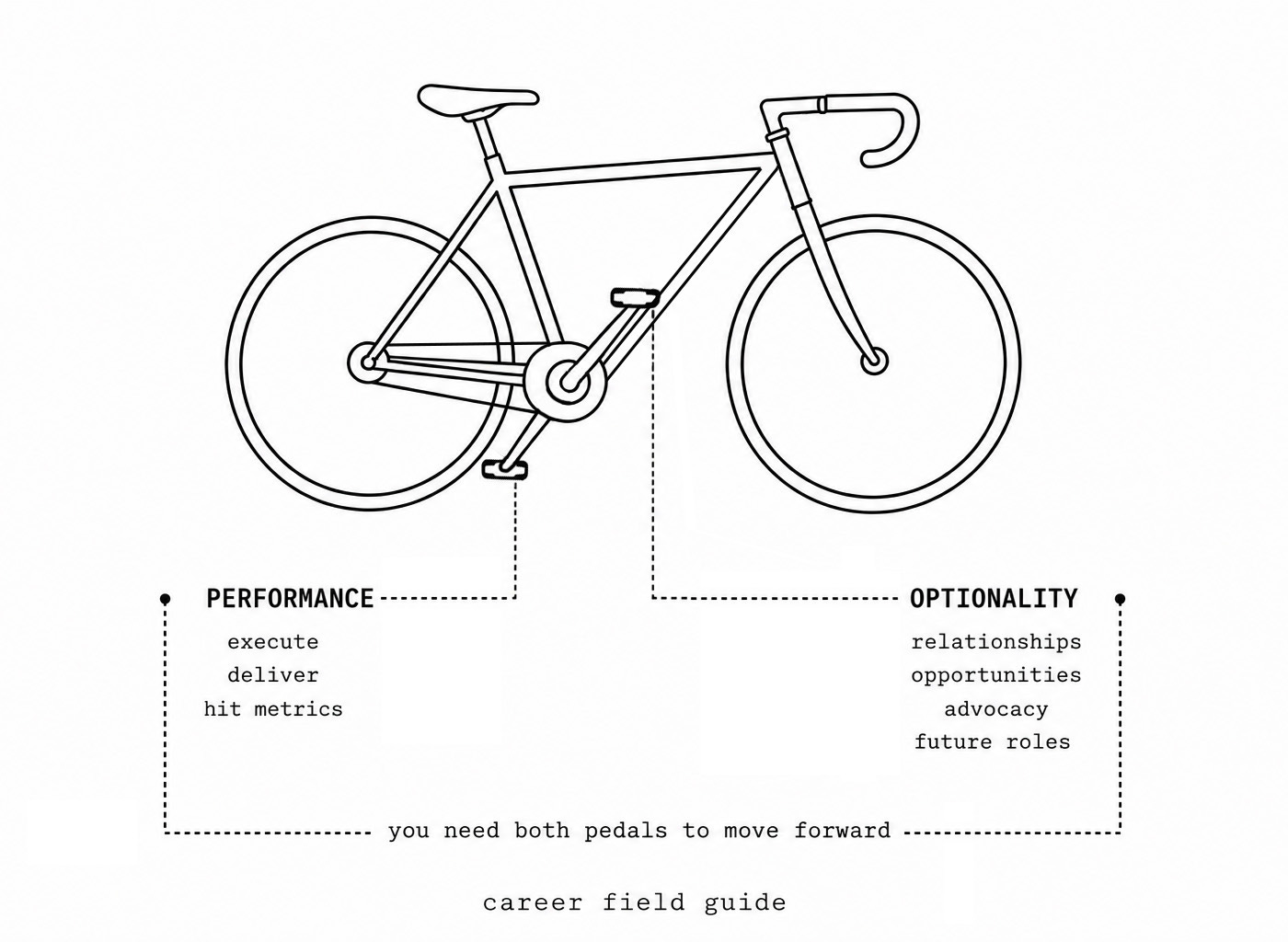
Optionality is how you secure that incredible role in a competitive job market and get to celebrate it over drinks. It’s how you get your own projects green-lit at work and build a safety net of people who will vouch for you when the company decides to fund another server farm instead of your org. You need Optionality to survive the AI era, but you also need a way to do it without burning out, becoming inauthentic, or becoming “that guy” on LinkedIn (we all hate that guy).
The Optionality Grid
To get Optionality, you need to be two things: useful and enjoyable. You can map everyone in your company on a simple 2x2 matrix:
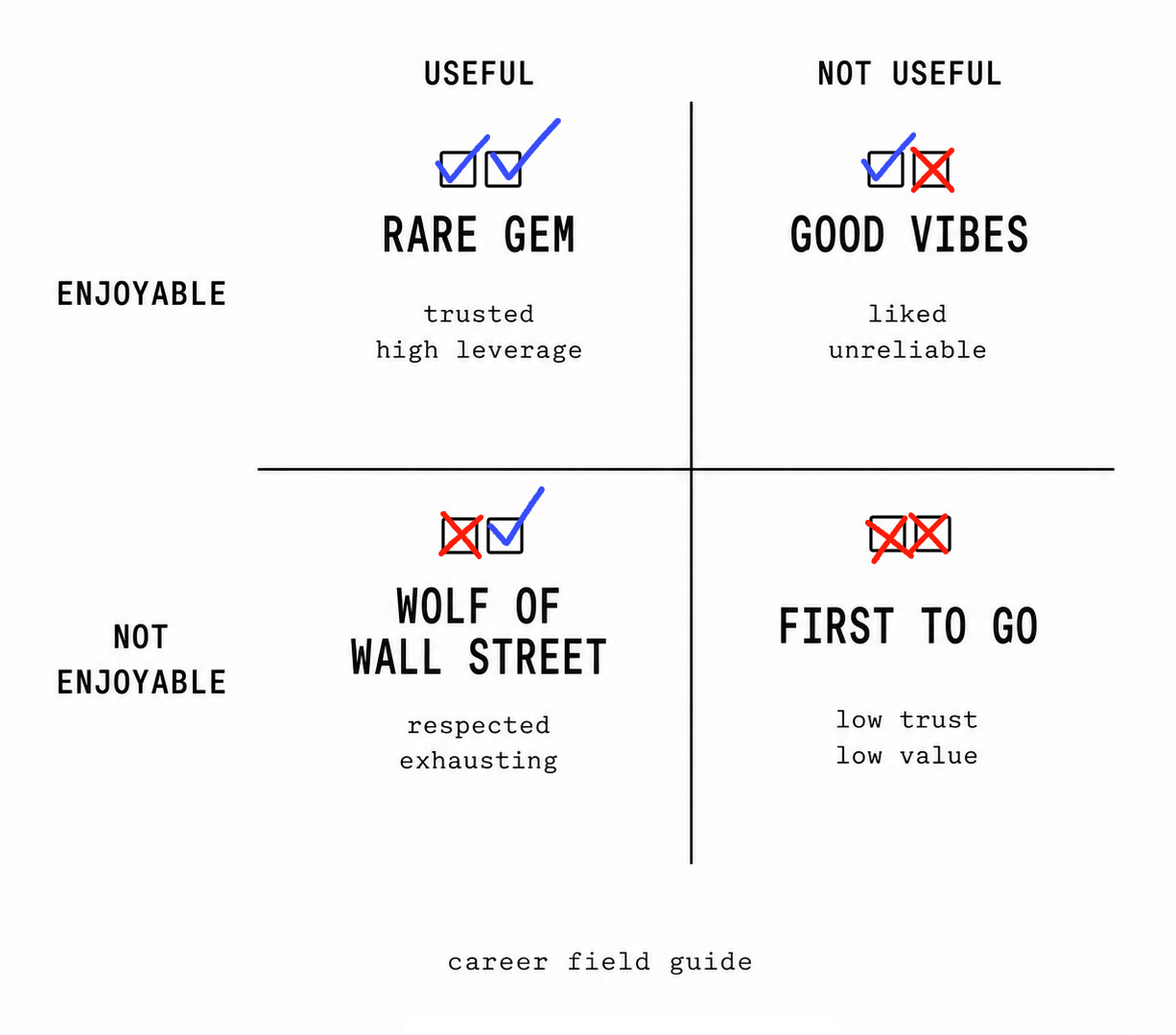
High Enjoyable / Low Useful (Good Vibezzz): Trades exclusively in fire emojis and virtual happy hours. Everyone likes them, but if they are on your project’s critical path, you panic.
High Useful / Low Enjoyable (Wolf of Wall Street): Crushes their KPIs, but views colleagues as raw materials to be consumed for their own promotion. They are respected, but not protected. When layoffs come, leadership won’t mind seeing them go because the culture tax is just too high.
Low Useful / Low Enjoyable (The First To Go): Self-explanatory. They won’t be here long.
High Useful / High Enjoyable (The Rare Gem): Highly competent, and working with them is completely frictionless. You actually smile when they send something or ping you. Limitless opportunities live here.
Here is the secret: in a corporate setting, “enjoyable” doesn’t mean you are the funniest person on the Zoom call. It means you are a low-friction partner.
When everyone is overworked, the most enjoyable person in the office is simply the one who doesn’t create extra headaches. Making someone’s day 10% easier is the highest form of professional empathy.
The alternative to networking isn’t isolation, it’s Friction Hunting.
How to Friction Hunt
Friction Hunting is the antidote to the virtual coffee. It is the practice of building Optionality not by being universally liked but by being undeniably useful.
To ingratiate yourself with a coworker and build those future connections (aka, networking), you don’t need to know the names of their pets ( though, it wouldn’t hurt)—you just need to make their job 10% less annoying. Here are three ways to start hunting this week:
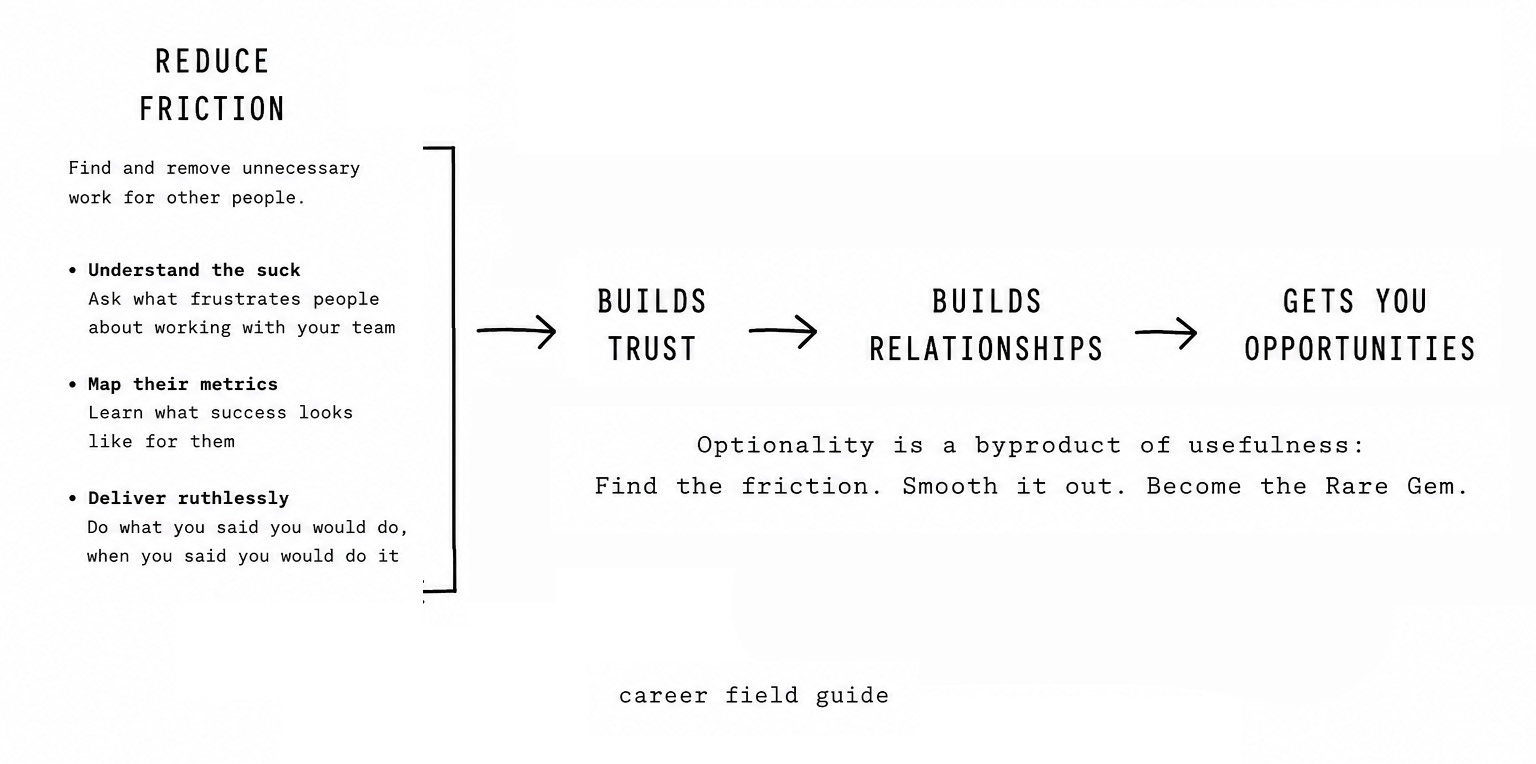
1. Understand the Suck
Stop asking cross-functional partners how their week is going. Ask them what sucks about working with your team.
Every department has a seam where work is handed off. That seam is almost always a mess of missing context, broken templates, and unspoken annoyance. Reach out to the person directly downstream from you and ask one question: “What is the most frustrating part of how we send X over to you?”
If they tell you that your team never includes the right billing codes and it adds to their workload, you now have a target. Start including the billing codes and then build a process so that it becomes automatic for your team; tell your manager what you learned from the 1:1, what you instituted, and that you’d like to scale for the rest of your team. You just built more cross-functional trust in five minutes than a year of forced small talk ever could.
2. Map Their Metrics
Stop pitching your priorities. Start speaking their metrics.
The biggest reason cross-functional relationships fail is incentive misalignment. You need Jessica to approve a project, but Jessica’s bonus is tied to cutting costs and your project costs money. Of course she’s ignoring your Slack messages; your request is an active threat to her paycheck.
Friction hunters figure out how their partners are evaluated. Are they measured on deployment speed? Margin? Risk reduction? When you reframe your requests in the language of their performance review, you stop being a distraction and become an asset. Pitching the long-term cost savings outcome of your project shows Jessica that you see what she needs. When you can align your priorities with theirs, you start becoming an asset to them (and you get your goals met too).
3. Deliver Ruthlessly
Understand the power of the micro-commitment economy.
In a remote or hybrid environment, physical visibility is zero. No one can see you typing furiously at your desk. Your entire professional brand is reduced to the promises you make and whether you keep them.
Trust isn’t built at annual offsites or during trust-fall exercises. It is built in the micro-interactions. If you say on a call, “I’ll drop that link in the chat,” drop the link. If you say, “I’ll double-check that and get back to you by Tuesday,” have the answer in their inbox on Tuesday morning.
A single forgotten email attachment does more damage to your Optionality than skipping the virtual happy hour (managers: no one likes these events, please stop doing these!).
Be Authentically You (But Keep Getting Better)
You don’t have to be an extrovert to gain office clout. You don’t have to play the corporate game of pretending your coworkers are your family. You just need to identify the friction in the system and smooth it out. You can be yourself and become a 1% better version of yourself each week.
The performative theater of modern work is exhausting because it’s fundamentally fake. Leaning into being more fake is a direct path to burnout. Friction Hunting is energizing because it’s fundamentally you and challenges you to keep improving each week. You are actually solving problems and building the Optionality pedal on your career bike not through forced smiles, but through undeniable utility.
Find the friction. Smooth it out. Become the Rare Gem.
Do that consistently and you won’t just survive the next org chart shake-up, you’ll be accepting that next incredible job because you were the top person that the hiring manager wanted.
Over to You
I want to hear about the friction in your org. What is the single most absurd, soul-crushing bottleneck you deal with when handing off work? Drop it in the comments.
If you’re feeling brave, honestly map yourself on the grid and consider what you need to adjust to become that rare gem. If you need help, you can always ping me on any of the socials or here. I read/respond to every email and truly want you to succeed, whatever “success” means to you.
If this series is hitting home, forward it to someone in their first few years of work. It’s free, and it might be the thing nobody’s told them yet.
P.S. — I work with a small number of readers one-on-one to help them apply these frameworks to their own career. If you are at a moment where you need more than a newsletter, book one off or ongoing sessions here.
If you enjoyed this, here’s what to read next
How to Make Better Decisions at Work

Welcome back to Career Field Guide: the weekly newsletter for people who want to build a career that holds up in the age of AI. If someone forwarded this to you, subscribe here.
Write Well: Email, Slack, and Docs

Welcome back to Career Field Guide: weekly career advice for early-career professionals learning how work really works in the age of AI. If someone forwarded this to you, subscribe here.