


Welcome back to Career Field Guide: the weekly newsletter for people who want to build a career that holds up in the age of AI. If someone forwarded this to you, subscribe here.
This is Part 3 of 8 in the Essential Skills Series: the 10 skills that separate people who advance from people who plateau. Find the whole series here.
The Communication Trap
No matter how smart you are, it’s almost inevitable that you’ll get this feedback at some point in your career:
“You need to work on your communication skills.”
What do you do with that?
Their first reaction is usually confusion, especially for folks who are used to succeeding throughout life, so they assume the feedback means they need to be more confident, polished, or concise. They might watch a few TikToks on communicating well, but they’re still not sure what it means to “work on your communication.”
Here is what the feedback actually means: the way you communicate works perfectly in one room and completely fails in another. You’re probably not bad at communicating overall (we all communicate well throughout our life), but you’re likely stuck in one mode, and each workplace has (at least!) four layers of communication.

Most people never learn to switch between layers, but the ones who do have an uncanny ability to accelerate their career.
The Scene You’ve Either Lived or Watched
A 26-year-old analyst gets her first chance to present directly to a VP. She has done the work, prepared well, and has a defensible recommendation.
The VP joins the Zoom three minutes late, apologizes, and says he will have to leave early for another call. The analyst skips her intro, starts at slide one (of 27), and provides baseline context. The VP nods politely, but interrupts by slide three:
“What’s the one thing I need to know? Are we on track or not?”
She freezes. The one thing she needs to tell him is on slide nine. She tries to explain that it requires the context from slides four through eight to make sense. The VP says, “Okay, let me come back to this. Send it and I’ll read it later.” He drops off (and does not read it later).
Weeks of work, evaluated in a few minutes, and the evaluation is not about the analysis. It is about whether this person is able to effectively communicate with senior leadership. In this case the answer is no, because she wasn’t able to communicate effectively with the VP. She hasn’t learned how to communicate at this level.
I’ve Been on Both Sides
I spend a lot of my week at Zero100 translating between levels. I sit with factory leaders in the morning, hear what is actually happening on the floor, and by the afternoon I am in front of a COO compressing all of it into three sentences they can act on. My entire job is closing other people’s compression gaps and it took me twenty years to get good at this, but I learned it the hard way.
The first time I presented to a general manager at one of my early corporate jobs, I fumbled it badly. I had not prepared the way I should have and I ended up rambling and burying the point. When the GM asked me what the “so-what” was, I gave him a meandering answer that was really a confession that I did not know. He was polite, but my boss sidelined me and it took a lot of reps before he let me present again at that level (rightly so).
I did not lose that opportunity because my work was bad. My work was fine for my level and experience. I lost it because I had not yet learned that the work and the compression of the work into a clear executive message are two different skills. Senior leaders evaluate you on the second one long before they trust you with more of the first one.
Why This Is Getting More Brutal, Not Less
Standard career advice has not caught up to how AI is changing communication. Anyone with a laptop and a good prompt can produce a memo, a model, a first draft, or an analysis. The raw output that used to take a team of analysts a week now takes a single person an afternoon. That may sound like good news for early-career professional, but it changes what you are being evaluated on.
When everyone can produce the work, producing the work stops being the differentiator. The differentiator now is whether you can take messy, conflicting, or dense information and compress it into something a decision-maker can actually use to improve the company.
Execution is a commodity now. Compression is what is left. That is the skill AI amplifies rather than replaces, and the people who develop it early are going to succeed in the AI era.
The Four Translation Layers
The ability to translate between layers is not one skill, it’s four: in a workplace you are constantly translating in four different directions depending on who you’re talking to.
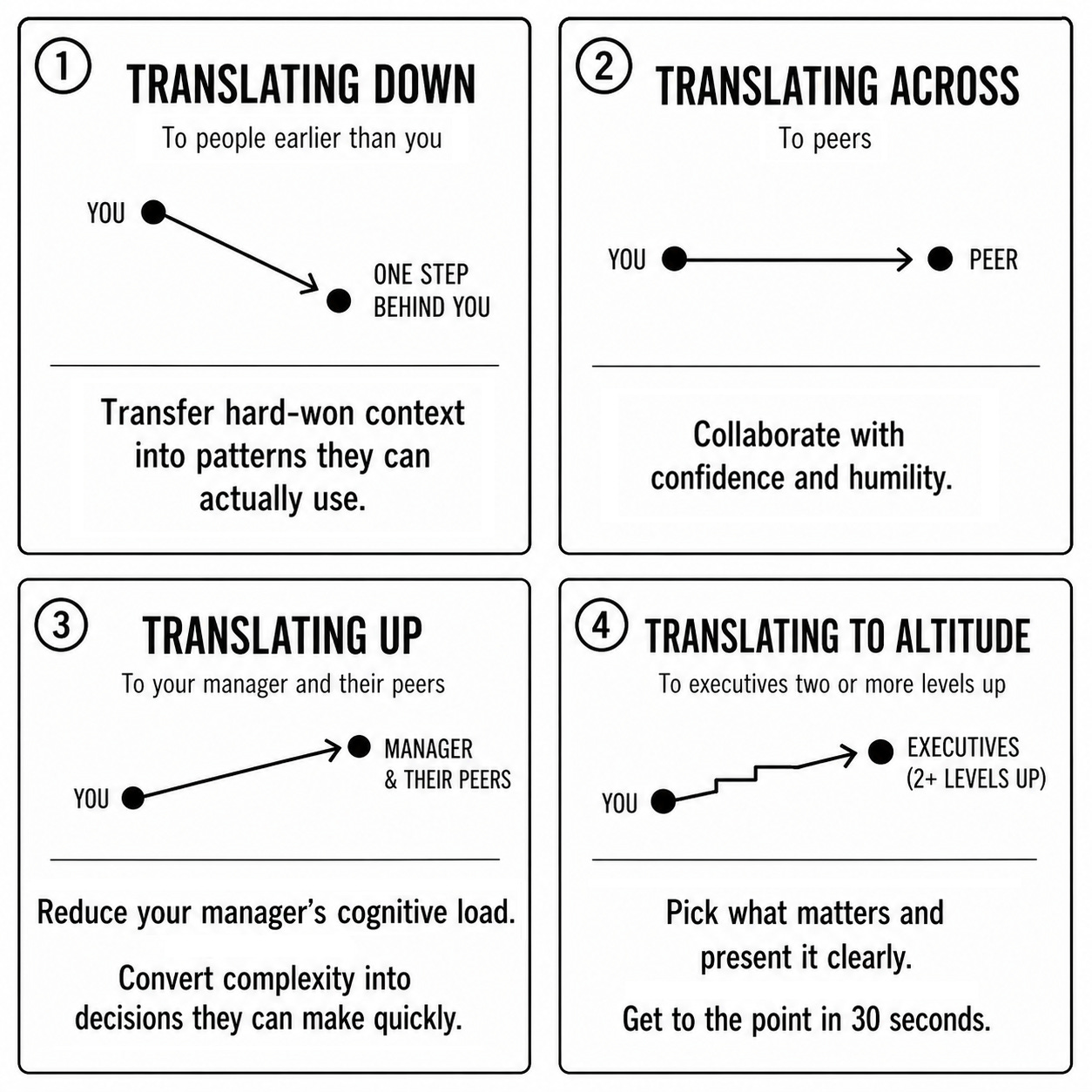
Translating Down (to people earlier than you)

The job: Transfer hard-won context into patterns they can actually use.
The failure mode: Assuming they already know what you know. Explaining the mechanics without explaining why any of it matters. Being so eager to sound senior that you talk past them.
The mastery signal: They make a decision on their own that you would have made yourself. Without calling you.
This one starts earlier than you think. If you’re a junior in college, the person you are translating down to is the sophomore on the group project. If you are two years into a job, the person is the intern. Every time you help someone one step behind you get unstuck, you are building the muscle you will use with your own team later. Because you’re explaining a topic to someone with less experience, you may need to go more in-depth and take your time. Don’t compress information at this level because you risk creating confusion.
Translating Across (to peers)
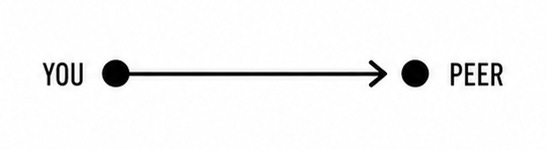
The job: Coordinate without hierarchy. Make your context portable.
The failure mode: Treating peers like they’re managers or subordinates. Looping in your manager on peer conflicts before doing the work of influence yourself. Communicating like you are trying to win instead of trying to get the work done.
The mastery signal: When a new project starts, someone from another team asks if you can be on it because you make the work easier.
This is the layer most junior people ignore completely, and it shows up later as the invisible ceiling. How you communicate with your peers affects how they feel about you.
If you treat everyone like they’re your manager, you aren’t going to be helpful. You defer, avoid pushing back, and fail to offer real input because you’re trying to be agreeable. If you go the other direction and try to assert authority that you don’t have, you create friction. You push too hard, overstep, and turn collaboration into something people have to manage instead of benefit from.
How you treat your peers is important because a strong peer network built in your first five career years is the single biggest hedge you have against a bad manager, a bad market, or a bad economy. Only compress information at this level when you’re clear that both you and your peer have the same context and understanding of the topic.
Translating Up (to your manager and their peers)
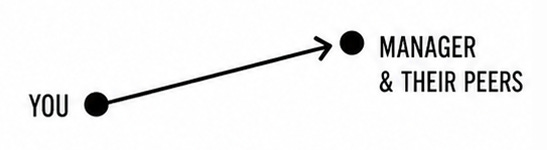
The job: Reduce your manager’s cognitive load. Convert complexity into decisions they can make quickly.
The failure mode: Dumping information and calling it an update. Asking for direction when you should be asking for calibration. Sending a weekly status that buries the three things that actually matter under nine things that do not.
The mastery signal: Your manager’s manager knows who you are and knows one specific thing you are working on because your manager keeps mentioning you.
This is where the skill really starts to really show up. A manager who has to work hard to extract the point from you will not bring you into the next opportunity. A manager who can walk into their own boss’ office and cleanly represent your work will find more ways to give you visibility. It’s the same work, but with wildly different outcomes. You need to compress the information and provide a little context.
Translating to Altitude (to executives two or more levels up)
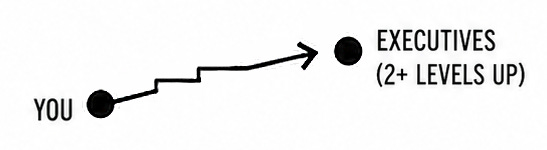
The job: Fit your work into a narrative they are already telling themselves. Get to the point in thirty seconds.
The failure mode: Explaining what you do when you should be explaining why it matters for their agenda. Taking three minutes to get to the headline. Bringing fourteen slides when the decision can be made from one to three.
The mastery signal: Someone two levels up references your work in a meeting you were not in.
Nobody teaches you how to do this because most of your managers are not great at it either. The entire executive communication skill is built on this: can you see the big picture, pick what matters, and present it clearly.
If you’re presenting to senior leadership, they already trust your analysis so no need to waste time explaining how you got to your conclusion; present just the details that leadership needs. Executives are drowning in information and they don’t need more. They need someone who can look at all of it and hand them the one sentence that allows them to make a decision. Compress information to the essentials; if leadership wants more info, they’ll ask.
This is the altitude where this skill either makes or breaks careers. It’s also the altitude where AI has raised the bar because most executives are now getting more AI-generated material than ever (noise) which means the human who can compress reality clearly (signal) stands out more than ever.
From the Executive Floor
A CSCO recently shared with me: “I may not remember everything my team said in a meeting. I remember the one slide they put in front of me that synthesized the issue, the solution, and the next steps with clear time-based outcomes that I could easily use with my boss. That’s the value.”
Three months of work judged on one slide. That’s why it’s important to understand what the other person will take away based on how you translate it for them.
Your Move This Week
Below are four questions, one for each translation direction. Answer them honestly. Wherever you flinch or have to guess, that is your skill gap right now.
Down: Who have I made more capable in the last 90 days?
Across: Who on another team would describe me as the easiest person to work with on mine?
Up: Does my manager’s manager know one specific thing I am working on right now?
Altitude: Has anyone two or more levels above me ever referenced my work in a room I was not in?
If the answer is “no” or “I don’t know” for any of these, pick one, and make that your focus for the next 30 days.
If you are in college, Translation 1 and 2 are your first real test. Communicating well with your junior and equal peers gives you practice for the workplace.
If you are a few years in to your career, Translation 3 is the wall most people hit. You are doing the work, but you have to learn how to hand it up.
If you are ten years in, Translation 4 is where careers plateau. The audiences got more senior and the thirty-second test got harder. Nobody ages out of developing these skills, you just meet it at higher altitudes. Learn how to communicate quickly within the high-level context of senior leaders and you will be well on your way to building a great career.
If this series is hitting home, forward it to someone in their first few years of work. It’s free, and it might be the thing nobody’s told them yet.
P.S. — I work with a small number of readers one-on-one to help them apply these frameworks to their own career. If you are at a moment where you need more than a newsletter, book one off or ongoing sessions here.
If you enjoyed this, here’s what to read next
Opportunity at Work is Not Random: 3 Ways to Make it Yours

Want to dive in deeper? Get the free article worksheet here