


I recently joined Unilever’s supply chain team for an event to share how AI is driving us toward more autonomous operations and what it takes to be an in-demand worker of the future.
Following the session, their Global Chief Product Supply Chain Officer, shared this reflection on LinkedIn.
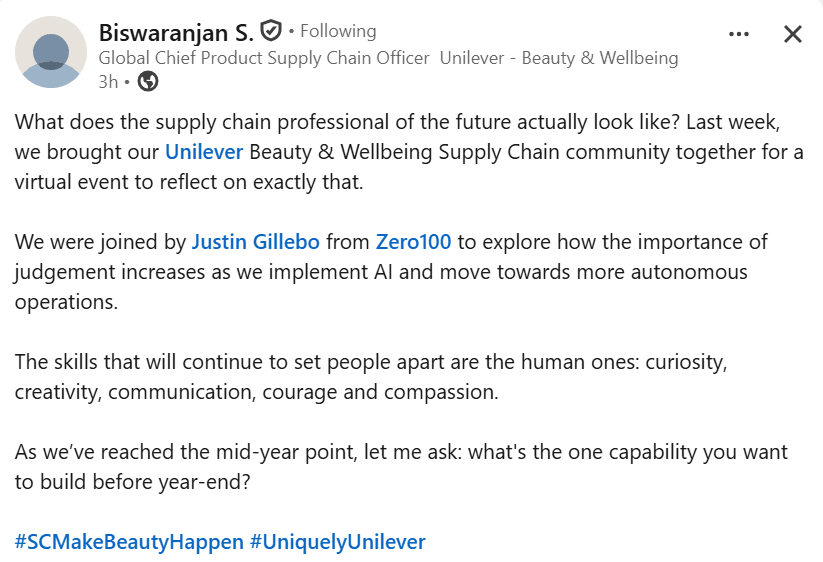
While his audience was operations leaders, his takeaway perfectly captures the reality of the AI transition for every function in modern business.
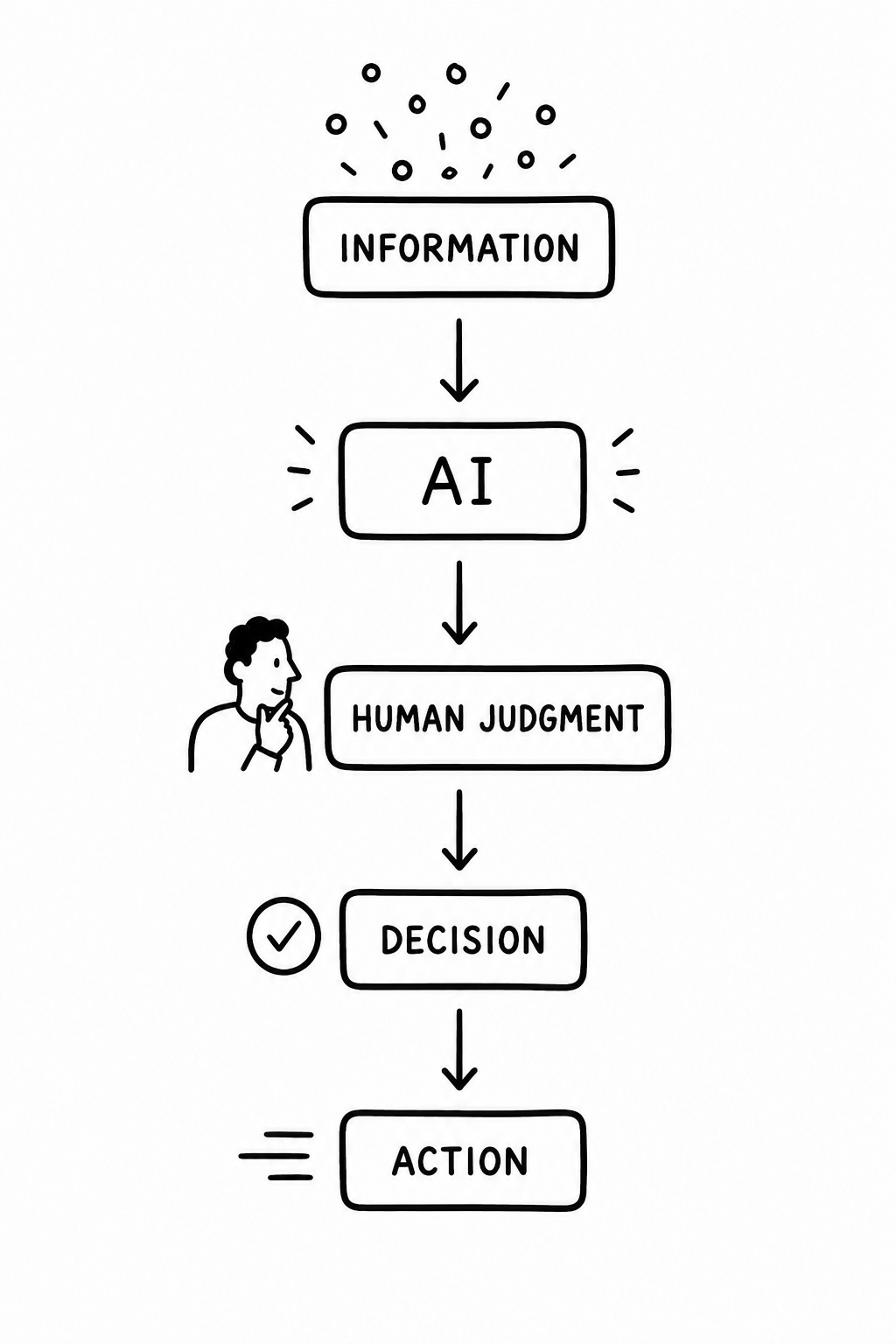
We are rapidly moving away from a world where professionals are valued primarily for their ability to process information, and into a world where we are valued for our judgment.
Future Proofing Your Career
If you want to future-proof your career in an increasingly automated landscape, you need to cultivate the skills that algorithms cannot replicate.
Here is how to operationalize the five traits that will set you apart on any team:
1. Curiosity: Asking the Right Questions
AI is exceptional at answering questions, but it cannot decide which questions matter. Curiosity in modern business means looking beyond the immediate dashboard. It is the drive to ask, “Why is this customer segment churning?” or “What happens if we fundamentally change this constraint in our business model?”
Career Action: Dedicate 15 minutes a week to researching a part of the business entirely adjacent to your role. Ask cross-functional partners how their core metrics are calculated.
2. Creativity: Designing the Unstructured
While autonomous systems excel at optimizing within defined parameters, they struggle when the rules of the game change. Creativity is the ability to design entirely new parameters, workflows, or partnership models when market disruptions alter the status quo.
Career Action: When presenting a problem to leadership, always bring one “standard” solution and one “unconventional” solution that challenges existing assumptions.
3. Communication: Translating Complexity into Action
An AI agent might identify the most efficient go-to-market strategy, but it cannot persuade a skeptical executive board to fund it, nor can it inspire a team to execute it. Communication is the bridge between raw data and human action.
Career Action: Practice distilling complex project updates into a single, jargon-free paragraph. If you can’t explain the value simply, the data doesn’t matter.
4. Courage: Making the Call
Algorithms provide probabilities; leaders make decisions. In business, you rarely have 100% of the data. Courage is looking at the 80% provided by your systems and taking accountability for the final call, especially when the stakes are high and the outcome is uncertain.
Career Action: Start taking explicit ownership of smaller decisions in your sphere without hedging. Build your “judgment muscle” incrementally.
5. Compassion: Understanding the Human Impact
Businesses are ultimately networks of people serving other people. Reorganizing a team structure or pivoting a product line on paper is easy; understanding how that change impacts the daily lives of your colleagues or your end-consumers requires empathy.
Career Action: Spend time “on the floor” whether that means listening in on customer service calls, shadowing a sales rep, or grabbing coffee with a junior team member. Understand the human reality behind the metrics.
The Shift in Capability
There’s a clear difference between the legacy and future skills required for success in this autonomous age.
The Legacy Worker
Valued for data processing
Focuses on finding the right answer
Manages the system
The Future Worker
Valued for strategic judgment and curiosity
Focuses on asking the right question
Designs the system
As we cross the mid-year point, Biswaranjan poses a critical question that all of us should be asking: What is the one capability you want to build before year-end?

If you enjoyed this, here’s what to read next:
The Messy Reality of a Massive Career Pivot

Hi Everyone! I’m writing this from a cafe in London, three weeks after I landed in the UK as an expat.
How to Get More Opportunities at Work

Welcome back to Career Field Guide: weekly career advice for early-career professionals learning how work really works in the age of AI. If someone forwarded this to you, subscribe here.