



Imagine spending months planning your dream surfing trip…only to discover the ocean is flat.
You can paddle out and exhaust yourself trying to create momentum or sit on the beach wondering what went wrong. Either way, you miss the point of surfing.
Most people plan their careers the same way.
They pick the right “board” — a degree, a resume, a company — but never ask if there’s a wave worth riding.
That’s why some careers compound effortlessly while others stall despite hard work.
Why the Wave Matters
When I worked in supply chain at Starbucks Coffee Company, I saw how operational innovation could win in a crowded market. But retail growth was slow in the low single digits each year. I was surfing, but only on a small ripple.
When I moved into cloud technology, first at Microsoft Azure and then at Amazon AWS, it felt like stepping into a completely different ocean. The current was stronger, faster, full of energy. The industry was growing more than 30% a year, and with it came rapid promotions, new roles, and opportunities I had never seen in retail.
Same skills. Same work ethic. Just a bigger wave.
Your skills, network, and effort matter, but the right industry amplifies all of them. If you want to accelerate your career, you must surf the biggest available wave, not merely pick a nice surfboard.
The Pattern Behind Every Industry Wave
1890s-1980s: Sears rode the catalog and department store wave.
1910s-1980s: Ford drives mass production and automobile growth.
1970s-2000s: Walmart upended Sears with discount retail at-scale.
1990s-2000s: Microsoft rode the personal computer wave.
1990s-Present: Amazon innovated on e-commerce, then launched AWS.
2020s-Present: OpenAI and Anthropic are riding the frontier-model of AI.
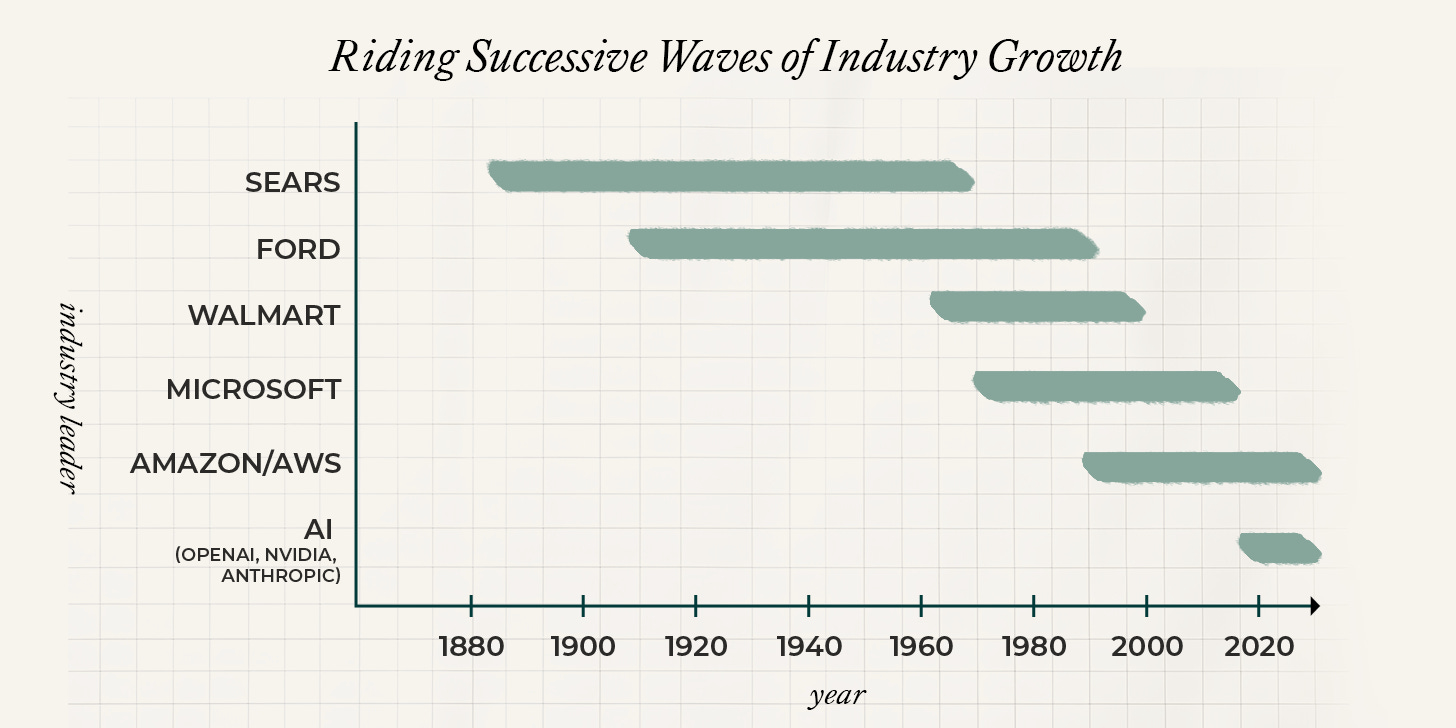
These companies all still exist, but their true dominance came during specific industry waves. For people working within these companies and industries, these periods opened huge opportunities for workers to gain valuable skills and grow alongside their industry’s momentum. Sears employees in 1990 worked just as hard as Sears employees in 1950, but their career trajectories had different results. One group rode the wave; the other missed it.
Most people don’t recognize the wave until it’s already passed. The people who build wealth and accelerate their careers are the ones to spot waves early and position themselves to ride them.
You cannot outwork a shrinking wave. But if you catch a growing one, even average paddling takes you farther.
That’s the real secret of strategic industry selection.
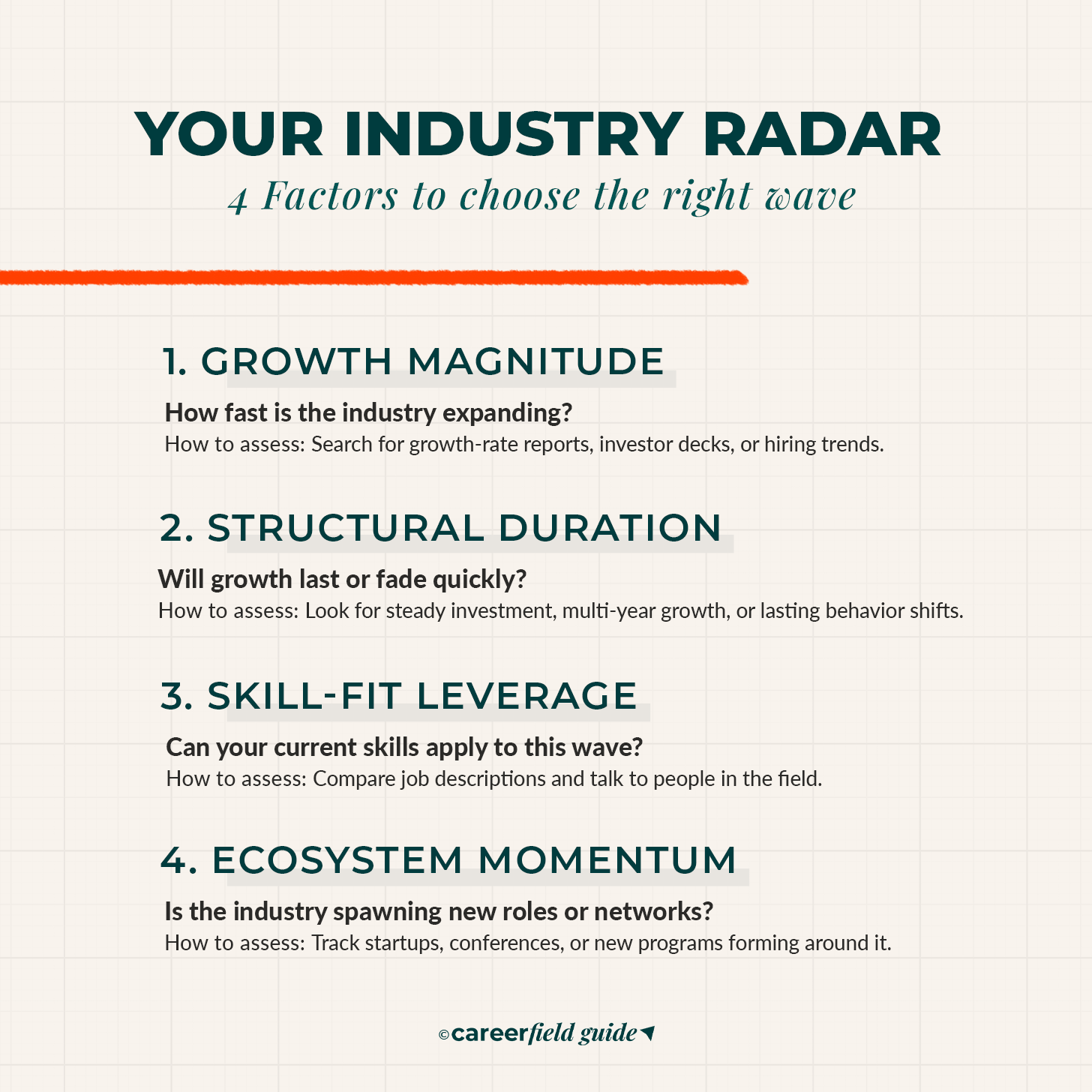
So how do you read the surf before paddling out? These four factors act as your industry radar.
4-Factor Framework to Choosing Your Industry Wave
Once you know waves matter, the next step is finding the right one to ride. Here’s how to read the surf before you paddle out:
Factor 1: Growth Magnitude
How fast is the industry expanding? A fast-rising wave creates new roles and faster promotion paths. Cloud technology grew at more than 30 percent a year, far outpacing retail’s single-digit growth. Look for industries with momentum and scale.
How to Assess: Search for “industry growth rate” or “market size” reports, investor presentations, or hiring trends on LinkedIn and Indeed.
Factor 2: Structural Duration
Will this growth last? Walmart’s discount-retail wave sustained decades of expansion. A microtrend might vanish in a few years. Choose waves with long structural tailwinds, not fleeting hype.
How to Assess: Look for signs of steady investment (venture funding or R&D), consistent year-over-year growth, or durable consumer behavior changes.
Factor 3: Skill-Fit Leverage
Can your existing skills and network apply to this new wave, or would you need to start over? Moving from retail to cloud technology worked because the role stayed similar, even though the industry changed. The best waves multiply what you already know.
How to Assess: Review job descriptions in that industry and highlight overlapping skills. Talk to people working there to see what transfers easily and where you might need to learn more.
Factor 4: Ecosystem Momentum
Is the industry spawning new business models, adjacent roles, or partner ecosystems—or is it isolated? Look for ripple effects: new companies, new job types, new geographies.
How to Assess: Watch for clues like new startups being funded, conferences forming, or universities adding new programs. These are early signs of an industry building lasting infrastructure.
Use these four factors as your industry radar.
Ask yourself:
Where are the industries growing 20–30 percent or more each year?
Which sectors seem small today but are quietly building momentum?
How can I align my skills to surf one of those waves?
What to Do Next
Identify three industries that genuinely interest you (the waves you might want to ride).
Score each one on the four factors above (high, medium, or low).
Rank them and choose the industry with the highest combined score.
Then pick companies and roles within that industry, not the other way around.
If you plan only for the role or the company, you might end up paddling in flat water. If you plan for the wave and then choose your board, you set yourself up to ride momentum instead of fighting it.
Rooting for you,
Justin
If this helped you, forward it to someone still paddling in flat water.
New to Career Field Guide? Click below for articles on interview prep, planning the next step in your career, and networking without the ick.
Start Here: Your Career Field Guide

Frameworks, stories, and strategies to help ambitious professionals navigate the modern workplace