


Welcome back to Career Field Guide: weekly career advice for early-career professionals learning how work really works in the age of AI. If someone forwarded this to you, subscribe here.
This is Part 7 of 8 in the Essential Skills Series: the 10 skills that separate people who advance from people who plateau. Find the whole series here.
I learned how to manage my time and energy in environments where there was always more work than capacity.
At Amazon, Microsoft, and later in consulting and research, there was never a week where everything fit neatly. A peer needed feedback, a vendor needed an answer, a customer issue needed attention, and a cross-functional team needed alignment. Then I would open my email and a new meeting got added, a Slack thread turned into an escalation, and something that looked small on Monday became urgent by Wednesday.
For a while, I thought the answer was to become more responsive, so I tried to reply faster, attend every meeting, meet everyone’s need, and always hit inbox zero. That worked for a while because responsiveness is useful, especially early in your career. People like working with someone who follows through, replies quickly, and does not make everything harder than it needs to be.
Eventually I learned the harder lesson: everyone wanting something from you is not the same as everything being equally important.
If you treat every request as equal, your week will get built by whoever is loudest, fastest, most senior, or most obnoxious in the moment. You may work hard all week and still not move the thing your boss, team, or the business most needed from you.
That is when time management stops being about calendar tricks and starts becoming a career skill. The real skill is not blocking time, it’s knowing what deserves your time in the first place.
The Problem Is Not Your Calendar
I have nothing against time blocking. It can be useful and it’s worth understanding basic productivity tools like task batching, focus windows, day theming, and all the other systems people love to argue about online.
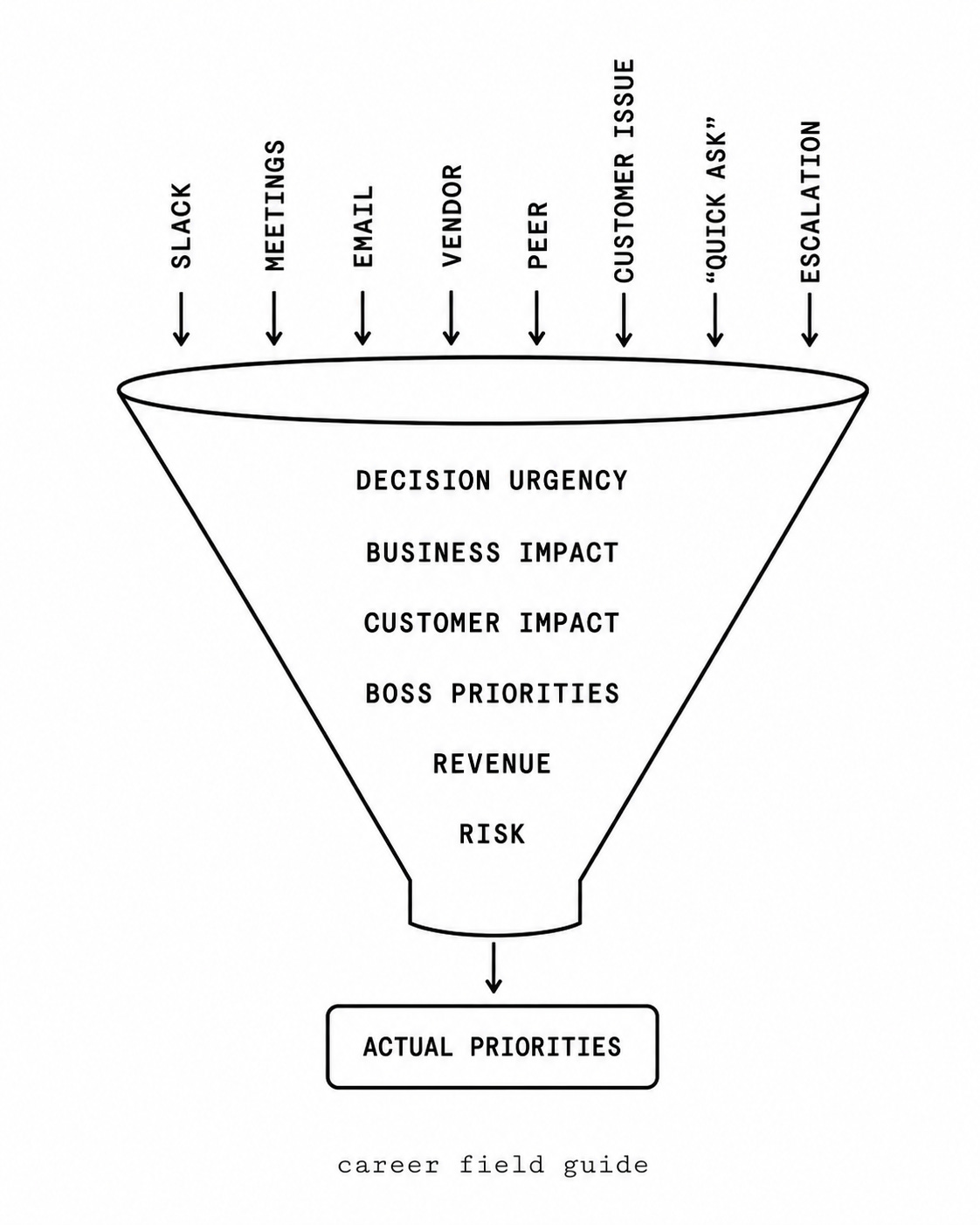
The issue is that most productivity advice starts too late. It assumes the problem is that your calendar is messy, your to-do list is too long, or your inbox is too distracting. Those things may be true, but they are usually symptoms of the bigger issue: you have not decided what matters most, or you have not aligned it with the people who are counting on you.
You can have a beautifully organized calendar and still spend the week on the wrong things.
Molly Graham has a line I love: “Time is emphasis.” In other words, your calendar is not just a schedule. It is a record of what is actually getting your attention.
That is true for CEOs and senior leaders, but it is also true earlier in your career. Your calendar, Slack messages, and meetings you attend all show what you are emphasizing. The thing you keep pushing to Friday afternoon shows something too.
This is why protecting your time starts before the calendar. Before you protect time, you have to know what deserves protection.
Align Before You Optimize
The most useful shift I made when I started in corporate roles was learning to map my priorities to my boss’ priorities.
That sounds obvious, but it is easy to miss in practice.
Early in your career, you can spend a lot of energy trying to make everyone happy. You want to be helpful to peers, responsive to cross-functional partners, available to vendors, and impressive to leaders. That instinct is not bad and often comes from wanting to be useful and build trust.
The issue is that your boss is not only evaluating whether you are busy or helpful, they are evaluating whether your effort maps to the outcomes they are accountable for and to the metrics that determine whether your org is delivering what actually matters.
That means you should understand what matters to them, what pressure they are under, what goals they are trying to hit, and how your work fits into the larger picture.
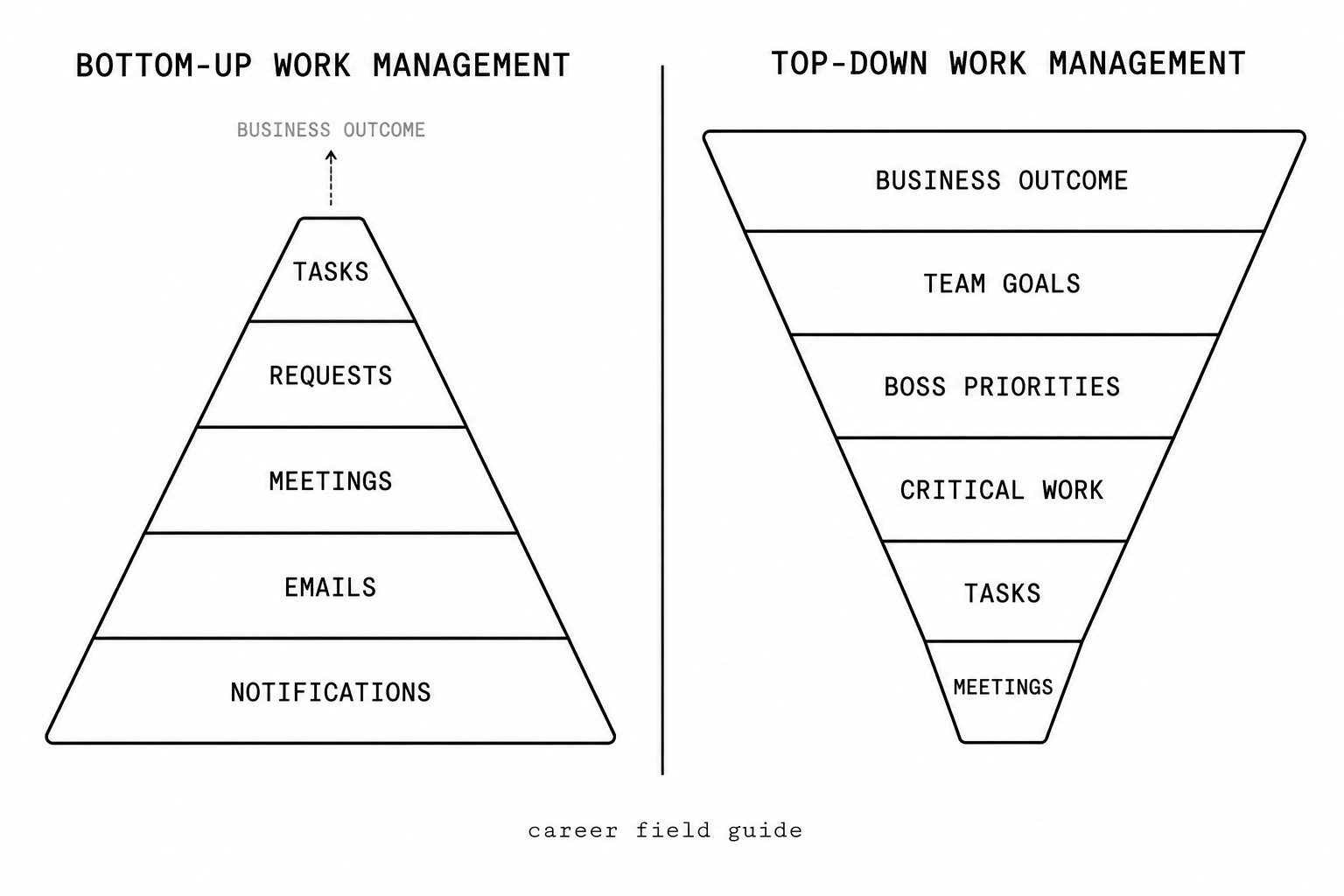
A lot of people manage their week from the bottom up:
What meetings are on my calendar?
What tasks are due?
Who asked me for something?
What emails need a response?
Better professionals learn to manage from the top down:
What outcomes matter this week?
What does my boss care about most right now?
What work reduces risk, improves quality, helps the customer, moves revenue, supports the team, or makes a decision easier?
What can wait?
What should be smaller?
What should be escalated?
One of the best questions you can ask is simple:
“Of everything on my plate this week, what would be most painful if it slipped?” Asking that question shows that you understand work is a tradeoff, not a bottomless pile of tasks.
The point is to calibrate your judgment. Your manager should not have to tell you what to do every hour of the week, but they should also not be surprised that the thing they cared about most received your leftover energy.
Stay in Audit Mode
GaryVee has a good phrase for this: audit mode.
The idea is that priorities are not static. What mattered yesterday may matter less today if something more important enters the system. That is how real work feels. The plan you made Monday morning can be outdated by Tuesday afternoon.
This is why the goal is not to worship your original plan, but to update the plan without losing the plot. Some people are too rigid with their time and become hard to work with. They protect their calendar so aggressively that they miss the reality of the work around them.
Other people are too reactive and become impossible to trust with anything important. They let the day rearrange itself around every ping, request, meeting, and minor escalation. Neither version works well.
The professional move is to keep checking whether your effort is still pointed at the right work. What changed? What matters now? What can move? What needs to be escalated? What tradeoff needs to be said out loud?
That is the job. Not perfectly controlling the week, but staying oriented as the week changes.
Every Yes Has a Cost
James Clear has a useful definition of productivity:
“Productivity is not getting more things done. It is getting important things done consistently.“
That distinction matters because a lot of people are very busy doing work that does not move the outcome. A yes does not just add a task, it spends your future time.
When you say yes to a meeting, you are spending future attention.
When you say yes to a “quick” review, you are spending future focus.
When you say yes to work that does not matter, you are spending time you may need for work that does.
This does not mean you should become difficult or allergic to helping people. Some of my best career opportunities came from saying yes to things that were not technically part of my job. But every yes has a cost, and the more responsibility you carry, the more important it becomes to understand that cost.
A lot of people say yes because they want to be helpful, then get frustrated because they are overwhelmed, scattered, and behind on the work that matters. They blame the calendar, the meetings, the company, the boss, or the culture. Sometimes those things deserve blame, but often the issue is simpler: they kept saying yes without naming the tradeoff.
If everything is urgent, you do not need a longer workday. You need a priority conversation.
Say the Tradeoff Out Loud
The fastest way to mature in this area is to stop silently absorbing work.
When new work shows up, name the tradeoff.
If your boss asks for something new, try:
“I can take this on. To make room, should I push the draft to Thursday or deprioritize the analysis?”
If three things are competing, try:
“My read is that the customer issue comes first, then the deck, then the tracker. Does that match how you’re thinking about it?”
If you need focus time, try:
“I’m blocking 9 to 11 tomorrow to finish the recommendation. I’ll be slower on Slack during that window but will respond before lunch.”
If you are unclear what matters, try:
“Of everything on my plate this week, what would be most painful if it slipped?”
If someone asks for help and you cannot do it now, try:
“I can help, but I won’t be able to get to it until Thursday. Does that still work?”
If a meeting shows up and you are not sure why you are needed, try:
“Happy to join if useful. What decision are we trying to make in the meeting?”
These scripts work because they do not make you sound lazy. They make you sound aware. You’re saying, “I understand there is a tradeoff, and I want to make the right one.”
Especially earlier in your career, boundaries work better when they are framed as tradeoffs. People may not love the tradeoff, but they will usually respect that you are thinking clearly about it.
Calm Is Part of the Job
Some people respond to busyness by turning every week into a crisis. They rush between meetings, reply to every message, tell everyone how slammed they are, and treat every new request like the thing that finally broke the system.
I understand the feeling. I have had seasons where my calendar was packed, my inbox was behind, my patience was thin, and the work felt like it was coming from every direction at once.
That said, you need to understand that visible panic does not read as professional maturity.
You may think you are showing people how much you care. And to be fair, sometimes you really are overwhelmed and need support. But if every busy season becomes visible panic, leaders may start to wonder whether you can stay steady when the work gets heavier.
Good bosses do not want their people silently suffering, but they also do not want every priority shift to become emotional noise that the rest of the team has to absorb. Professional maturity is learning how to communicate pressure without spreading panic.
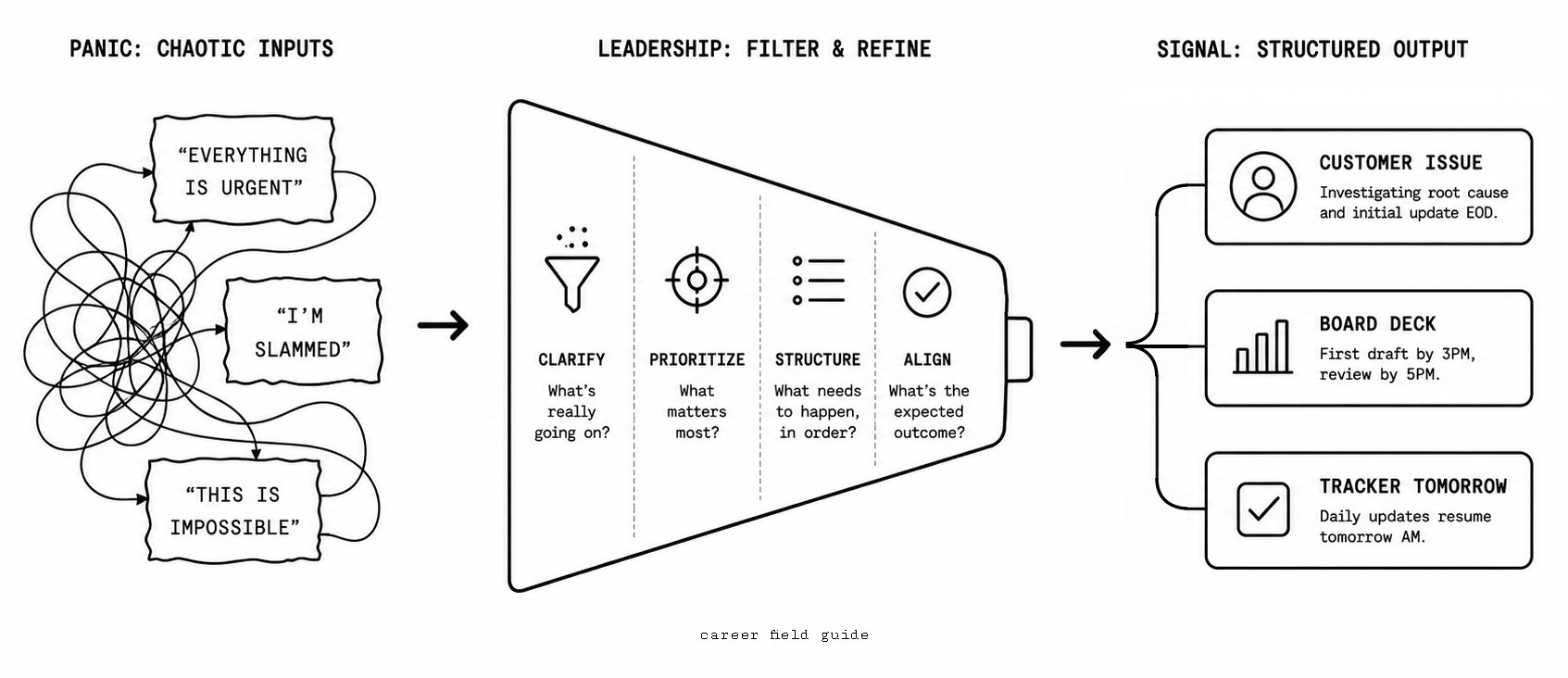
That does not mean hiding stress. It means turning stress into useful information.
A bad version sounds like:
“I’m completely slammed and don’t know how I’m supposed to get all of this done.”
A better version sounds like:
“I have a few things competing today and may need help prioritizing.”
A better version still sounds like:
“Three things are competing today: the customer issue, the board deck edits, and the tracker update. My read is that the customer issue comes first, the board deck comes second, and the tracker can move to tomorrow. Does that match how you’re thinking about it?”
That kind of update does not pretend everything is fine. It just does something more useful than panic by naming the pressure, sorting the priorities, and giving your boss something to react to and direct.
Protect Your Best Energy
Once you know what matters, then protect time for it.
The mistake most people make is protecting whatever time is left over. They give their best energy to Slack, meetings, inbox triage, and quick asks. Then they try to do the most important work at 4:45 p.m. when their brain is fried and their patience is gone.
Not all hours are equal. A focused morning hour is not the same as a scattered end-of-day hour after six meetings. A deep work block after sleep is not the same as a rushed hour between calls.
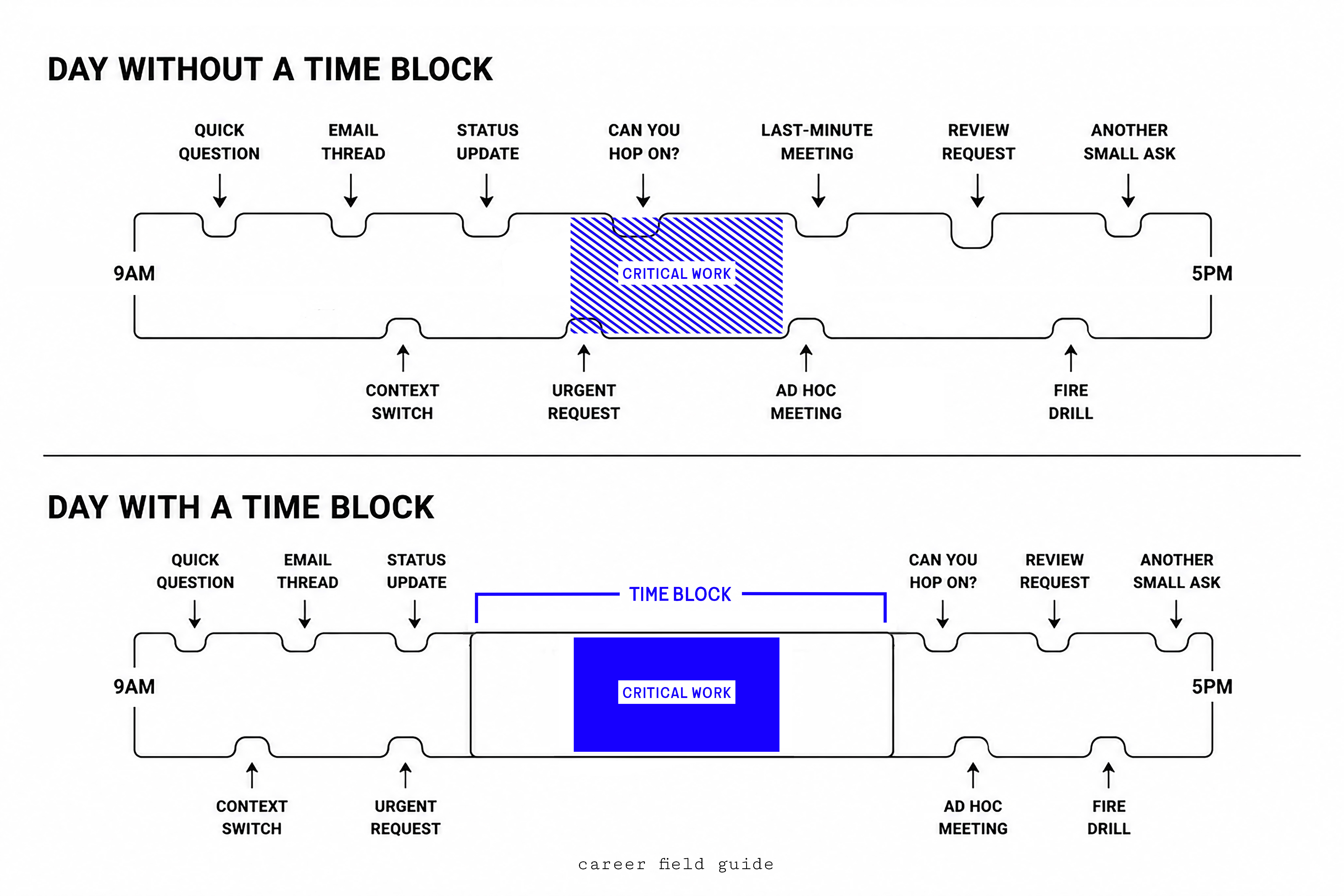
The work that matters most usually needs your best energy, not your leftover energy.
This does not mean you get to ignore your team. It means you stop letting every ping decide where your best energy goes.
Use your best energy for the work that moves the outcome.
Use lower-energy windows for admin, simple reviews, updates, and shallow work.
Create small buffers for chaos because chaos will come.
Earlier in your career, it will be much tougher to dictate your own schedule, but you can start practicing with the freedom available to you today. As you earn more autonomy, use it well. Do not wait for someone else to protect your best hours for you.
Your Move This Week
In your next 1:1, bring a short list of what you believe are your top priorities for the next few weeks. If you already have clear quarterly goals, bring those too. Ask your boss: “Does this match what matters most to you and the team right now?” Then ask one sharper question: “Of these, what would be most painful if it slipped?”
Then look at your calendar and ask whether your time actually reflects the answer. If the most important work is getting your leftover energy, change the week. Move a meeting, block the morning, or tell someone what has to wait.
Protecting your time is not about becoming less helpful. It is about becoming more useful. Everyone will want something from you. The people who advance learn how to stay calm, sort the pressure, and keep their best energy pointed at the work that matters.

If this series is hitting home, do me the honor of sending it to someone who could use it.
P.S. — I work with a small number of readers one-on-one to help them apply these frameworks to their own career. If you are at a moment where you need more than a newsletter, book one off or ongoing sessions here.